The tradition & historical record
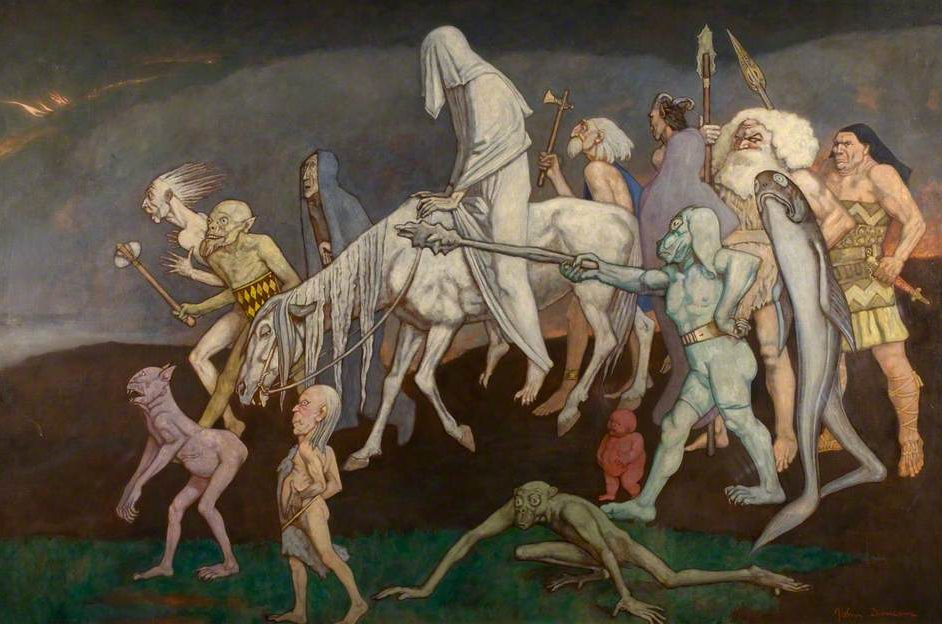
7 min read · 2 sourcesThe Fomorians or Fomori (Old Irish: Fomóire, Modern Irish: Fomhóraigh / Fomóraigh) are a supernatural race in Irish mythology, who are often portrayed as hostile and monstrous beings. Originally they were said to come from under the sea or the earth. Later, they were portrayed as sea raiders and giants. They are enemies of Ireland's first settlers and opponents of the Tuatha Dé Danann, the other supernatural race in Irish mythology; although some members of the two races have offspring. The Tuatha Dé Danann defeat the Fomorians in the Battle of Mag Tuired. This has been likened to other Indo-European myths of a war between gods, such as the Æsir and Vanir War in Norse mythology, the Titanomachy (Olympian-Titan War) in Greek mythology, and the Devas and Asuras in Indian mythology. One theory is that the Fomorians were supernatural beings representing the wild or destructive powers of nature; personifications of chaos, darkness, death, blight and drought. 1
Name
In Old and Middle Irish, the race is usually called the Fomóire or Fomóiri (plural), and an individual member is called a Fomóir (singular). In Middle Irish, they are also called the Fomóraiġ (plural) and a Fomórach (singular). This is spelt Fomhóraigh/Fomóraigh (plural) and Fomhórach (singular) in Modern Irish. Their name is Latinized as Muiridi in the Lebor Bretnach. In English, they are called the Fomorians, Fomori or Fomors. The etymology of the name is debated. The first part is generally agreed to be the Old Irish fo, meaning under, below, lower, beneath, nether, etc. The meaning of the second part is unclear. One suggestion is that it comes from Old Irish mur (sea), and that the name means something like "the undersea ones". This was the interpretation offered by some medieval Irish writers. Another suggestion is that it comes from mór (great/big) and means something like "the great under(world) ones", "the under(world) giants" or "the nether giants". A third suggestion, which has more support among scholars, is that it comes from a hypothetical Old Irish term for a demon or phantom, found in the name of The Morrígan and cognate with the archaic English word "mare" (which survives in "nightmare"). The name would thus mean something like "underworld demons/phantoms" or "nether demons/phantoms". Building on this, Marie-Louise Sjoestedt interprets the name as meaning "inferior" or "latent demons", saying the Fomorians are "like the powers of chaos, ever latent and hostile to cosmic order". John T. Koch suggests a relationship with Tartessian omuŕik. 1
Description
Originally the Fomorians seem to have been regarded as malevolent spirits dwelling underwater and in the nether regions of the earth. In one of the earliest references to them, a probably 7th-century elegy for Mess-Telmann, they are said to dwell "under the worlds of men". Later they were portrayed as sea raiders. This was influenced by the Viking raids on Ireland that were taking place around that time. They are often portrayed as monstrous. Sometimes they are said to have the body of a man and the head of a goat, according to an 11th-century text in Lebor na hUidre (the Book of the Dun Cow), or to have had one eye, one arm and one leg. However, those Fomorians who have relationships with the Tuath Dé, such as Elatha and his son Bres, were portrayed as darkly beautiful. The Fomorians are the enemies of Ireland's first settlers and of the supernatural Tuath Dé, with whom they are contrasted. However, in some sources there is an overlap between the Fomorians and Tuath Dé. A figure called Tethra is named as presiding over both races. The conflict between the Tuath Dé and Fomorians has been likened to other Indo-European myths of a war between gods: between Æsir and Vanir in Norse mythology, between Olympians and Titans in Greek mythology, and between Devas and Asuras in Vedic mythology. Dáithí Ó hÓgáin writes that the Tuath Dé gaining agricultural knowledge from the Fomorians is similar to the Norse and Vedic versions, where the defeated races represent the fertility of the soil. 1
Myths
The medieval myth of Partholón says that his followers were the first to invade Ireland after the flood which occurred in Genesis, but the Fomorians were already there: Geoffrey Keating reports a tradition that the Fomorians, led by Cichol Gricenchos, had arrived two hundred years earlier and lived on fish and fowl until Partholon came (this detail only appears in the 3rd Redaction of the Lebor Gabála Érenn), bringing the plough and oxen. Partholon defeated Cíocal in the Battle of Mag Itha, but all his people later died of plague. Then came Nemed and his followers. Ireland is said to have been empty for thirty years following the death of Partholon's people, but Nemed and his followers encountered the Fomorians when they arrived. At this point, Céitinn reports another tradition that the Fomorians were seafarers from the Middle East, descended from Ham, son of Noah. Nemed defeated them in several battles, killing their kings Gann and Sengann, but two new Fomorian leaders arose: Conand son of Faebar, who lived in Conand's Tower on Tory Island, County Donegal, and Morc son of Dela (note that the first generation of the Fir Bolg were also said to be sons of Dela). After Nemed's death, Conand and Morc enslaved his people and demanded a heavy tribute: two thirds of their children, grain and cattle. Nemed's son Fergus Lethderg gathered an army of sixty thousand, rose up against them and destroyed Conand's Tower, but Morc attacked them with a huge fleet, and there was great slaughter on both sides. The sea rose over them and drowned most of the survivors: only thirty of Nemed's people escaped in a single ship, scattering to the other parts of the world. 1
The Training of Cú Chulainn
The Fomorians were still around at the time of Cú Chulainn. In the medieval Irish tale entitled The Training of Cú Chulainn, preserved as a copy by Richard Tipper in British Library, Egerton MS 106, it gives the following mention: 1
Then they parted from each other, and Cúchulainn went and looked forth on the great sea. As he was there he beheld a great assembly on the strand nearest to him, to wit, a hundred men and a hundred women seated in the bosom of the haven and the shore, and among them a maiden shapely, dear and beautiful, the most distinguished damsel of the world's women, and they a-weeping and lamenting around the damsel. Cúchulainn came to the place and saluted them. "What is this sorrow or the misery upon you?" says Cúchulainn. The damsel answered and this she said: "A royal tribute which the tribe of Fomorians carry out of this country every seventh year, namely, the first-born of the king's children. And at this time it has come to me to go as that tribute, for to the king I am the dearest of his children.""What number comes to lift that tribute?" asks Cúchulainn. 1
List of Fomorians
Indech, King of the Fomorians Balor Bres Cethlenn Cichol Gricenchos Conand Elatha Ethniu Tethra Manannán under his byname the Gilla Decair Tuiri Tortbuillech Goll Irgoll Loscenn-lomm Oct… 1
The text above is adapted from the Wikipedia article “Fomorians”, available under the Creative Commons Attribution-ShareAlike 4.0 licence. 1
Fomorians is supernatural race in Irish mythology, according to the structured record cited below. This entry was generated automatically from that record and has not yet been reviewed by a person familiar with the tradition. 2
The source record links this tradition to 3 external registers, which can be verified through the citation. 2