The tradition & historical record
6 min read · 2 sourcesFortunatus is a German proto-novel or chapbook about a legendary hero popular in 15th- and 16th-century Europe, and usually associated with a magical inexhaustible purse. The plot of the novel also appears in variants from oral tradition across Europe, Asia, Americas and Africa, which are classified in the international Aarne-Thompson-Uther Index as tale type ATU 566, "The Three Magic Objects and the Wonderful Fruits". 1
Tale
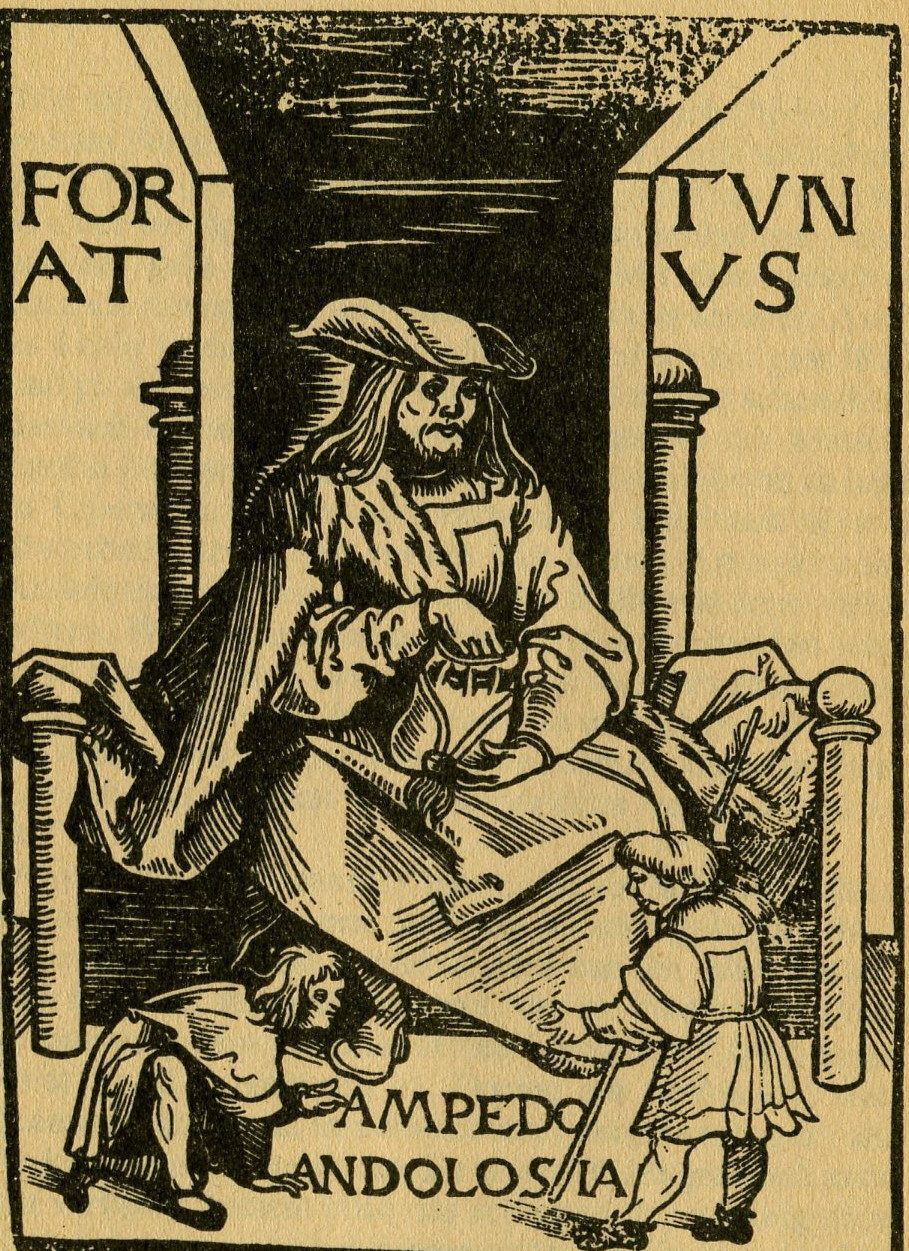
The tale follows the life of a young man named Fortunatus from relative obscurity through his adventures towards fame and fortune; it subsequently follows the careers of his two sons. Fortunatus was a native, says the story, of Famagusta in Cyprus, and meeting the goddess of Fortune in a forest received from her a purse which was continually replenished as often as he drew from it. With this he wandered through many lands, and at Cairo was the guest of the sultan. Among the treasures which the sultan showed him was an old napless hat which had the power of transporting its wearer to any place he desired. Of this hat, he feloniously possessed himself and returned to Cyprus, where he led a luxurious life. On his death he left the purse and the hat to his sons Ampedo and Andelosia; but they were jealous of each other, and by their recklessness and folly soon fell on evil days. Like Miguel de Cervantes' tale Don Quixote, Fortunatus is a tale which marks the passing of the feudal world into the more modern, globalised, capitalist world. Not quite a morality tale in the purest sense, it nonetheless was clearly written in order to convey lessons to the reader. The moral of the story is obvious: men should desire reason and wisdom before all the treasures of the world. It is far too easy, without wisdom, to lose one's fortune, no matter how it was acquired. 1
Author
The author is not known; it has been suggested that he may have been Burkhard Zink (1396-1474/5), an Augsburg merchant, councillor, chronicler and traveller. His Augsburg chronicle covers the years 1368-1468 and comprises four books, of which the third, an autobiography, is considered the best, and he is praised for giving "Einblicke von seltener Eindringlichkeit in die Lebensrealität des SpätMA" ("outstandingly penetrating insights into the reality of life in the late Middle Ages"); The most plausible suggestion to date is that Johannes Heybler – the publisher – was himself the author. 1
Versions
The earliest known edition of the German text of Fortunatus appeared at Augsburg in 1509, and the modern German investigators are disposed to regard this as the original form. Karl Simrock reproduced this version in his Deutsche Volksbücher (3 vols., Frankfort, 1846). In 1530 an edition was published entitled Fortunatus von seinem Seckel und Wunschhütlein. Innumerable versions occur in French, Italian, Dutch and English. The story was dramatized by Hans Sachs in 1553, and by Thomas Dekker in 1600, titled Old Fortunatus; and the latter's comedy appeared in a German translation in Englische Komodien und Tragodien, 1620. Ludwig Tieck has utilized the legend in his Phantasus, and Adelbert von Chamisso in his Peter Schlemihl; and Ludwig Uhland left an unfinished narrative poem entitled Fortunatus and his Sons. 19th-century theologue Johann Andreas Christian Löhr wrote an abridged and moralizing tale (German: "Fortunat mit seinem Säckel und Wünschhütlein"; English: "Fortunatus with his bag and wishing-cap"), using as basis the story of Fortunatus. An anonymous English compilation of French fairy tales written by Charles Perrault and Madame d'Aulnoy published the story as Fortunatus, or the Wishing Cap. A later publication renamed it Fortunatus and the Wishing Cap. Andrew Lang included it in The Grey Fairy Book as "Fortunatus and his Purse". A fairy tale compilation by English novelist Dinah Craik included the tale, under the name Fortunatus, following an 1818 publication by Benjamin Tabart, who included an homonymous tale. In the same vein, Ernest Rhys edited a collection of English fairy tales and included one version of tale, named Old Fortunatus after the English play. A third English version exists, titled The History of Fortunatus. 1
Hero and donor
In folkloristics, the gifting of a never-emptying purse by a magical being is part of a series of tales later classified in the Aarne–Thompson–Uther Index as ATU 566, "The Three Magic Objects and the Wonderful Fruits". In several variants, the goddess of Fortune of the original tale is replaced by an old lady, a princess or other supernatural being. Scholarship points that the hero of the tale is sometimes an only child who is given the three objects, or one of three brothers or friends who are each given one of the items. Folklorist Joseph Jacobs also noted that the protagonists of the story were "generally ... three soldiers, or often brothers, but more frequently casual comrades." 1
Magic objects
The tale is close to "The Knapsack, the Hat, and the Horn" (KHM 54 and ATU 569), where three brothers are given the magical objects. In the same vein, scholarship points to some relationship between tale types ATU 563, "The Table, the Ass, and the Stick", ATU 566 and ATU 569, a relationship already noticed by scholar Reinhold Köhler (de). 1
Despite their proximity, these tales differ in that in the ATU 566 the adversary is a cunning princess who acquires the magical objects, but gets her just deserts with magical fruits that grow horns or other deformities when eaten. The usual deformities are horns, instead of the nose (as in Grimm's version). In tale type ATU 563, the hero regains the magical objects by a third magical item, usually a stick. William Alexander Clouston, Scottish folklorist, published an essay in which he compared the magic objects of the Fortunatus tale with many tales featuring similar items. Professor Michael Meraklis noted that the usual objects in Greek variants are a hat that grants invisibility, a rifle that shoots in any direction, a sheet that makes the user fly and a tobacco pipe that summons a servant. 1
The text above is adapted from the Wikipedia article “Fortunatus (book)”, available under the Creative Commons Attribution-ShareAlike 4.0 licence. 1
Fortunatus is German proto-novel, chapbook about a legendary hero; unknown author, according to the structured record cited below. This entry was generated automatically from that record and has not yet been reviewed by a person familiar with the tradition. 2
The source record links this tradition to 4 external registers, which can be verified through the citation. 2