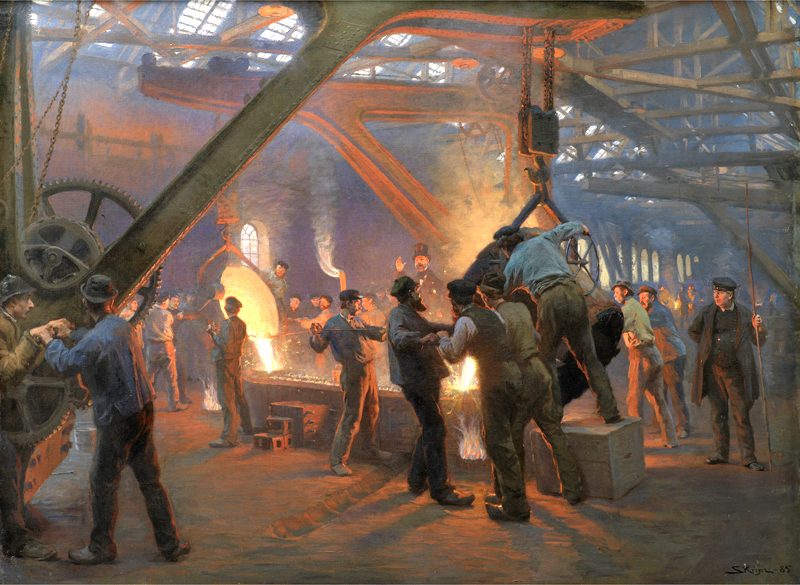
The tradition & historical record
6 min read · 2 sourcesA foundry is a factory that produces metal castings. Metals are cast into shapes by melting them into a liquid, pouring the metal into a mold, and removing the mold material after the metal has solidified as it cools. The most common metals processed are aluminium and cast iron. However, other metals, such as bronze, brass, steel, magnesium, and zinc, are also used to produce castings in foundries. In this process, parts of desired shapes and sizes can be formed. Foundries are one of the largest contributors to the manufacturing recycling movement, melting and recasting millions of tons of scrap metal every year to create new durable goods. Moreover, many foundries use sand in their molding process. These foundries often use, recondition, and reuse sand, which is another form of recycling. 1
Process
In metalworking, casting involves pouring liquid metal into a mold, which contains a hollow cavity of the desired shape, and then allowing it to cool and solidify. The solidified part is also known as a casting, which is ejected or broken out of the mold to complete the process. Casting is most often used for making complex shapes that would be difficult or uneconomical to make by other methods. 1
Melting
Melting is performed in a furnace. Virgin material, external scrap, internal scrap, and alloying elements are used to charge the furnace. Virgin material refers to commercially pure forms of the primary metal used to form a particular alloy. Alloying elements are either pure forms of an alloying element, like electrolytic nickel, or alloys of limited composition, such as ferroalloys or master alloys. External scrap is material from other forming processes such as punching, forging, or machining. Internal scrap consists of gates, risers, defective castings, and other extraneous metal oddments produced within the facility. The process includes melting the charge, refining the melt, adjusting the melt chemistry and tapping into a transport vessel. Refining is done to remove harmful gases and elements from the molten metal to avoid casting defects. Material is added during the melting process to bring the final chemistry within a specific range specified by industry and/or internal standards. Certain fluxes may be used to separate the metal from slag and/or dross, and degassers are used to remove dissolved gas from metals that readily dissolve in gasses. During the tap, final chemistry adjustments are made. 1
Furnace
Several specialised furnaces are used to heat the metal. Furnaces are refractory-lined vessels that contain the material to be melted and provide the energy to melt it. Modern furnace types include electric arc furnaces (EAF), induction furnaces, cupolas, reverberatory, and crucible furnaces. Furnace choice is dependent on the alloy system quantities produced. For ferrous materials EAFs, cupolas, and induction furnaces are commonly used. Reverberatory and crucible furnaces are common for producing aluminium, bronze, and brass castings. Furnace design is a complex process, and the design can be optimized based on multiple factors. Furnaces in foundries can be any size, ranging from small ones used to melt precious metals to furnaces weighing several tons, designed to melt hundreds of pounds of scrap at one time. They are designed according to the type of metals that are to be melted. Furnaces must also be designed based on the fuel being used to produce the desired temperature. For low temperature melting point alloys, such as zinc or tin, melting furnaces may reach around 500 °C (932 °F). Electricity, propane, or natural gas are usually used to achieve these temperatures. For high melting point alloys such as steel or nickel-based alloys, the furnace must be designed for temperatures over 1,600 °C (2,910 °F). The fuel used to reach these high temperatures can be electricity (as employed in electric arc furnaces) or coke. The majority of foundries specialize in a particular metal and have furnaces dedicated to these metals. For example, an iron foundry (for cast iron) may use a cupola, induction furnace, or EAF, while a steel foundry will use an EAF or induction furnace. Bronze or brass foundries use crucible furnaces or induction furnaces. 1
Degassing
Degassing is a process that may be required to reduce the amount of hydrogen present in a batch of molten metal. Gases can form in metal castings in one of two ways: 1
by physical entrapment during the casting process or by chemical reaction in the cast material. Hydrogen is a common contaminant for most cast metals. It forms as a result of material reactions or from water vapor or machine lubricants. If the hydrogen concentration in the melt is too high, the resulting casting will be porous; the hydrogen will exit the molten solution, leaving minuscule air pockets, as the metal cools and solidifies. Porosity often seriously deteriorates the mechanical properties of the metal. An efficient way of removing hydrogen from the melt is to bubble a dry, insoluble gas through the melt by purging or agitation. When the bubbles go up in the melt, they catch the dissolved hydrogen and bring it to the surface. Chlorine, nitrogen, helium and argon are often used to degas non-ferrous metals. Carbon monoxide is typically used for iron and steel. There are various types of equipment that can measure the presence of hydrogen. Alternatively, the presence of hydrogen can be measured by determining the density of a metal sample. In cases where porosity still remains present after the degassing process, porosity sealing can be accomplished through a process called metal impregnating. 1
Mold making
In the casting process, a pattern is made in the shape of the desired part. Simple designs can be made in a single piece or solid pattern. More complex designs are made in two parts, called split patterns. A split pattern has a top or upper section, called a cope, and a bottom or lower section called a drag. Both solid and split patterns can have cores inserted to complete the final part shape. Cores are used to create hollow areas in the mold that would otherwise be impossible to achieve. Where the cope and drag separates is called the parting line. When making a pattern it is best to taper the edges so that the pattern can be removed without breaking the mold. This is called draft. The opposite of draft is an undercut where there is part of the pattern under the mold material, making it impossible to remove the pattern without damaging the mold. The pattern is made of wax, wood, plastic, or metal. The molds are constructed by several different processes dependent upon the type of foundry, metal to be poured, quantity of parts to be produced, size of the casting, and complexity of the casting. 1
The text above is adapted from the Wikipedia article “Foundry”, available under the Creative Commons Attribution-ShareAlike 4.0 licence. 1
foundry is factory that produces metal castings, according to the structured record cited below. This entry was generated automatically from that record and has not yet been reviewed by a person familiar with the tradition. 2
The source record links this tradition to 26 external registers, which can be verified through the citation. 2