The tradition & historical record
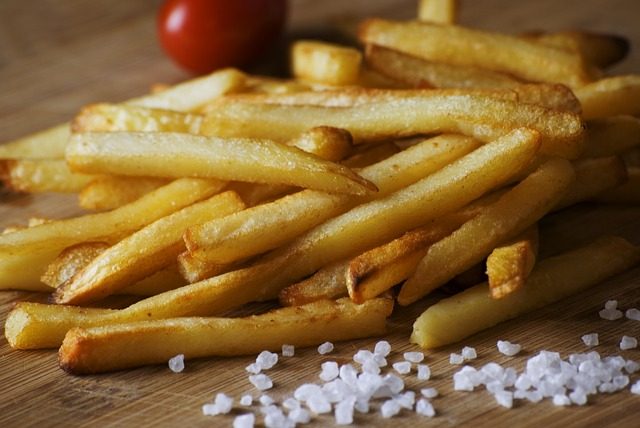
7 min read · 2 sourcesFrench fries, or simply fries, also known as French fried potatoes, chips, and finger chips, are batonnet or julienne-cut deep-fried potatoes of disputed origin. They are prepared by cutting potatoes into even strips, drying them, and frying them, usually in a deep fryer. Pre-cut, blanched, and frozen russet potatoes are widely used, and sometimes baked in a regular or convection oven, such as an air fryer. French fries are served hot, either soft or crispy, and are generally eaten as part of lunch or dinner or by themselves as a snack, and they commonly appear on the menus of diners, fast food restaurants, pubs, and bars. They are typically salted and may be served with ketchup, mustard, vinegar, mayonnaise, barbecue sauce, tomato sauce, or other sauces. French fries can be topped more heavily, as in the dishes of poutine, loaded fries or chilli cheese fries, and are occasionally made from sweet potatoes instead of potatoes. 1
Preparation
The standard method for cooking French fries is deep frying, which submerges them in a hot fat, typically oil. The potatoes are prepared by first cutting them (peeled or unpeeled) into even strips, which are then wiped off or soaked in cold water to remove the surface starch, and thoroughly dried. They may then be fried in one or two stages. Chefs generally agree that the two-bath technique produces better results. Freshly harvested potatoes have a high moisture content that results in a soggy texture when fried; consequently, stored potatoes are preferred for crisp fries. In the two-stage or two-bath method, the first bath, sometimes called blanching, is in hot fat (around 160 °C/320 °F) to cook the fries through. This step can be done in advance. Then they are more briefly fried in very hot fat (190 °C/375 °F) to crisp the exterior. They are then placed in a colander or on a cloth to drain, then served. The exact times of the two baths depend on the size of the fries. For example, for 2–3 mm strips, the first bath takes about 3 minutes, and the second bath takes only seconds. Since the 1960s, most French fries in the US have been produced from frozen Russet potatoes which have been blanched or at least air-dried industrially. The usual fat for making French fries is vegetable oil. In the past, beef suet was recommended as superior, with vegetable shortening as an alternative. McDonald's used a mixture of 93% beef tallow and 7% cottonseed oil until 1990, when they changed to vegetable oil with beef flavouring. Horse fat was standard in northern France and Belgium until recently, and is recommended by some chefs. 1
Chemical and physical changes
French fries are fried in a two-step process: the first time is to cook the starch throughout the entire cut at low heat, and the second time is to create the golden crispy exterior of the fry at a higher temperature. This is necessary because if the potato cuts are only fried once, the temperature would either be too hot, causing only the exterior to be cooked and not the inside, or not hot enough where the entire fry is cooked, but its crispy exterior will not develop. Although the potato cuts may be baked or steamed as a preparation method, this section will only focus on French fries made using frying oil. During the initial frying process (approximately 150°C), water on the surface of the cuts evaporates off the surface and the water inside the cuts gets absorbed by the starch granules, causing them to swell and produce the fluffy interior of the fry. The starch granules are able to retain the water and expand due to gelatinisation. The water and heat break the glycosidic linkages between amylopectin and amylose strands, allowing a new gel matrix to form via hydrogen bonds which aid in water retention. The moisture that gets trapped within the gel matrix is responsible for the fluffy interior of the fry. The gelatinised starch molecules move towards the surface of the fries "forming a thick layer of gelatinised starch" and this layer of pre-gelatinised starch becomes the crisp exterior after the potato cuts are fried for a second time. During the second frying process (approximately 180 °C), the remaining water on the surface of the cuts evaporates and the gelatinised starch molecules that collected towards the potato surface are cooked again, forming the crisp exterior. 1
Name and etymology
In the United States and most of Canada, the term French fries or French fried potatoes (also written as french fries or French-fried potatoes), or shortened to fries, refers to all dishes of fried elongated pieces of potatoes. Variants in shape and size may have names such as curly fries, shoestring fries, etc. In Great Britain, Australia, South Africa, Ireland and New Zealand, the term chips is generally used, being a popular dish in most Commonwealth countries. However, the term French fries or skinny fries is used for thinly cut fried potatoes which are distinguished from the more traditional thick cut chips. In the US or Canada, these more thickly-cut chips might be called steak fries, depending on the shape, while the word chips is more often used in North America to refer to potato chips, commonly known in the UK, Ireland and South Africa as crisps. In Australia and New Zealand, chips are often referred to as hot chips to distinguish them from potato chips, although the type of 'chip' is often implied through context. Thomas Jefferson had "potatoes served in the French manner" at a White House dinner in 1802. The expression "French fried potatoes" first occurred in print in English in the 1856 work Cookery for Maids of All Work by Eliza Warren: "French Fried Potatoes. – Cut new potatoes in thin slices, put them in boiling fat, and a little salt; fry both sides of a light golden brown colour; drain." This account referred to thin, shallow-fried slices of potato. It is not clear where or when the now familiar deep-fried batons or fingers of potato were first prepared. In the early 20th century, the term "French fried" was used in the sense of "deep-fried" for foods like onion rings or chicken. The term was in use in the United States as early as 1880. 1
Chile
The oldest documents where a fried potato is mentioned are from Chile in 1629 in the city of Nacimiento, extracted from Happy Captivity, written in 1673 by Chilean Francisco Núñez de Pineda, where he narrates his experiences as a captive war soldier in 1629 at the hands of Mapuche warriors. In the text, he mentioned eating "papas fritas" (fried potatoes) in 1629 and Mapuche women "sent fried and stewed potatoes" to the chiefs. The exact shape is unclear, likely wide slices or cubes fried in lamb or guanaco tallow which was customary. However, the cane shape originates from Europe. 1
Spain
French fries in their current form may have been invented in Spain, the first European country in which the potato appeared from the New World colonies. 1
The text above is adapted from the Wikipedia article “French fries”, available under the Creative Commons Attribution-ShareAlike 4.0 licence. 1
fries is deep-fried potatoes, according to the structured record cited below. This entry was generated automatically from that record and has not yet been reviewed by a person familiar with the tradition. 2
The source record links this tradition to 35 external registers, which can be verified through the citation. 2