The tradition & historical record
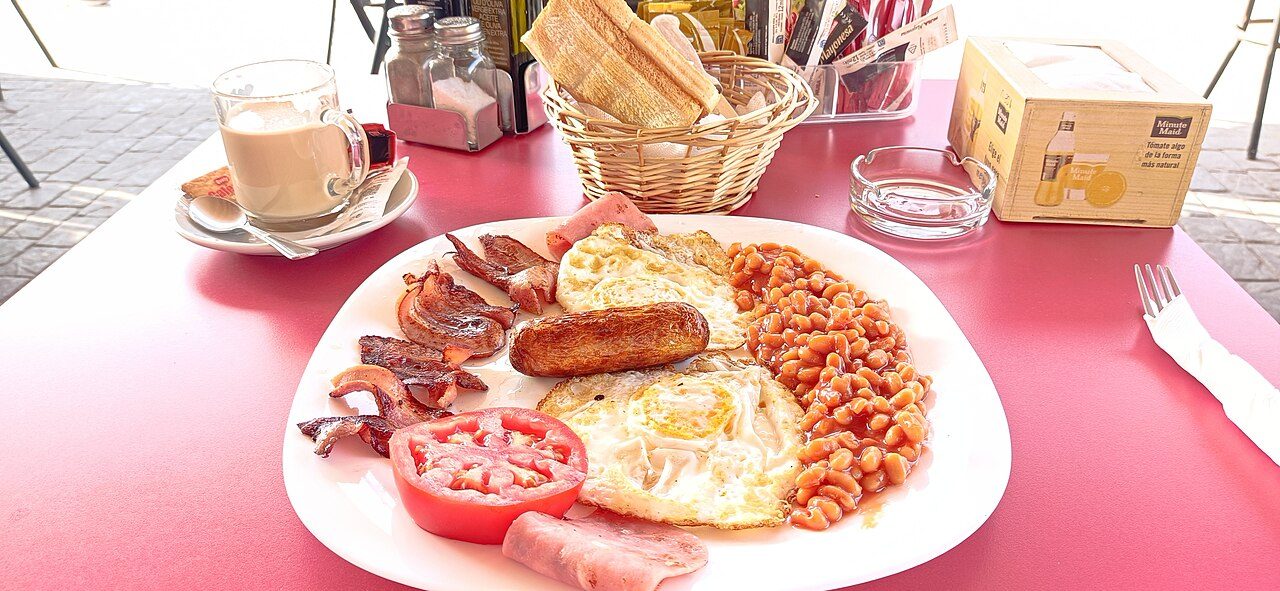
6 min read · 2 sourcesA full breakfast or fry-up is a substantial cooked breakfast meal often made in Great Britain and Ireland. Depending on the region where it is served a full breakfast, or one of its variants, may also be referred to as a full English, full Scottish, full Welsh, full Irish fry up, or Ulster fry. Other variants of the full breakfast are made elsewhere. The typical ingredients of a full breakfast are bacon, sausages, eggs, black pudding, tomatoes, mushrooms, and fried bread or toast. The meal is often served with tea. Baked beans, hash browns, and coffee (in place of tea) are common contemporary but non-traditional inclusions. Fried breakfasts became popular in Great Britain and Ireland during the Victorian era; while the term "full breakfast" does not appear, a breakfast of "fried ham and eggs" is in Isabella Beeton's Book of Household Management (1861). 1
History
Many of the ingredients of a full breakfast have long histories, but "large cooked breakfasts do not figure in English life and letters until the 19th century during the Victorian era, when they appeared with dramatic suddenness". Across Britain and Ireland, early modern breakfasts were often breads served with jams or marmalades, or else forms of oatmeal, porridge or pottage. Eggs and bacon started to appear in breakfasts in the seventeenth century, but they were not the only meats consumed in breakfasts at that time. The rising popularity of breakfast was closely tied to the rise of tea as a popular morning drink. Of note were the lavish breakfasts of the aristocracy, which would centre on local meats and fish from their country estates. Cookbooks were important in the fixing of the ingredients of a full breakfast during this time, and the full breakfast appeared in the best-selling Isabella Beeton's Book of Household Management (1861). This new full breakfast was a pared-down version of the country breakfasts of the upper class, affordable to the emergent middle classes and able to be prepared and consumed in a shorter time before a day's work. The full breakfast reached its peak of popularity in Edwardian Britain, and despite a decline following the food shortages of World War II, new technologies of food storage and preparation allowed it to become a staple of the working class in the 1950s. Since then the full breakfast has declined in popularity as a daily meal, due to concerns about health and the longer preparation time needed compared to convenience-food breakfasts. 1
England
There is no fixed menu or set of ingredients for a full English breakfast. A common traditional English breakfast typically includes back bacon, sausages (usually pork), eggs (fried, poached or scrambled), fried or grilled tomatoes, fried mushrooms, black pudding, baked beans, and toast or fried bread. The other ingredients may be put on top of the toast. Bubble and squeak is a traditional accompaniment but is now more commonly replaced by hash browns. Black pudding is a type of blood sausage made from pork or occasionally beef blood, with fat or suet, and a cereal. Its high proportion of cereal, along with the use of certain herbs, distinguishes it from other blood sausages. Bubble and squeak is an English dish made from cooked potatoes and cabbage, mixed together and fried. Its name, according to the Oxford English Dictionary (OED), alludes to the sounds made by the ingredients when being fried. A poll by YouGov in 2017 found the following to be on more than 50% of 'ideal' Full English breakfasts: bacon; sausage; beans; bread (either toast or fried); eggs (fried, scrambled or poached); hash browns; mushrooms (fried or grilled); and tomatoes (fried, grilled or tinned). Black pudding was the least popular of the traditional ingredients, chosen 35% of the time, and 26% of people included either chips or sautéed potatoes. Buttered toast, and jam or marmalade, are often served at the end of the meal, although toast is generally available throughout the meal. As nearly everything is fried in this variant of the meal, it is commonly known as a "fry-up". In the UK it is sometimes referred to as a "Full Monty". 1
Scotland
There are some distinctively local elements of the full Scottish breakfast, including Scottish style or Stornoway black pudding, Lorne sausage, Ayrshire middle bacon and tattie scones. Commonly, a full Scottish breakfast is offered on a menu as an 'all day' dish. Stornoway black pudding is a variety of black pudding (Scottish Gaelic: marag-dhubh) made in the Western Isles of Scotland. Lorne sausage, also known as square sausage or slice sausage, is a traditional Scottish food item made from minced meat, rusk and spices. Although termed a sausage, no casing is used to hold the meat in shape, hence it is usually served as square slices from a formed block. A tattie scone (tottie scone) or potato scone is a regional variant of the savoury griddle scone, and is especially popular in Scotland. Tattie scones are typically made with mashed potato and a small quantity of plain flour. Occasionally a full Scottish breakfast will also include haggis, white pudding, fruit pudding or oatcakes. Early editions of Brewer's Dictionary of Phrase and Fable referred to a Scotch breakfast as "a substantial breakfast of sundry sorts of good things to eat and drink". 1
Wales
Two key ingredients that distinguish the full Welsh breakfast from the other "full" variants are cockles and laverbread. The common cockle (Cerastoderma edule) is a species of edible saltwater clam, a marine bivalve mollusc in the family Cardiidae, the cockles. It is found in waters off Europe, from Iceland in the north, south into waters off western Africa as far south as Senegal. Laverbread is a purée made from laver, an edible seaweed (littoral alga) consumed mainly in Wales as part of local traditional cuisine. It is often mixed with oatmeal and fried. Fried laver with cockles and bacon was the traditional breakfast for mine workers in the South Wales Coalfield, but a breakfast in that area may have also included Welsh sausages, mushrooms and eggs. In modern Welsh breakfasts, smoked fish may be included instead of black pudding. 1
Connacht, Leinster and Munster
In most of Ireland, a full breakfast consists of the common ingredients of sausage, bacon and eggs, and sometimes brown soda bread, fried potato farls, white pudding or boxty. Soda bread is a variety of quick bread in which sodium bicarbonate is used as a leavening agent instead of yeast with buttermilk used to activate the soda. White pudding is a meat dish originating in Britain and Ireland; it is broadly similar to black pudding, but does not include blood. 1
The text above is adapted from the Wikipedia article “Full breakfast”, available under the Creative Commons Attribution-ShareAlike 4.0 licence. 1
full breakfast is substantial British and Irish breakfast, according to the structured record cited below. This entry was generated automatically from that record and has not yet been reviewed by a person familiar with the tradition. 2
The source record links this tradition to 1 external register, which can be verified through the citation. 2