The tradition & historical record
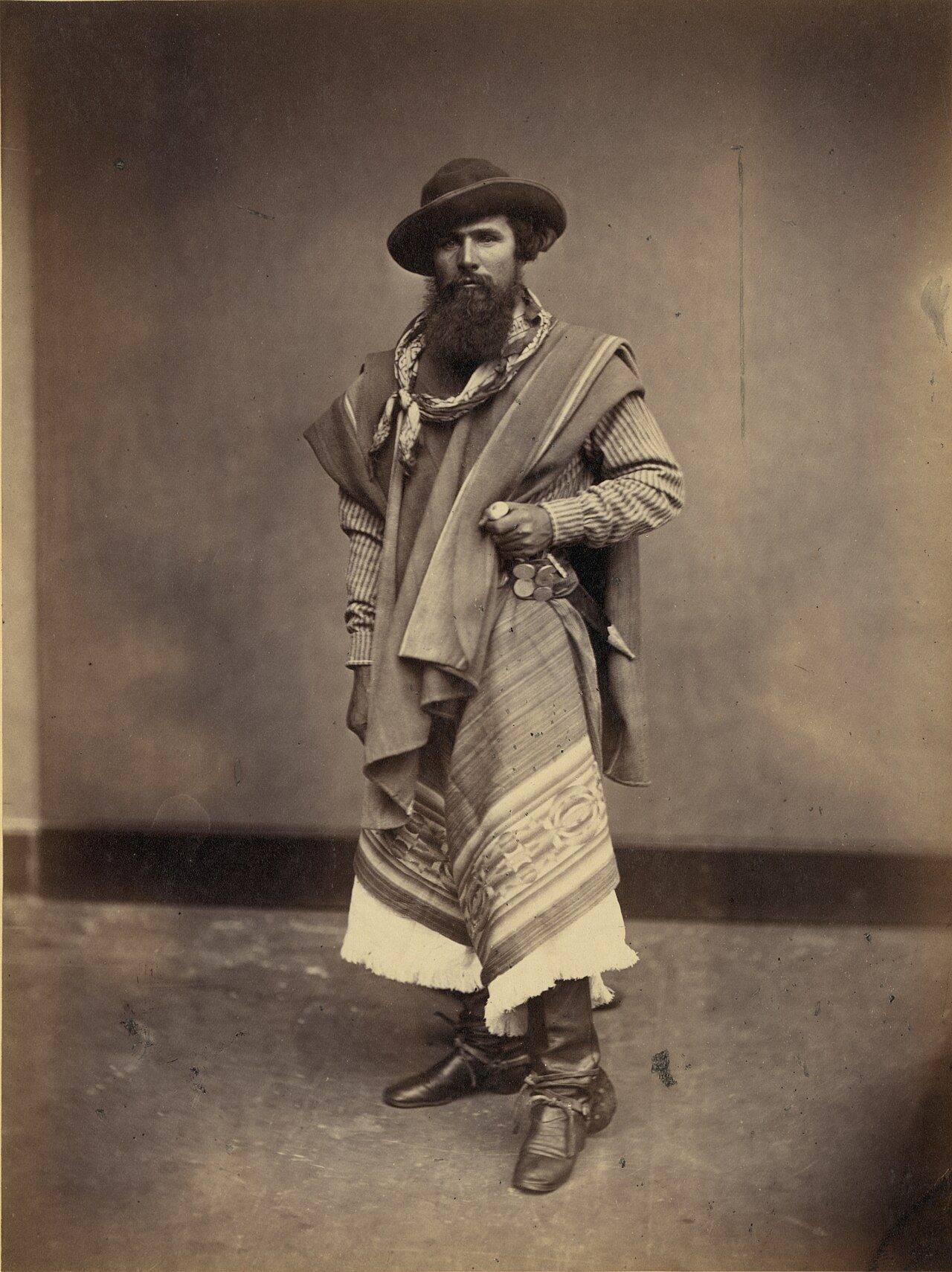
5 min read · 2 sourcesA gaucho (Spanish: [ˈɡawtʃo]) or gaúcho (Portuguese: [ɡaˈuʃu], locally [ɡaˈuʃo]) is a skilled horseman, reputed to be brave and unruly. The figure of the gaucho is a folk symbol mainly in Argentina and Uruguay but also in Paraguay, southern Brazil, southern Bolivia, and southern Chile. Gauchos became greatly admired and renowned in legend, folklore, and literature and became an important part of their regional cultural tradition. Beginning late in the 19th century, after the heyday of the gauchos, they were celebrated by South American writers. According to the Diccionario de la lengua española, in its historical sense a gaucho was a "mestizo who, in the 18th and 19th centuries, inhabited Argentina, Uruguay, and Rio Grande do Sul in Brazil, and was a migratory horseman, and adept in cattle work". In Argentina and Uruguay today, gaucho can refer to any "country person, experienced in traditional livestock farming". Because historical gauchos were reputed to be brave, if unruly, the word is also applied metaphorically to mean "noble, brave and generous", but also "one who is skillful in subtle tricks, crafty". In Portuguese the word gaúcho means "an inhabitant of the plains of Rio Grande do Sul or the Pampas of Argentina of European and indigenous American descent who devotes himself to lassoing and raising cattle and horses"; gaúcho has also acquired a metonymic signification in Brazil, meaning anyone, even an urban dweller, who is a citizen of the state of Rio Grande do Sul. 1
Etymology
Many explanations have been proposed, but no-one really knows how the word gaucho originated. Already in 1933 an author had counted 36 different theories; more recently, over fifty. They can proliferate because "there is no documentation of any sort that will fix its origin to any time, place or language". 1
Resemblance theories
Most seem to have been conjured up by finding a word that looks something like gaucho and guessing that it changed to its present form, perhaps without awareness that there are sound laws that describe how languages and words really evolve over time. The etymologist Joan Corominas said most of these theories were "not worthy of discussion". Of the following explanations, Rona said that only #5, #8 and #9 might be taken seriously. 1
The dialect frontier theory
A different approach is to consider that the word might have originated north of the Río de la Plata, where the indigenous languages were quite different and there is a Portuguese influence. Two facts that any theory could usefully account for are: 1
The word actually exists in two forms: Port. gaúcho and Sp. gaucho, both long attested. Gauchos are first mentioned by name in the Spanish colonial records for present-day Uruguay, often in connection with smuggling to Brazil (see below, Origins). Thus Azara wrote (around 1784):There is in that land, and particularly around Montevideo and Maldonado, another class of people, most appropriately called gauchos or gauderios. Commonly all are criminals escaped from the jails of Spain and Brazil, or they belong to the number of those who, because of their atrocities, have had to flee to the wilderness... When the gaucho has some necessity or caprice to satisfy, he steals a few horses or cows, takes them to Brazil where he sells them and where he gets whatever it is he needs. Hence the Uruguayan sociolinguist José Pedro Rona thought the origin of the word was to be sought "on the frontier zone between Spanish and Portuguese, which goes from northern Uruguay to the Argentine province of Corrientes and the Brazilian area between them". Rona, himself born on a language frontier in pre-war Europe, was a pioneer of the concept of linguistic borders, and studied the dialects of northern Uruguay where Portuguese and Spanish intermingle. Rona thought that, of the two forms — gaúcho and gaucho — the former probably came first, because it was linguistically more natural for gaúcho to evolve by accent-shift to gáucho, than the other way round. 1
History
The historical "gaucho" is elusive, because there has been more than one kind. Mythologisation has obscured the topic. 1
Origins
Itinerant horsemen, hunting wild cattle on the pampas, originated as a social class during the 17th century. "The great natural abundance of the pampa", wrote Richard W. Slatta, with its plethora of cattle, horses, ostriches, and other wild game, meant that a skilled horseman and hunter could live without permanent employment by selling hides, feathers, pelts, and eating free beef. This pampean largess shaped the gaucho's independent, migratory existence and his aversion to a sedentary regimen". The original gaucho was typically descended from unions between Iberian men and Amerindian women, although he might also have African ancestry. A DNA analysis study of rural inhabitants of Rio Grande do Sul, who style themselves gaúchos, has claimed to discern, not only Amerindian (Charrúa and Guaraní) ancestry in the female line but, in the male line, a higher proportion of Spanish ancestry than is usual in Brazil. However, gauchos were a social class, not an ethnic group. Gauchos are first mentioned by name in the 18th century records of the Spanish colonial authorities who administered the Banda Oriental (present-day Uruguay). For them, he is an outlaw, cattle thief, robber and smuggler. Félix de Azara (1790) said gauchos were "the dregs of the Rio de la Plata and of Brazil". Summarised one scholar: "Fundamentally [the gaucho of the time] was a colonial bootlegger whose business was contraband trade in cattle hides. His work was highly illegal; his character lamentably reprehensible; his social standing exceedingly low. "Gaucho" was an insult; yet it was possible to use the word to refer, without animosity, to country people in general. Furthermore the gaucho's skills, though useful in banditry or smuggling, were just as useful for serving in the frontier police. 1
The text above is adapted from the Wikipedia article “Gaucho”, available under the Creative Commons Attribution-ShareAlike 4.0 licence. 1
gaucho is skilled horseman in South America, according to the structured record cited below. This entry was generated automatically from that record and has not yet been reviewed by a person familiar with the tradition. 2
The source record links this tradition to 25 external registers, which can be verified through the citation. 2