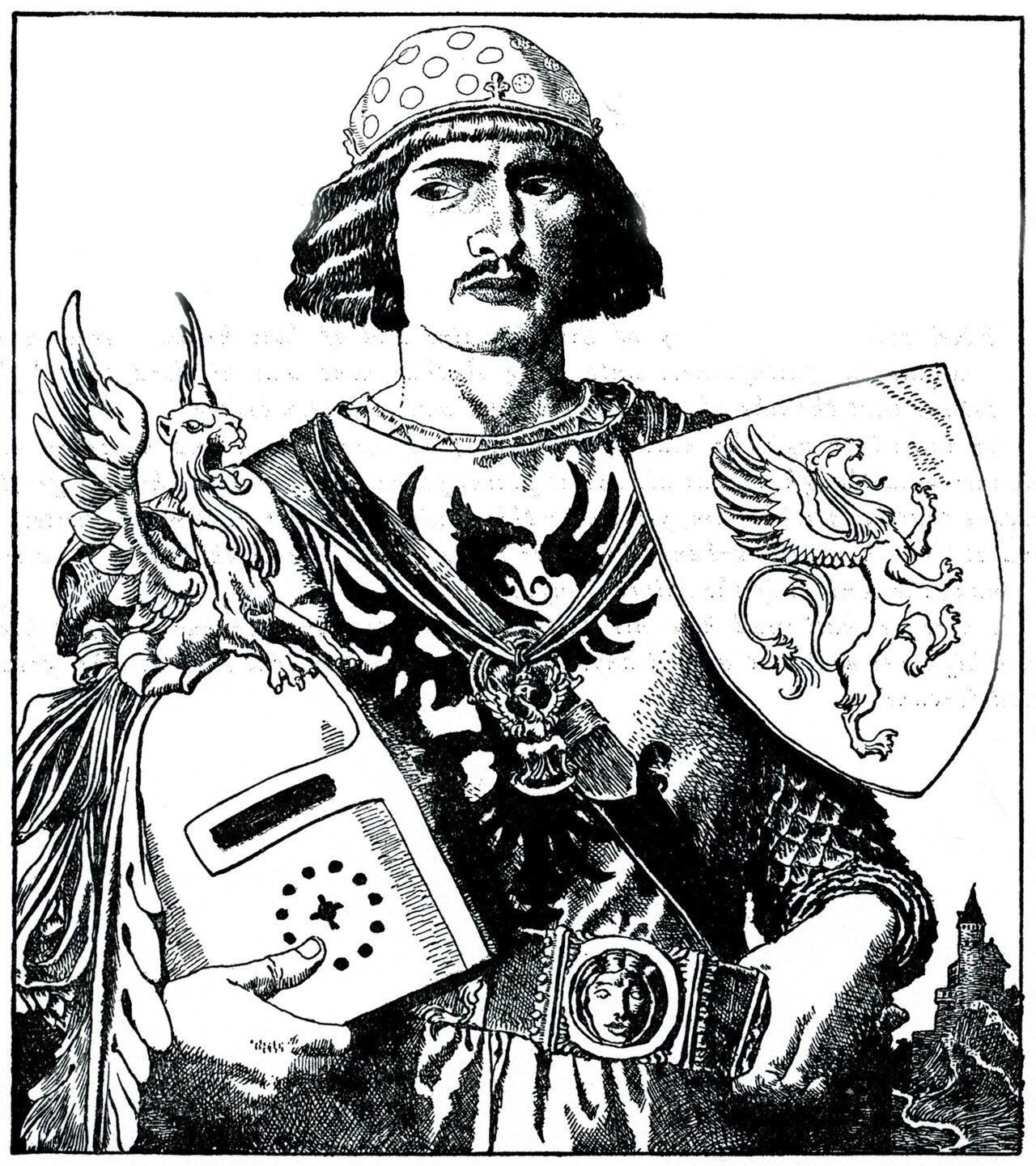
The tradition & historical record
6 min read · 2 sourcesGawain ( GA(H)-wayn, -win, gə-WAYN), whose name is spelled in multiple ways, is one of the Knights of the Round Table in the Arthurian legendary cycle. His prototype appears under the name Gwalchmei in the earliest Welsh sources. He has subsequently appeared in Arthurian tales in multiple languages – Welsh, Latin, French, English, Scottish, Dutch, German, Spanish, and Italian – notably as the protagonist of the Middle English poem Sir Gawain and the Green Knight. Other works featuring Gawain as the central character include De Ortu Waluuanii, Diu Crône, Ywain and Gawain, Golagros and Gawane, Sir Gawain and the Carle of Carlisle, L'âtre périlleux, La Mule sans frein, La Vengeance Raguidel, Le Chevalier à l'épée, Le Livre d'Artus, The Awntyrs off Arthure, The Greene Knight, and The Weddynge of Syr Gawen and Dame Ragnell. In Arthurian chivalric romances, Gawain is typically depicted as King Arthur's closest companion and an integral member of the Round Table. Gawain is often depicted as the son of Arthur's sister, Morgause, and King Lot of Orkney and Lothian. In this family, Gawain's younger brothers (or half-brothers) are Agravain, Gaheris, Gareth, and the infamous Mordred, though his family relations and upbringing vary among romances. Gawain is often said to have been raised unknowingly in foster care in Rome, before returning to Britain to reunite with his biological relatives. 1
Sir Gawain
The character of Gawain has multiple names (and variants) in different languages: 1
Welsh: Gwalchmei ap Gwyar (meaning "son of Gwyar"), also spelled Gwalchmai Latin (throughout the Middle Ages): Galvaginus, Gualgunus (Gualguanus, Gualguinus), Gualgwinus, Walwanus (Walwanius), Waluanus, Walwen, etc. Old French (and sometimes English): primarily Gavain (Gavaine) and also Gauvain (Gauvaine), Gauvan (Gauvayn), Gauven (Gauvein/Gauveyn), Gavan (Gavane) or Gavayn (Gavayne). Middle High German: Gâwein or Gâwân Italian dialects: Gavino, Galvagin or Galvano Old Spanish: Galván Old Portuguese: Galvam or Galvão Middle English: Gawaine, Gawan (Gawane), Gawayn (Gawayne), Gawein (Gaweine), Gaweyn (Gaweyne), Gauwein (Gauweine), Gauweyn (Gauweyne) or Wawen (Wowen), among other forms and spellings. The later forms are generally assumed to derive from the Welsh Gwalchmei. In Gwalchmei's name, the element Gwalch – meaning hawk – is an epithet typical of medieval Welsh poetry. The meaning of the element mei is uncertain, however. While it has been suggested that this element refers to the month of May (Mai in Modern Welsh) – rendering the full name as "Hawk of May" – medievalist and linguist Rachel Bromwich considers this meaning unlikely. Celticist Kenneth Jackson suggests the name Gwalchmei evolved from an early Common Brittonic name *Ualcos Magesos, meaning "Hawk of the Plain". Some scholars disagree with the "hawk" interpretation altogether. For example, John T. Koch suggests that the name Gwalchmei could be derived from the Brythonic *Wolcos Magesos, "Wolf/Errant Warrior of the Plain". 1
By contrast, other scholars argue that the continental forms of the character's name do not ultimately derive from Gwalchmei. 1
Gwalchmei
The Gawain character's precursor – Gwalchmei, son of Gwyar – was a hero of Welsh mythology and a major figure of the largely lost oral tradition. Gwalchmei's popularity increased significantly after foreign versions of the mythology, particularly those derived from Geoffrey of Monmouth's account Historia Regum Britanniae, became known in Wales. The element Gwyar (meaning "gore" or "spilled blood/bloodshed") in the name Gwalchmei ap Gwyar is likely the name of Gwalchmei's mother, rather than his father, as is standard in the Welsh Triads. Gwyar appears as a daughter of the legendary king Amlawdd Wledig in one version of the hagiographical genealogy Bonedd y Saint. The 14th-century fragment Birth of Arthur – a Welsh text that adapts scenes from Geoffrey – substitutes Gwyar for Anna, Geoffrey's name for Gawain's mother, the Queen of Orkney. Gwalchmei's father is named as Emyr Llydaw (Emperor of Brittany), that is, Budic II of Brittany. 1
Histories and romances
The first known references to Gawain outside Wales appeared in the first half of the 12th century. In his chronicle Gesta Regum Anglorum from around 1125, William of Malmesbury wrote that "Walwen's" grave had been uncovered in Pembrokeshire county hundreds of years after his death, following the 11th-century Norman conquest of England. William recounts how Arthur's nephew, a well-known Post-Roman Briton soldier celebrated for his bravery, tirelessly fought against the Saxons led by Hengest's brother: "He deservedly shared in his uncle's praising, because he prevented the fall of his collapsing country for many years." William also noted uncertainty regarding the manner of Walwen's death: 1
There, as certain people claim, he [Walwen] was wounded by his enemies, and cast forth from a shipwreck; by others, it is said that he was killed by his fellow citizens at a public feast. Therefore, knowledge of the truth falls in doubt, although neither of these stories would fail in defense of his fame. William also described Walwen as a former ruler of the Galloway region, which William noted was still called Walweitha centuries later, in his own era. Geoffrey of Monmouth's version of Gawain in the Historia Regum Britanniae, written around 1136, made the character available to a wider audience. As in the Welsh tradition, Geoffrey's Gawain (Gualguanus) is the son of Arthur's sister (here named Anna) and her husband Lot (Loth), the prince of Lothian and one of Arthur's key supporters. Geoffrey mentioned that Gawain was twelve years old when King Lot and Arthur began a war with Norway, and that Gawain had previously served Pope Sulpicius in Rome. 1
Origin narratives and alternate siblings
The romance Les Enfances Gauvain, based in part on De Ortu Waluuanii, tells how Arthur's sister Morcades (Morgause) becomes pregnant by Lot, at this point a page in King Arthur's court. She and Lot secretly give the child to a knight named Gawain the Brown (Gauvain li Brun), who baptises the infant with his own name, puts the infant Gawain in a cask with a letter explaining the child's identity, and sets him adrift at sea. The cask is found by a fisherman and his wife. Sometime after Gawain is ten years old, his foster-father vows to make a pilgrimage to Rome if he recovers from his severe illness. When he undertakes this pilgrimage, he takes his foster-child along. In Rome, a clerk reads the knight's letter, understands that the boy is high-born, and the Pope takes Gawain as his foster son. (Stories like this can be found in Perlesvaus, the collection Gesta Romanorum, and other texts.) In De Ortu Waluuani, the young Gawain – trained as a Roman cavalry officer – undertakes a quest to determine whether Rome or Persia should possess Jerusalem. On his way, Gawain and his men defeat the pirate king Milocrates and his brother Buzafarnam, rescuing the Roman Emperor's niece whom Milocrates has abducted. 1
Attributes and characterisations
Arthurian scholar Ryan Harper considers Gawain's varied (and mo… 1
The text above is adapted from the Wikipedia article “Gawain”, available under the Creative Commons Attribution-ShareAlike 4.0 licence. 1
Gawain is knight in Arthurian legends, according to the structured record cited below. This entry was generated automatically from that record and has not yet been reviewed by a person familiar with the tradition. 2
The source record links this tradition to 27 external registers, which can be verified through the citation. 2