The tradition & historical record
6 min read · 2 sourcesWorm, wurm or wyrm (Old English: wyrm; Old Norse: ormr; Old High German: wurm), meaning serpent, are archaic terms for dragons (Old English: draca; Old Norse: dreki/*draki; Old High German: trahho) in the wider Germanic mythology and folklore, in which they are often portrayed as large venomous snakes and hoarders of gold. Especially in later tales, however, they share many common features with other dragons in European mythology, such as having wings. Prominent worms attested in medieval Germanic works include the dragon that killed Beowulf, the central dragon in the Völsung Cycle – Fáfnir, Nidhogg (Old Norse: Níðhǫggr), and the great world serpent, Jǫrmungandr, including subcategories such as lindworms and sea serpents. 1
Etymology
In early depictions, as with dragons in other cultures (compare Russian: zmei), the distinction between Germanic dragons and regular snakes is blurred, with both being referred to as: "worm" (Old English: wyrm; Old Norse: ormʀ → ormr; Old High German: wurm), "snake" (Old English: snaca; Old Norse: snókr, snákr; Old High German: *snako), "adder" (Old English: nǣdre; Old Norse: naðr m., naðra f.; Old High German: nātara), and more, in writing; all being old Germanic synonyms for serpent and thereof. "Worm", in Old Germanic, specifically meant "long legless animal" in general, thus extending to serpents as well as invertebrates, with the latter later becoming the primary sense in modern English, etc. The descendant term worm remains used in modern English to refer to dragons, such as those similar to snakes or without wings, while the Old English form wyrm has been borrowed back into modern English to mean "dragon". The word also appear archaically in the original broader sense, for example in the names for the common legless lizard: blindworm, hazelworm, slowworm, including the form deaf adder etc (compare Elfdalian: näder, nädra, "common legless lizard", from Old Norse: naðr, naðra, "adder"). The Nordic descendants of Old Norse: ormr – Danish: orm, Faroese: ormur, Icelandic: ormur, Norwegian: orm, Swedish: orm – beyond being the common word for snake in Faroese, Norwegian and Swedish, in Danish and Icelandic instead being more ambiguous with invertebrate worms, remain a poetic or archaic word for dragon and similar mythological serpentine creatures. 1
Early corpus
In the 10th century Old English epic poem Beowulf, probably composed a century or two earlier, "the dragon" is referred to as both a wyrm and a draca. Within Beowulf, there is a story of Sigemund the Wælsing featuring a treasure-hoarding dragon slain by the aforementioned hero (paralleling Beowulf himself), and which scholars suggests comes from an older tradition of dragonslayers within Germanic pagan mythology. In the eddic poem Völuspá, dating back to the 10th century, the dragon Nidhogg (Old Norse: Níðhǫggr), is foretold to show himself at the dawn of the new world, revealing himself to be a "flying dragon" (dreki), and a "shimmering adder" (naðr), flying over the land, carrying the dead between his "feathers". 1
In the Middle High German epic poem Nibelungenlied, written around 1200, the unnamed dragon ("Fáfnir") is referred to as a lintrache ("lin-drake", ie, lindworm), which associate professor of German, George Henry Needler (1866–1962), translated as "worm-like dragon". The Old Norse Eddic poem Fáfnismál, written around 1270, tells an alternate version of the same root story as Nibelungenlied, were the dragon, Fáfnir, is described as flightless and snake-like, and is referred to as an ormr. In the later, late 13th century Icelandic saga, Völsunga saga, Fáfnir is instead described with shoulders, suggesting legs, wings or both, and is referred to as both a dreki (dragon) and an ormr (worm). Both of these descriptions are consistent with 11th century depictions of Fáfnir as a runic animal on various picture stones, sometimes being limbless and other times featuring various forms of limbs. Such stones are collectively called Sigurd stones, after Fáfnir's killer, Sigurd, who often acts as the indicator for the motif. 1
Later corpus
In the later, 14th century, Icelandic sagas: Ketils saga hœngs, and Konráðs saga keisarasonar, ormar and drekar are portrayed as distinct beings, with winged dragons sometimes specified as flugdreki, "flying dragon" (lit. 'fly-dragon'), however, in contrast, the term flugormr, "flyging serpent", is also recorded. The Icelandic written corpus still describe dragons as very serpentine-like, however. Their tail, for example, is often called a sporðr, a word for "fish tail, serpent tail and thereof" (a tail for swimming). The 13th century saga, Bjarnar saga Hítdœlakappa, writes the following: 1
The later, 14th century saga, Ketils saga hœngs, specifically refers to sporðr as the tail of a serpent, and also describes the dragon as having a "coil" (lykkja) like a serpent, but "wings like a dragon": 1
The evolution of wingless and legless worms and lindworms to flying, four-legged romanesque dragons in Germanic folklore and literature is most likely due to influence from continental Europe that was facilitated by Christianisation and the increased availability of translated romances. It has thus been proposed that the description in Völuspá of Níðhöggr with feathers and flying after Ragnarök is a late addition and potentially a result of the integration of pagan and Christian imagery. Old Icelandic flugdreki was later literarily borrowed into Old Swedish as flughdraki and floghdraki, which then became a term for a Swedish type of wingless, limbless, flying dragon – Flogdrake – said to soar across the skies as a fiery or golden stripe that stretches across the sky (compare the Swedish lindworm, which lacks both limbs and wings, also the analog European firedrakes). 1
Technical terminology
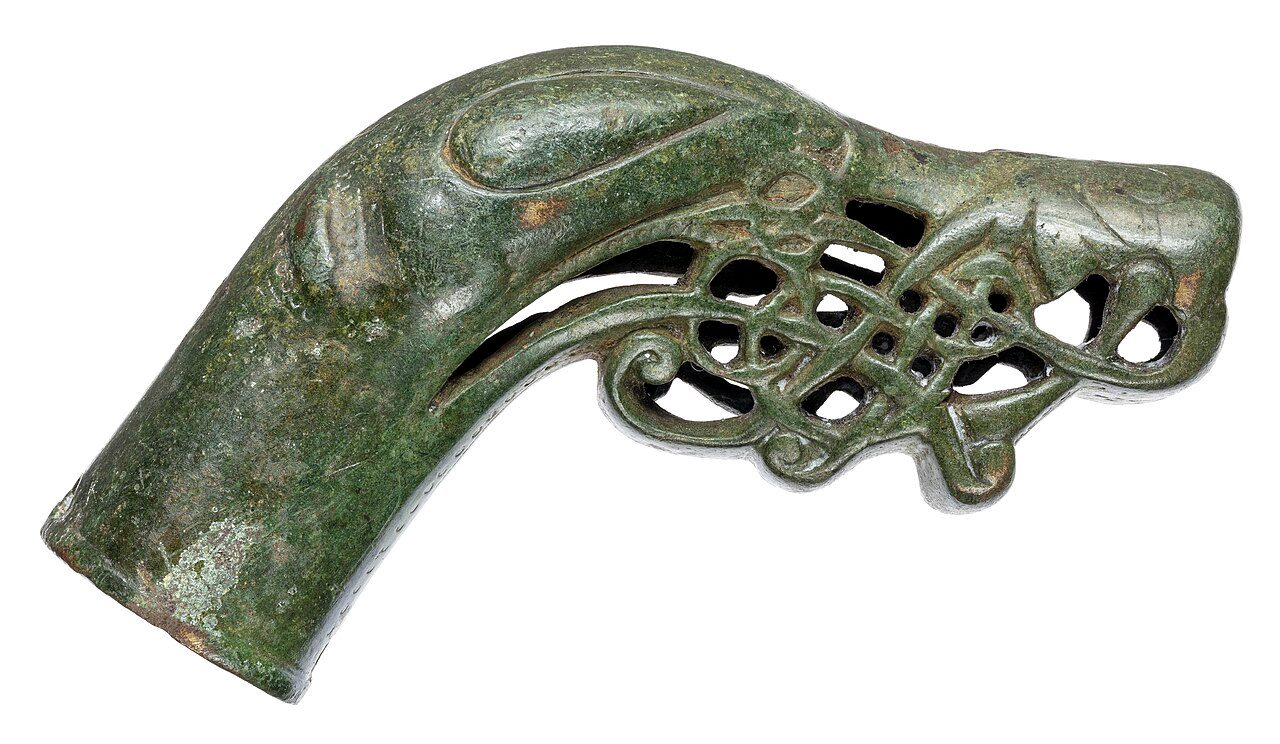
To address the difficulties with categorising Germanic dragons, the term drakorm (Swedish for "dragon serpent") has been proposed, referring to beings described as either a dragon or worm. Irish historian A. Walsh used the term "worm-dragon" already in 1922 to describe the runic dragon like ornament found side by side with the Celtic interlaced patterns on the Cross of Cong from 1123. 1
There are also dragon-like monsters in Germanic folklore which continue the use of worm or other synonyms in the ambiguous sense of either dragon or snake, such as lindworm (Swedish: lindorm, German: Lindwurm) and sea serpent (Swedish: sjöorm, German: Seeschlange), the latter popularized by Swede Olaus Magnus through his Carta marina (1539) and A Description of the Northern Peoples (1555), in the latter describing a sea serpent found in Bergen, Norway. Olaus gives the following description of a Norwegian sea serpent: 1
Those who sail up along the coast of Norway to trade or to fish, all tell the remarkable story of how a serpent of fearsome size, from 200 feet [60 m] to 400 feet [120 m] long, and 20 feet [6 m] wide, resides in rifts and caves outside Bergen. 1
Named dragons
Fáfnir is a widely attested dragon that has a prominent role in the Völsung Cycle. 1
The text above is adapted from the Wikipedia article “Germanic dragon”, available under the Creative Commons Attribution-ShareAlike 4.0 licence. 1
Germanic dragon is creature in Germanic mythology and folklore, according to the structured record cited below. This entry was generated automatically from that record and has not yet been reviewed by a person familiar with the tradition. 2
The source record links this tradition to 2 external registers, which can be verified through the citation. 2