The tradition & historical record
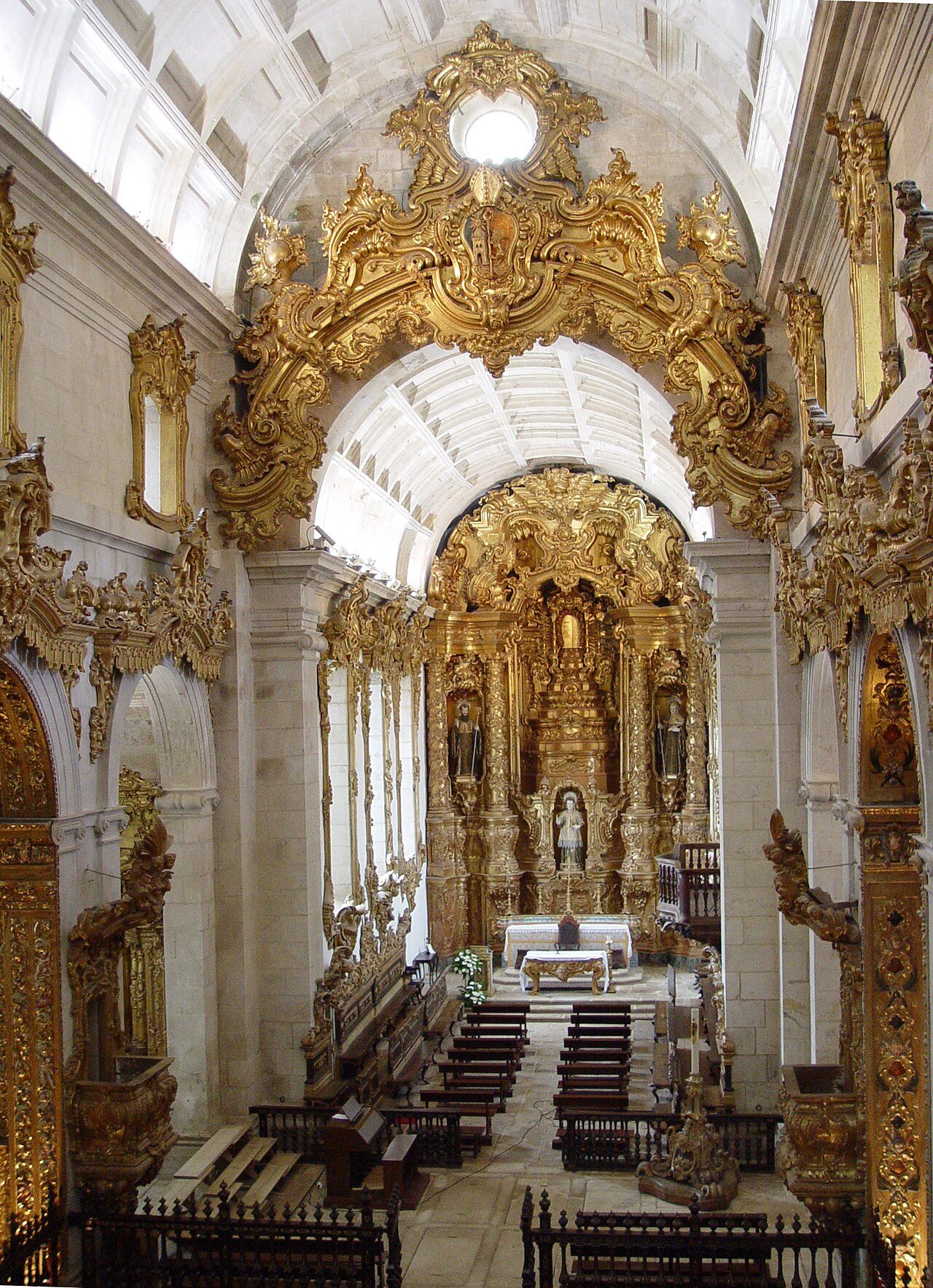
6 min read · 2 sourcesGilded woodcarving in Portugal (Portuguese: talha dourada) is, along with azulejos, one of the country's most original and rich artistic expressions. It is usually used in the interior decoration of churches and cathedrals and of noble halls in palaces and large public buildings. An impressive collection of altarpieces are found in Portuguese churches. Originating in the Gothic era, Portuguese gilded woodcarving assumed a nationalist character during the 17th century and reached its height in the reign of King D. João V. In the 19th century it lost its originality and began to disappear with the end of the revival era. 1
Comparison
Gilded woodcarving is a less expensive and more flamboyant artform than other technically more demanding types of decoration, such as sculpture or painting, although tile is also inexpensive. The amount of gold required is relatively small. It does not require the extensive training of a sculptor or painter. The forms are copied and adapted from decorative architecture and inspiration taken from books. During the 17th century, a typically Portuguese vocabulary developed. After being transported to the empire, it adapted to local traditions and artistic capacities, as is visible in Brazil or in India – mainly in Goa. Artists take commissions from regional orders to guarantee the activity of their workshop, sometimes making several related works in a specific geographical area. Examples exist in colour, white or natural wood, but without the visual impact of the gilded carvings. 1
Gothic, and Renaissance Manueline
Gilded woodcarving in Portugal started during the Gothic period following architectural models, taken mainly from sculpture and goldsmithery, using the decorative vocabulary of the style. Gothic arches, pinnacles, columns, etc., are associated with sculpture or painting. The typical form was a wooden structure, with the gold carving kept for the architectural part of the “machine” and the rest of the elements left either in plain wood or covered with colour. In spite of the small number of surviving altarpieces (the overwhelming majority was replaced during the Baroque period), it is known that they followed the international taste, such as the main altarpiece in the old Cathedral of Coimbra. The Manueline follows the vocabulary of architecture, using mainly the portal structure, giving importance to the heraldic, armillary sphere, Cross of Christ and sculpted naturalistic elements. The main examples, altarpiece and Choir Stalls, from Convent of the Order of Christ in Tomar and Monastery of Alcobaça, disappeared, but the monumental Choir Stalls from Santa Cruz Monastery in Coimbra remains. The wood gilt followed the approach of northern Europe, adjusted with the Portuguese aesthetic at the time and was made by Flemish master Machim. The Renaissance followed the architectural decoration, but without golden carving, employing painting and sculpture and following the classic imagination from books of the time. The carved decoration in wood was close to the intended stone forms, visible in portals, tombs or even in goldsmithery. The preference for large altarpieces in stone or painting did not allow the development of woodcarving as an autonomous form of expression, leaving it a decorative art. 1
Mannerism
Economic and other factors led to the expansion of gilt woodcarving during the Mannerist era. The economic crisis at the end of the sixteenth century, the growing importance of the Jesuits, the loss of the spice trade and, finally, the death of King D. Sebastião in Alcácer Quibir, cause a gradual reduction of economic resources and the reduction of major programmes of expensive painting and sculpture, because they were considered a major art, and more subject to the rules imposed by the Council of Trent. Woodcarving was the perfect decorative type for a time of economic and spiritual crisis, a consequence of the rupture between Catholics and Protestants. The woodcarvings dazzled - giving the idea of wealth - and adapted to all directives of the Catholic Church, while essentially exploring the architectural form. The altarpiece became a composition of architectural character, often designed by architects and subsequently adapted by the artist. The carvings often covered an entire wall and operated as a picture frame. Woodcarving gained autonomy and left the simple task of framing works of art. The set is built into floors, with several kinds of solutions. Triumph arches might be combined with sculpture, usually in the choir, allowing the space behind the decorated altarpiece to be seen. Examples include the monumental little-painted altarpieces of the choir at Church of São Domingos de Benfica and Church of Luz in Carnide - Lisbon and the highly painted Carnide altarpiece, executed by Francisco Venegas with the collaboration of Diogo Teixeira. The main altarpiece of Church of São Roque in Lisbon belongs to another group, typical of the Jesuitical churches. São Roque in Lisbon is the head of the series for the whole Portuguese empire. 1
The Baroque
This period was the most monumental phase of woodwork in Portugal and Brazil. With the end of 60 years of forced Iberian unification under the government of the Spanish kings Felipe II, III and IV, the restoration of independence in 1640 and subsequent war, woodcarving in Portugal detached from Spanish baroque models. In difficult economic times, woodcarving gained in meaning, as sculpture and painting were reduced in altarpieces, leaving behind the classical inspirations, taken from international books arriving through Spain. The inspiration is clearly taken from Romanesque and Manueline portals. The design flowed from the first while the decoration adopted the latter's naturalistic style. The altarpiece resembles a powerful machine, built with concentric archivolts, classical spiral columns (pseudo salomonic), platforms and throne. The decoration is based mainly on dispersed leaves covering the whole set. The altarpiece is undoubtedly Baroque, although presenting characteristics clearly opposed to the Spanish models. Iberian peace, and the discovery of Brazilian gold and diamonds make Portugal under King D. João V Europe's richest country, allowing the development of international Baroque art in all forms. Portuguese taste adjusted to international models and was baptised "Joanina". It converted the archivolts to trim cut, incorporated sculpture-like angels, garlands, vegetal-like forms, birds and architectural elements. It kept the spiral columns, gallery and throne. The decor is suggestive of sculpture and spreads throughout the church, covering every available surface - vaults, walls, columns, arches and pulpits. Notable examples are scattered from north to south, but the main ones are the Church of São Francisco (Porto) and Church of Santa Clara (Porto). 1
The Rococo
King D. João V was succeeded by his son King D. José. 1
The text above is adapted from the Wikipedia article “Gilded woodcarving in Portugal”, available under the Creative Commons Attribution-ShareAlike 4.0 licence. 1
gilded woodcarving in Portugal and Brazil is recorded in open cultural data. The structured record cited below does not describe the practice, and this entry has not yet been reviewed by a person familiar with the tradition. 2
The source record links this tradition to 1 external register, which can be verified through the citation. 2