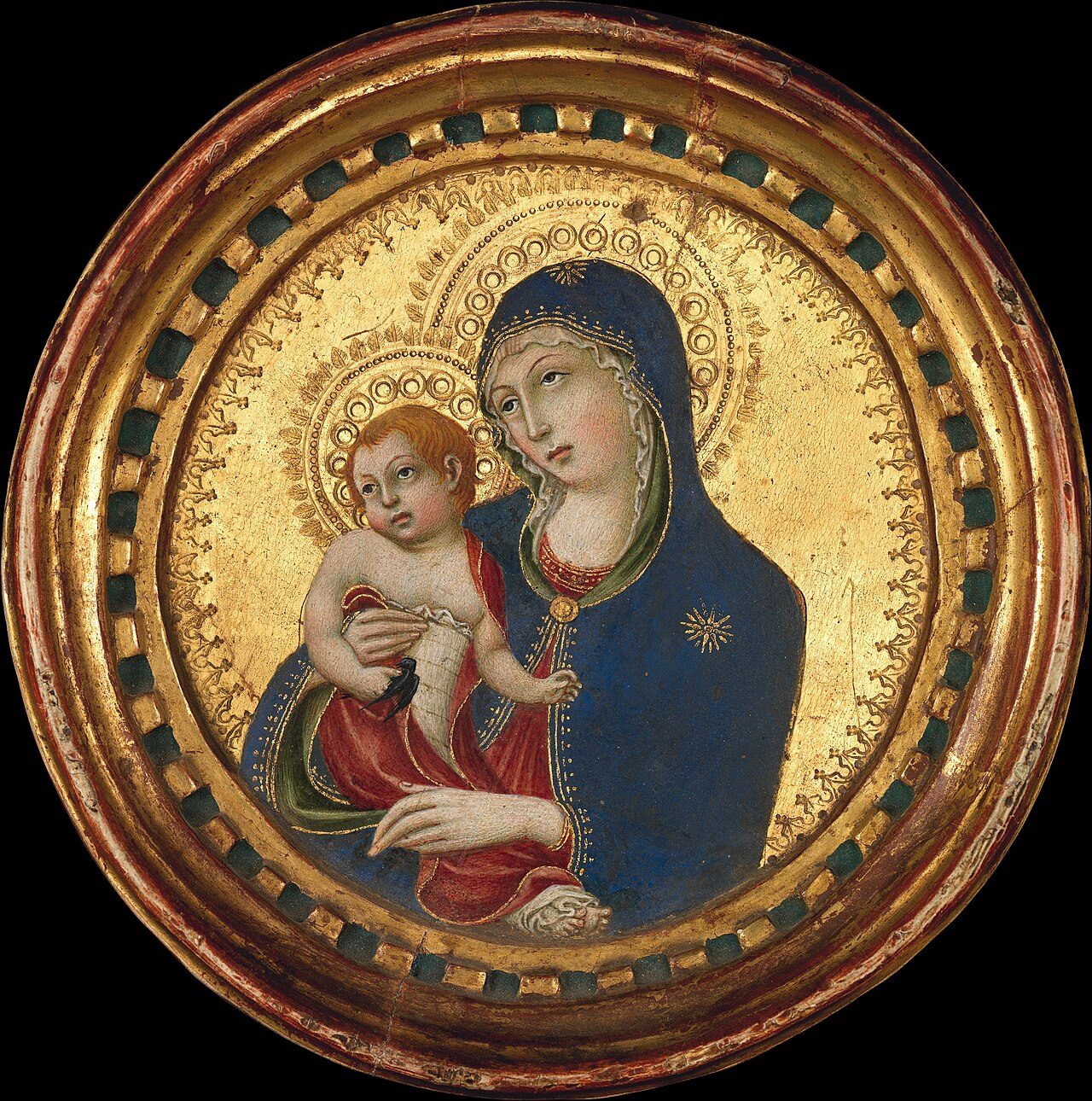
The tradition & historical record
7 min read · 2 sourcesGold ground (both a noun and adjective) or gold-ground (adjective) is a term in art history for a style of images with all or most of the background in a solid gold colour. Historically, real gold leaf has normally been used, giving a luxurious appearance. The style has been used in several periods and places, but is especially associated with Byzantine and medieval art in mosaic, illuminated manuscripts and panel paintings, where it was for many centuries the dominant style for some types of images, such as icons. For three-dimensional objects, the term is gilded or gold-plated. Gold in mosaic began in Roman mosaics around the 1st century AD, and originally was used for details and had no particular religious connotation, but in Early Christian art it came to be regarded as very suitable for representing Christian religious figures, highlighting them against a plain but glistering background that might be read as representing heaven, or a less specific spiritual plane. Full-length figures often stand on more naturalistically coloured ground, with the sky in gold, but some are shown fully surrounded by gold. The style could not be used in fresco, but was adapted very successfully for miniatures in manuscripts and the increasingly important portable icons on wood. 1
Effects
Recent scholarship has explored the effects of gold ground art, especially in Byzantine art, where the gold is best understood as representing light. Byzantine theology was interested in light, and could distinguish several different kinds of it. The New Testament and patristic accounts of the Transfiguration of Christ were an especial focus of analysis, as Jesus is described as emitting or at least bathed in a special light, whose nature was discussed by theologians. Unlike the main late medieval theory of optics in the West, where the viewer's eye was believed to emit rays that reached the viewed object, Byzantium believed the light proceeded from the object to the viewer's eye, and Byzantine art was very sensitive to alterations in the light conditions in which art was seen. Otto Pächt wrote that "medieval gold ground was always interpreted as a symbol of transcendental light. In the light transmitted by the gold of Byzantine mosaics there was eternal cosmic space dissolved at its most palpable in the unreal, or even, in the supernatural; and yet our senses are directly touched by this light." According to one scholar, "in a gold ground painting, the sacred image the Virgin, for example was firmly located on the material surface of the picture plane. She was, in this way, real, and the painting as much presented the Madonna as represented her ... [gold ground paintings] ...which blurred the distinction between the subject and its representation, were considered to have a physical and psychological presence like that of a real person." 1
Technique
In mosaics the figures and other areas in colours were normally added first, then the gold placed around them. In painting the opposite sequence was used, with the figures "reserved" around their outline in the underdrawing. 1
Mosaic
Gold leaf was glued to glass sheets about 8 mm thick with gum arabic, then a very thin extra layer of glass added on top for durability. In ancient times, the technique of creating "gold sandwich glass" was already known in Hellenistic Greece by around 250 BC, and used for gold glass vessels. In mosaics the top layer was applied by covering the sheet with powdered glass and firing the sheet enough to melt the powder and fuse the layers. In 15th-century Venice the method changed and the top layer of molten glass was blown onto the other two at high temperature. This gave a better bond at the weakest point of a tessera, when the gold joined the thicker bottom layer of glass. The sheets of glass were then broken into small tesserae. There are then two methods of fixing to the wet cement on a prepared wall, which already had a number of different layers of plaster, sometimes giving as much as 5 cm between the stone or brick of the wall and the glass. Either the tesserae were individually pushed into place onto the wall, which gave a slightly uneven surface with tesserae at different angles. These could to some extent be controlled by the artisan, and allowed for subtle shimmering effects as light fell onto the surface. The other method was to use a water-soluble glue to fix the tesserae face down to a thin sheet; in modern times this is paper. The sheet was then pressed into the cement on the wall, and when this had dried the paper and glue are wetted and scrubbed away. This gives a much smoother surface. 1
Painting
There are a number of different methods for applying the gold. The prepared surface of wood or vellum to be painted was underdrawn with at least the outlines of the figures and other elements. Then (or perhaps before) a layer of a reddish clay mix called bole was added. This gave depth to the gold colour, and prevented a greenish tinge that gold leaf on a white background tended to display. After several centuries, this layer is often revealed where the gold leaf has been lost. 1
On top of this the gold leaf was added. Most commonly this was done a whole "leaf" at a time, by the water gilding technique. The leaf could then be "burnished", carefully rubbed with either the tooth of a dog or wolf, or a piece of agate, giving a brightly shining surface. Alternatively mordant gilding was used, which needed to be left as unburnished leaf giving a more muted effect. After several hundred years the different appearance of the two is often greatly reduced for modern viewers. Shell gold was gold paint with powdered gold as its pigment. This was generally used only for small areas, usually details and highlights within the coloured parts of the painting. The name came from the habit of using seashells to hold mixed paint of all types when painting. "Gilded applied relief" was unburnished gold leaf applied by mordant gilding to a moulded relief surface of gesso or pastiglia. The flat surfaces might then be "tooled" with punches and line-making tools, to make patterns within the gold, very often on halos or other features, but sometimes all over the background. Several of these techniques might be used on the same piece to give a variety of effects. 1
Manuscripts
Any gold leaf was applied, and usually burnished, before painting began. According to Otto Pächt, it was only in the 12th century that Western illuminators learnt how to achieve the full burnished gold leaf effect from Byzantine sources. Previously, for example in Carolingian manuscripts, "a gold pigment of sandy, grainy character, with only a faint glitter, was used." The techniques in manuscript painting are similar to those for panel paintings, though on a smaller scale. One difference, both in Western and Islamic works, is that the gesso or bole ground is reduced in depth at its edges, giving the gold areas a very slight curve, which makes gold reflect the light differently. 1
The text above is adapted from the Wikipedia article “Gold ground”, available under the Creative Commons Attribution-ShareAlike 4.0 licence. 1
gold ground is gold leaf or paint applied as a background on a painting support such as panel or parchment, according to the structured record cited below. This entry was generated automatically from that record and has not yet been reviewed by a person familiar with the tradition. 2
The source record links this tradition to 2 external registers, which can be verified through the citation. 2