The tradition & historical record
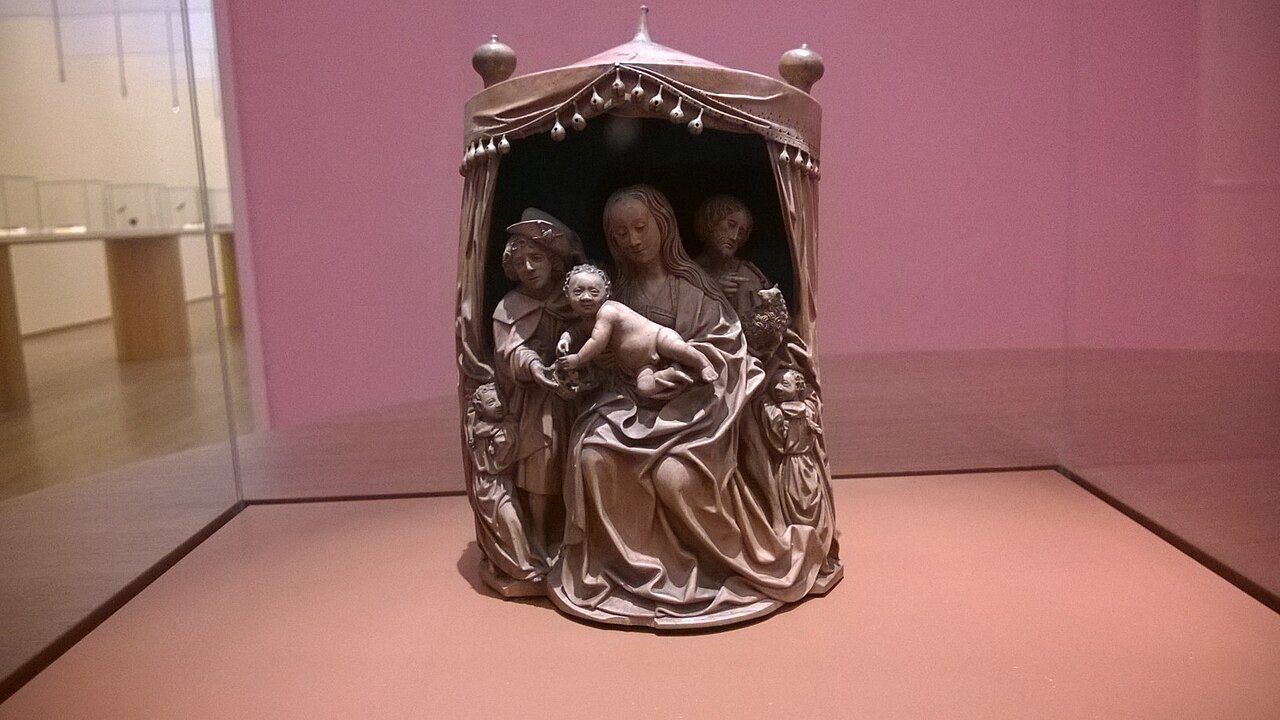
6 min read · 2 sourcesGothic boxwood miniatures are very small Christian-themed wood sculptures produced during the 15th and 16th centuries in the Low Countries, at the end of the Gothic period and during the emerging Northern Renaissance. They consist of highly intricate layers of reliefs, often rendered to nearly microscopic level, and are made from boxwood, which has a fine grain and high density suitable for detailed micro-carving. There are around 150 surviving examples; most are spherical rosary beads (known as prayer nuts), statuettes, skulls, or coffins; some 20 are in the form of polyptychs, including triptych and diptych altarpieces, tabernacles and monstrances. The polyptychs are typically 10–13 cm (3.9–5.1 in) in height. Most of the beads are 10–15 cm (3.9–5.9 in) in diameter and designed so they could be held in the palm of a hand, hung from necklaces or belts, or worn as fashionable accessories. Boxwood miniatures were highly prized in the early 16th century. Their iconography, form, and utility can be linked to medieval ivory carvings, as well as contemporary illuminated miniatures, altarpieces, panel paintings, sculpture, woodcuts, and engravings. They typically contain imagery from the life of Mary, the Crucifixion of Jesus, or vistas of Heaven and Hell. 1
Production
Boxwood is a dense hardwood with fine grain, resistant to splitting and chipping, making it ideal for wood carving. In the 16th century, wooden blocks used for woodblock printing were usually made of boxwood. The uses for boxwood were similar to those for ivory in medieval carvings, however boxwood was a far less expensive option. Designs were overseen by master craftsmen who must have had access to prints and woodcuts of contemporary works of art, and who were apparently influenced by diptych and triptych panel paintings. Boxwood grows slowly, and the trunk remains fairly narrow, a fact that limits the size of any carvings made from any single piece. The wood assumes an even, soft, and tactile surface if polished or frequently handled, such as was the case for prayer nuts. The wood loses its tactility when painted, explaining why most of the miniatures are in monochrome. Polychromy reduced the legibility of the carvings, "quite apart from the difficulty of effectively coloring such tiny and complex scenes" as the art historian Frits Scholten has noted. The tools used in production were similar to those used in the production of larger altarpieces, and included saws, planes, card scrapers, chisels, augers, braces and gimlets. Wood was cut into the required dimensions as blocks, after which the joints were carved out. Prayer beads were turned on a lathe. The woodcutters carved a single block of boxwood into a sphere, cut it in half, hollowed it out, and attached a fastening hinge and carrying loops. The carvings in the interiors were typically made separately from the smaller hemispheres and later fitted onto an outer shell. 1
Attribution and dating
Only one miniature is explicitly dated, a triptych (WB.232) in the Waddesdon Bequest at the British Museum is inscribed with "1511". A minority bear a coat of arms or other indications of origin or the source of commission. A carving in the Musée de Cluny, Paris, contains the letter "M", and must have been completed before the 1524 inventory of Margaret of Austria. Approximate dates for other examples can be inferred from the inventories of their owners. The rosary beads owned by Henry VIII of England must have been produced between his marriage to Catherine of Aragon in 1509 and his earliest efforts to separate from her in 1526. Most surviving boxwood miniatures are attributed to Northern Renaissance artisans working in the Burgundian and Habsburg Netherlands during the late 15th and early 16th centuries. Due to their quality and stylistic similarities to the full-sized Flemish and Brabantine altarpieces, they were for centuries assumed to originate from Southern Netherlands. However, more recent research has found that a majority of the early owners came from the northern provinces of Holland and Zeeland. There are examples from Italy, although according to Wilhelm Bode, "The broad monumental tendency of Italian art, especially in sculpture, seems to exclude a taste for daintily executed small works." German examples include a carving encased in a miniature skull, now in the Art Gallery of Ontario, which contains branchwork (Astwerk) of a type often found in contemporary German sculpture. That a majority of the miniatures share technical, stylistic, and thematic similarities, and could be considered as a near homogeneous group was first noted by the art historian Jaap Leeuwenberg. 1
Adam Dircksz
Because of shared characteristics, including the common use of horror vacui, similar spatial approaches and use of depth, as well as similar hinges and methods of construction, Leeuwenberg has suggested that production of a number of the miniatures was overseen by Adam Dircksz, Dircksz was first identified through a signature on a prayer nut now in the Statens Museum Copenhagen, reading "Adam Theodrici me fecit" (Adam Dircksz has made me). The Latin name "Adam Theodrici" may be translated into English as "Adam of Theodoric," but art historians usually use the Dutch version of his name. Although it was rare in the 16th century for artists to sign a work when done, it usually took the "me fecit" (made me) form, in effect making the object speak. Almost nothing is known about Dircksz except that the works were produced c. 1500–1530. The signature may indicate that he was a woodcutter, sculptor, medallist, or just simply the patron. Dircksz is thought to have been active between 1500 and 1530, and responsible for some sixty of the surviving examples. He may have led a workshop in the southern Netherlands, given that Flemish inscriptions appear on some of the carvings. Alternatively, it was located more northerly, possibly in the north of Brabant or at Delft in Holland. In any case, apart from Henry VIII and Catherine, all of the original owners come from the Netherlands. Regardless of the number of works that Dircksz or his workshop can be attributed with, art historians often debate what the artistic and technical precedents for the miniatures might be. 1
Iconography
Boxwood miniatures follow in the tradition of earlier Christian sculptures, including ivory diptychs, sculptures of the Virgin and Child, and relief carvings. They are similar in style to larger scale contemporary artworks, especially Flemish panel paintings, altarpieces, and sculpture, and they were conceived with similar religious outlook and conviction. Their iconography is often a mix of Old and New Testament scenes, with depictions of the Nativity and Passion being the most common. Although the central subject matter may be similar across many pieces, there are considerable differences in composition. Expansive depictions, such as of the Crucifixion, were sometimes influenced by contemporary literature. 1
Formats
The Metropolitan Museum of Art (MET) in New York broadly categorises the min… 1
The text above is adapted from the Wikipedia article “Gothic boxwood miniature”, available under the Creative Commons Attribution-ShareAlike 4.0 licence. 1
Gothic boxwood miniature is early 16th-century wood carving of the Low Countries, according to the structured record cited below. This entry was generated automatically from that record and has not yet been reviewed by a person familiar with the tradition. 2
The source record links this tradition to 1 external register, which can be verified through the citation. 2