The tradition & historical record
6 min read · 2 sourcesThe main Ancient Greek terms for riddle are αἴνιγμα (ainigma, plural αἰνίγματα ainigmata, deriving from αἰνίσσεσθαι 'to speak allusively or obscurely', itself from αἶνος 'apologue, fable') and γρῖφος (grîphos, pl. γρῖφοι grîphoi). The two terms are often used interchangeably, though some ancient commentators tried to distinguish between them. Riddles appear to have been a popular component of ancient symposia, and have at various points in the history of the Greek-speaking world also been a significant literary form. 1
Ancient riddles and riddle-culture
According to Naerebout and Beerden, 1
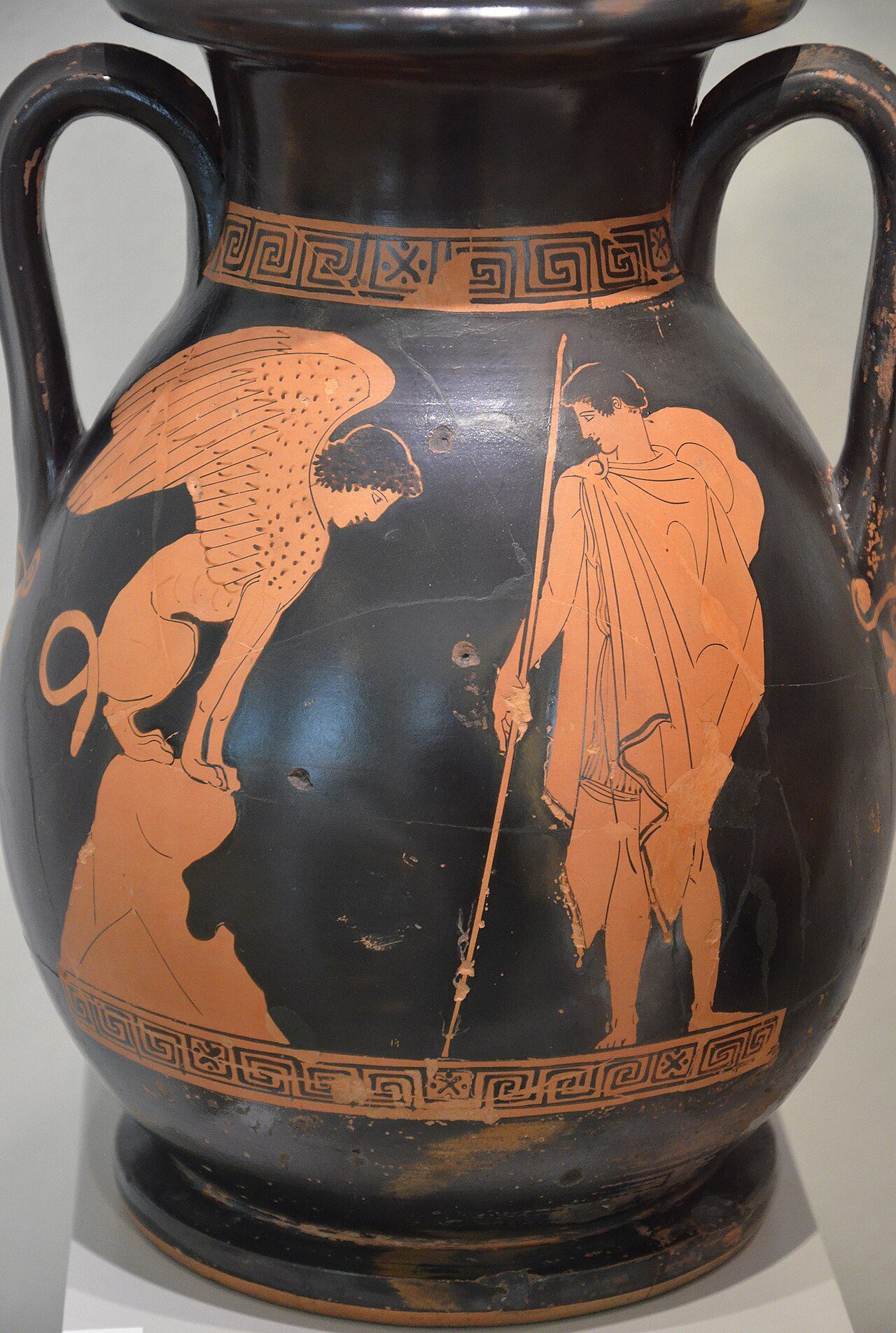
In the competitive Greek societies, words were a primary locus of competition: there can be no doubt about the popularity of wordplay in the Greek world. Riddles shared in this popularity: sympotic riddles are particularly well attested--it seems there was no symposium without a fair number of riddles. The contest-riddle was a known form of riddling. So riddling pervaded Greek life on many levels and during many occasions. A key source for this culture is Athenaeus. The most famous Classical riddle is the Riddle of the Sphinx: Oedipus killed the Sphinx by grasping the answer to the riddle it posed. This is just one example, however, of a considerable body of riddlic oracles in Ancient Greek literature: the gods' enigmatic answers to people asking questions of oracles appears to have been a significant literary trope, amongst other things a way to warn listeners of the perils and difficulties of seeking divine guidance. Heraclitus's enigmatic style overlaps to some extent with riddles, and indeed he told one story of Homer being presented with the following riddle by some boys: "What we have caught and what we have killed we have left behind, but what has escaped us we bring with us". (The answer is "lice".) Although Plato reports that ancient Greek children did indeed engage in riddle play (Republic 479c), he also recognized the important function that riddles can play in showing what cannot literally be said about ultimate truths (Letters, book 2, 312d). Aristotle considered riddles important enough to include discussion of their use in his Rhetoric. 1
Byzantine period
Literary riddles were also composed in Byzantium, from perhaps the tenth century with the work of John Geometres, into the fifteenth century, along with a neo-Byzantine revival in around the early eighteenth century. There was a particular peak around the long twelfth century: Christopher of Mytilene's στίχοι διάφοροι ('Various Verses') contain riddles, while John Mauropous, Michael Psellos, Basilios Megalomites, Theodore Prodromos, Eustathios Makrembolites, and Manuel Moschopoulos were all part of this movement. In form, 1
Byzantine riddles differ from classical ones more in terms of metre than in terms of subject-matter. [...] The structure of the riddle is basically the same. Most often a riddle is built around a paradoxical or ironical antithesis. The subject nearly always speaks of itself in the first person (in a personified form). Its speech usually begins with an explanation of its origins, provenance, birth, etc., in terms like: 'my mother was such-and-such, my father is so-and-so', or 'without my mother's help my father has given birth to me' (a very popular formula). At the end of its speech the subject will occasionally address the reader and dare him to use his brains and find the correct answer. In the Byzantine period, riddles were often copied by scribes into marginal or spare space in manuscripts. 1
Forms and subjects
The main edition of Byzantine riddles, by Čelica Milovanović, covers 214 of about 300 known riddles. Milovanović divides the corpus into the following genres, and identifies riddles on the following subjects (alongside 29 without a known solution [nos. 186-214]; the lists below give the numbers of each riddle in her edition). 1
True riddles (nos. 1–80)
An example of one of the true riddles is this, on a writing tablet: 'Wood gave birth to me and iron reformed me, and I am the mystic receptacle of the Muses. When shut I am silent, but I speak when you unfold me. Ares alone is the confidant of my conversation', where Ares is not only the name of a god, but a poetic term for a stylus. Acrobat 41 (?)42; Adam 1 2; alphabet 3; antidote 55; St Anne 4; angel 5; artichoke 6; baptism in the Jordan (?)29; bag 36; bird and egg 56; book 25; book (letter) 26; Cain and Abel (?)23; Christ and the Mother of God (?)7; Christ and the Samaritan Woman (?)75; clapper 24; cuttlefish 63; day and night (?)11; echo 22; Eve 15 16; female 17; fire 9, 18; fishermen and fish 59; funeral 68; gold 19; hawk 21; ink 34; Jacob's struggle with the angel (?)8; the prophet Jonah 53 54; king in a dungeon 27; lie 32; light 61; Lot's wife 16'; man (?)77 78; mill (?)37; mind 73 (?)74; the miracle of Moses on the Red Sea 79; month 35; musical instrument 38; Noah's Ark 39; olive 33; parchment 44; Penelope 43; pitcher 28; rainbow 13; rooster 45 46 47; salt 65 (?)66 67; scales 71; shadow 62; ship 30 (?)31; sleep 60; smoke 12; snail 57 57'; snow 64; soul (?)14; spider 40; sponge 69; stylus 48 49 (?)50 51; time 10; three boys in a fiery furnace (?)72; truth 20; the word of God (?)58; writing 52; writing tablets 70. 1
Letter riddles (nos. 81–144)
Byzantine riddles include many whose solution is arrived at through clues based on spelling. In some cases, this involves subtracting a letter from a word. Thus a riddle attributed to Basilos Megalomites says 'A tiny animal, I am not edible; my name consists of three letters only; should you take away the first of my letters, I'd be a large one, and ready for eating'. The answer is both μυς ('mouse') and υς ('hog'). Accent, stress 111; the prophet Amos 118; animals 93; apple 97; arrow 81; the Beginning 117; bread 143; breath 87; candle 128 129; dance 132; Delos 88; envy 95; Eros 91 92; eunuch (?)90; foot 112; fortification 141 (?)142; gate 102; goat 104; golden beekeeper 119; grass 137; hand 123; hard 136; hours 76; John the Baptist 100 101; joy 120 121; light 125 126 (?)127; lips/vagina 140; madness 107; mind 138 139; mockery 122; mouse 108 109; nail 113; neck 85; oak 144; only child 98; ox 83; pig 130; pillar 134; rope 105; rooster 115; sail 99; sand 113'; St Sava 124; seed 131; snow 133; soul 89; sparrowhawk 103; spring, well 96; sun 135; tent 80; thief 106; torrent 82; water 84; wool 86; weevil 94. 1
The text above is adapted from the Wikipedia article “Greek riddles”, available under the Creative Commons Attribution-ShareAlike 4.0 licence. 1
Greek riddles is riddles in Greek culture, according to the structured record cited below. This entry was generated automatically from that record and has not yet been reviewed by a person familiar with the tradition. 2
The source record links this tradition to 1 external register, which can be verified through the citation. 2