The tradition & historical record
6 min read · 2 sourcesGuanajuato handcrafts and folk art are mostly of European origin, although some indigenous work still survives in some communities. The most notable craft is the making of glazed mayolica pottery, followed by handmade traditional toys of various materials, especially a hard paper mache called cartonería. While handcrafts are not a large an industry here as in some other states, it does have several major handcraft markets which sell to tourists and foreign residents. Other handcraft traditions include wrought iron work, tin and glass, wood carving and leather working. 1
Overview
The handcrafts of Guanajuato are dominated by products and designs of European origin, such as glazed pottery, serapes, rebozos, tin wares, wrought iron and silver work, although what is made and how they look vary among the various communities of the state. They are more austere than those of other parts of Mexico which has a wider variety of brighter colors due to more indigenous influence. However, there are some crafts that show influence from the indigenous groups of the state (Otomi, Purhepecha and Chichimeca Jonaz, but they are very local. Unlike many other craft producing states, most Guanajuato artisans are full-time, with few alternation this activity with agriculture. However, the number of craftsmen is limited, and the state does not produce the same quantities as states such as Chiapas, Guerrero, Oaxaca or Michoacán. Like craftsmen from other areas, they can come from families who have producing a particular craft for generations or be new to the activity because of the popularity of Mexican handcrafts with tourists and collectors. In the first quarter of 2014, exports of Guanajuato handcrafts and furniture totaled 47.69 million USD; however, this number come from only forty enterprises which export. Many of the wares are sold in major outlets such as the city of Guanajuato and San Miguel de Allende, making them important destinations for handcraft shoppers. This is particularly true of San Miguel de Allende, as it is popular with US tourists and retirees. It not only sells wares from the state but from other parts of Mexico as well. One noted outlet for Guanajuato wares is the La Casa del Diseño en San Miguel de Allende, which has been in the Llamas family since the early 20th century. 1
Pottery
Guanajuato produces both glazed and unglazed pottery. In small indigenous communities, brown pieces with black decoration are produced. The city of Guanajuato makes black ceramics with gold decoration, a style introduced by an artisan named Behrens. It is not traditional but his work has been imitated, often not to the same quality. However, a glazed ware called mayolica is the most representative handcraft of the state. This pottery has its origins in the wares covered in a thick white glaze, brought to Mexico by the Spanish in the 16th century under the same name. Its making in Guanajuato was established in the colonial period, when it evolved to take on its own look. It flourished here because of the wealth that the state’s silver mines produced, allowing for the creation of luxury items as well as more common pieces. The technique, which has not changed much over the past 400 years, has been used to make plates, jars, storage containers, cups, mugs, bottles, flowerpots and more. Decorative motifs have not changed much since the colonial period either. Some of these designs were copied from Spanish pieces, but were adapted to Mexican tastes. Today designs generally include animals, plants and human (from popular culture and history), along with stripes and geometric patterns. The color scheme of mayolica ware is vivid but distinct from others in Mexico. The technique has the same origin as the better-known Talavera pottery of Puebla, and can have many of the same colors; however, the term talavera is legally reserved only for ceramics produced in certain parts of Puebla. While made in various parts of the Bajío region of the state, the two main centers of production and sale are Dolores Hidalgo and the city of Guanajuato. 1
Traditional toys
Many of Mexico’s traditional toys are not unique to the country, but they have developed their own styles. The most traditional are handcrafted from various materials and remain popular, although they have lost ground to mass-produced items. They have also become collector’s items, despite the fact that they are generally not marked by the maker. This also makes it difficult for Guanajuato toys having a denominación de origen despite the well-established tradition. The toys are made in various communities such as Guanajuato, San Miguel de Allende, Dolores Hidalgo, San Luis de la Paz, San Felipe Torres Mochas, San Francisco del Rincón, Silao, Irapuato, Celaya, Juventino Rosas and Jerúcaro. The main market for them is Celaya, especially those made of cartonería (a hard paper mache) or tin. The highest demand for this toys is for Christmas, Epiphany (Three Kings’ Day) and Corpus Christi. Many of the traditional toys are made from cartoneria, as Guanajuato is a major producer of items from this material. It is used to make dolls (Lupitas), charro figures, masks and more in towns such as San Miguel de Allende, Cortázar, Silao, Celaya, San Miguel de Allende and Juventino Rosas. Celaya is particularly noted for making cartonería toys, and Judas figures, as well as mojigangas and more. Toys, especially miniatures, are carved from wood, which includes dollhouse furniture, jointed animal figures and human figures such as boxers. Juventino Rosas and Silao are particularly noted for this work and one notable craftsman was Gumersindo España Olivares, whose work was commented upon by chronicler Juventino Rosas. Clay miniatures called arroz (rice) or arrocito (rice) are made, generally to form dish like objects for dollhouses. 1
Textiles
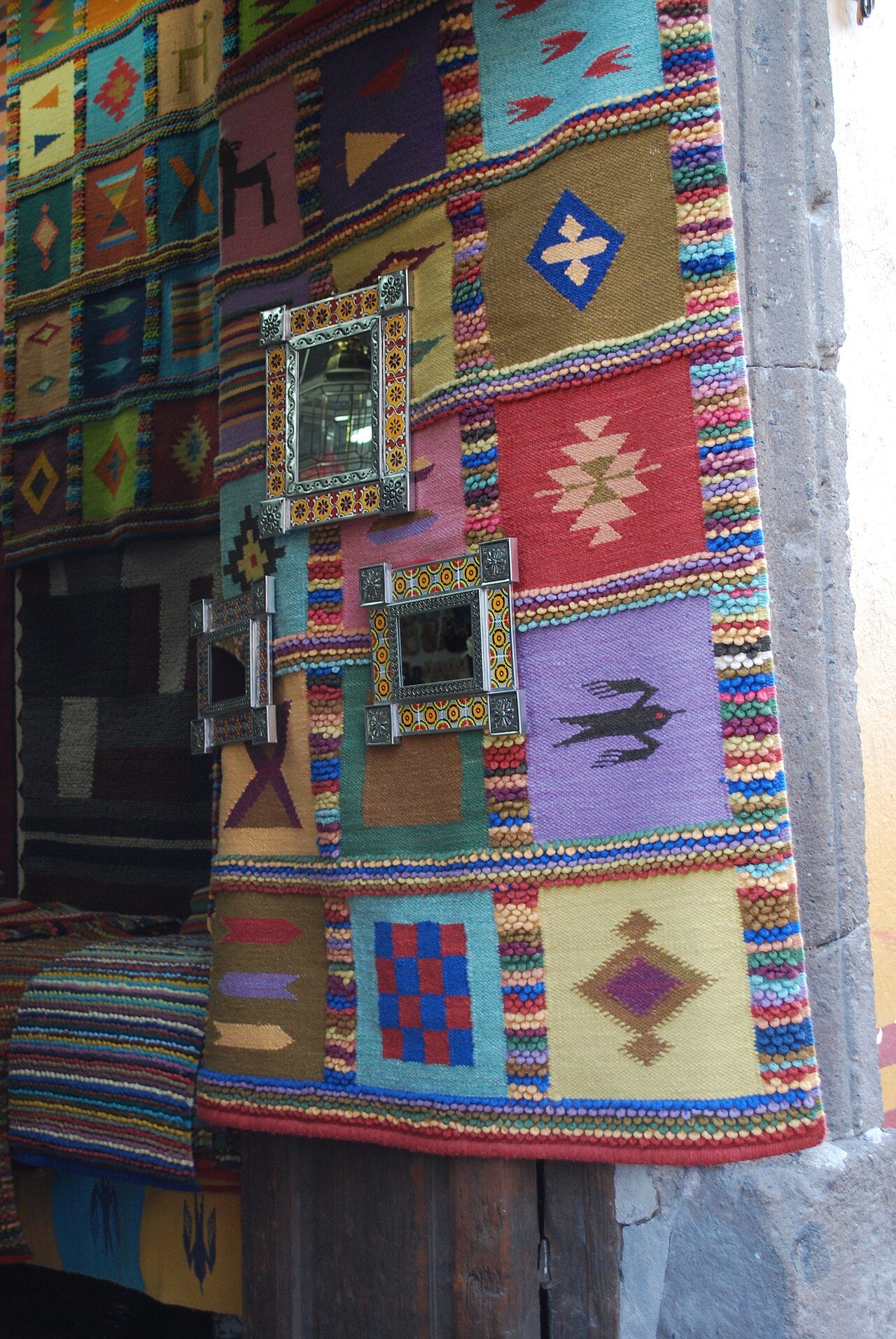
In the past, Guanajuato produced a significant amount of cotton textiles, especially rebozos. At its height, they were made in towns such as Valle de Santiago, Yurirapundaro, Leon, Uriangato and Moroleón, but today only León makes a small quantity of good quality cotton rebozos. Wool textiles remain important, woven or knitted in a number of towns. These include the high-quality sarapes woven in Coroneo and San Luis de la Paz. The ones from Coroneo are generally black and white, with diamond, circles and snake patterns. Wool is also woven to make jorongos, rebozos, rugs and cushions, and knitted to make sweaters, vests, socks, scarves, gloves and hats. Some workshop still work with old pedal looms. San Miguel de Allende makes sarapes with modern decorative designs in multiple colors. 1
Leather working
León is known for its leatherworking and shoe making. Although best known for shoes, a variety of handcrafted leather items are made such as huaraches, belts, bags and briefcases. Leather workshops in Leon also work in newer designs, especially in women’s handbags, such as the leather and woven palm bags are made in Leon at Estación del Ferrocarril de León and at Árbol de Viento. 1
The text above is adapted from the Wikipedia article “Handcrafts and folk art in Guanajuato”, available under the Creative Commons Attribution-ShareAlike 4.0 licence. 1
Guanajuato handcrafts and folk art is recorded in open cultural data. The structured record cited below does not describe the practice, and this entry has not yet been reviewed by a person familiar with the tradition. 2