The tradition & historical record
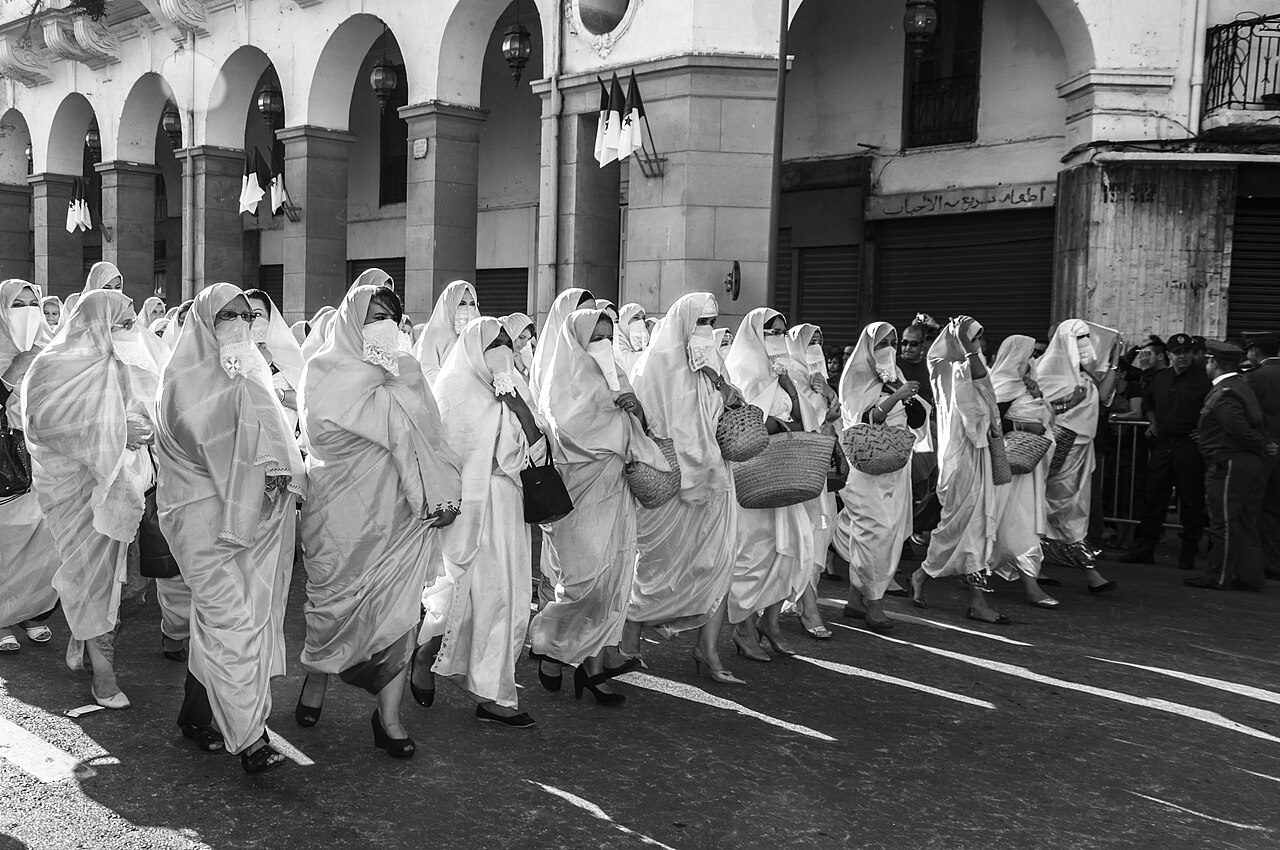
5 min read · 2 sourcesThe haik (also haïk; Arabic: حايك) is a traditional women's outer garment with a long documented history in Algeria. It consists of a large rectangular piece of fabric wrapped around the body and head over the wearer's clothing. In Algeria it was historically worn in a number of cities and regions, with differences in fabric, quality, terminology and manner of wearing according to locality and social circumstances. White became particularly associated with the haik in Algiers and other parts of northern and western Algeria. Historical examples were made from wool, cotton, silk or combinations of these materials. The National Bardo Museum in Algiers has devoted an exhibition and a 169-page publication to the garment under the title El haïk : identité algérienne au féminin ("The Haik: Algerian Identity in the Feminine"). 1
Etymology
The word haik is derived from the Maghrebi Arabic word ḥāyik, related to the Arabic verb ḥāka, meaning "to weave". The word entered French in a number of historical forms, including heque in 1654, hayque in 1667, alhaic and eque in 1670, haic in 1683 and hayc in 1686. The French word haïk was initially treated as feminine and later as masculine. 1
Sixteenth and seventeenth centuries
The haik and closely corresponding terminology are documented in descriptions of Algiers from the late sixteenth century. One important account appears in Topographia e Historia General de Argel, published in Valladolid in 1612 under the name of Diego de Haedo. Modern scholarship attributes the authorship of the work to the Portuguese cleric Antonio de Sosa, who had been held captive in Algiers. The account describes women in Algiers covering themselves outside the home with a white facial covering and an outer woollen or wool-and-silk cloth called a huyque, which was wrapped around the body and drawn over the shoulders and head. A modern study of Algerian clothing identifies Alhuyque among the historical forms of the name associated with descriptions of Algiers from this period. European visual sources also document the clothing of women in Algiers. Nicolas de Nicolay produced sixteenth-century representations of women of Algiers wearing enveloping outer garments. 1
In 1644, Wenceslaus Hollar produced the engraving Mulier habitans Algieri, depicting a woman from Algiers in an enveloping outer garment. The work is held by the British Museum. 1
Nineteenth century
During the nineteenth century, the haik was repeatedly documented by travellers, artists and writers describing Algeria. American painter and writer Frederick Arthur Bridgman, who spent extended periods in Algeria, described the haik in his 1890 book Winters in Algeria. He noted that women's haiks were made from materials including handwoven wool, silk and white cotton, with the quality of the fabric varying according to the wearer's means. Bridgman also described the outdoor dress of women in Algiers as predominantly white. Travel literature and other historical sources documented the haik in several Algerian cities and regions, including Algiers, Constantine, Sétif, Bou Saâda, Oran and Tlemcen, while recording regional differences in fabric and manner of wearing. 1
Twentieth century
The haik continued to be a prominent element of women's outdoor dress in Algeria during the early twentieth century. In Women of All Nations (1915), British anthropologist Thomas Athol Joyce described women in Algeria wearing a white haik over the head and body, accompanied in some cases by a smaller facial covering known as an adjar. The garment also became involved in wider debates concerning women, colonialism, modernity and Algerian identity during the French colonial period. Historian Sara Rahnama examines these debates in The Future Is Feminist: Women and Social Change in Interwar Algeria. One chapter, entitled "The Haik, the Hat, and the Gendered Politics of the New Public", examines the role of clothing in debates over tradition, modernity and the future of Algerian society during the interwar years. The haik also acquired political symbolism during the Algerian War. Scholarship on colonial Algeria has examined the veil as part of the conflict over women's visibility, colonial assimilation policies and Algerian resistance. The National Bardo Museum has likewise presented the haik as an element of Algerian national memory and has highlighted its role during the War of Independence. 1
Description and wearing
The haik consists of a large, unsewn piece of cloth wrapped around the body and head. Historical examples were produced from wool, cotton, silk and mixed fabrics. The garment was worn differently according to region. In Algiers, one method involved wrapping the material around the body and drawing the upper section over the head, while the edges were held beneath the chin. Earlier forms could also be secured using fibulae or pins. By the late nineteenth century, methods of wearing the haik in Algiers had changed and simpler methods of holding the fabric around the body became common. The style and quality of the haik could also communicate regional and social distinctions. Academic studies of Algerian clothing describe differences between the forms worn in central, western, eastern and southern parts of the country. 1
The text above is adapted from the Wikipedia article “Haik (garment)”, available under the Creative Commons Attribution-ShareAlike 4.0 licence. 1
Haïk is Traditional algerian women's garment, according to the structured record cited below. This entry was generated automatically from that record and has not yet been reviewed by a person familiar with the tradition. 2
The source record links this tradition to 3 external registers, which can be verified through the citation. 2