The tradition & historical record
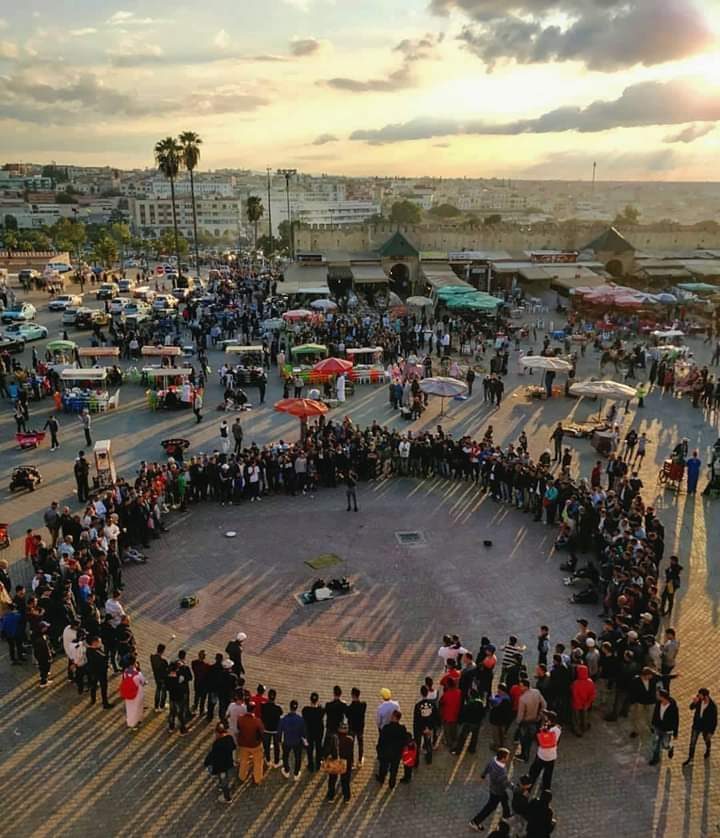
4 min read · 2 sourcesThe Halqa is a Moroccan concept that refers to people's theatre, an audience circle in the middle of which is the Helayqi (the artist who presents the show). This term has always been associated with the Moroccan intangible cultural richness of music, dance, singing, and storytelling. This type of social gathering slid into Moroccan popular culture over time, taking on a unique identity and becoming an intangible cultural asset. The Halqa is a custom that is deeply ingrained in Moroccan culture and is associated with a specific geographic area in Moroccan society. The anthropological interest in the traditions related to the location—dubbed the "place of memory," by Pierre Nora—rose from this. 1
Etymology
The word "Halqa" (plural: "Helaki"), which means "a circle" in Arabic, describes the arrangement of spectators or listeners (forming a circular shape) around an individual or group of individuals who are giving a speech or putting on a show. As a result, anything that has a round or semi-circular shape can utilize this name. It is well known in the Arab world that in the past, classes in the medrassa(schools) took the form of a circle, with students sitting in a semicircle around their teacher. The so-called Agora, a type of meeting, was also common in ancient Greek society. 1
History
According to certain historical accounts, the art of the halqa in Morocco began in the Jemaa el-Fna plaza of Marrakech in the 19th century AD before spreading to other cities. Particularly in its weekly Souq marketplaces, which attracted visitors from many neighboring cities. The origins of this kind of popular theater can be traced back to a long-standing ritualistic practice carried out by the local Arab, Jewish, or Berber communities. Experts in mime, storytelling, and acrobatics oversee the Halqa presentation, which takes place in major cities' markets and squares like Bab al-Saqma, Bab al-Futuh, Bab 'Ajisah in Fez, or al-Hedim square, Bab Mansour al-'Alaj in Meknes, and Jemaa el-Fna Square in Marrakech. The performances combine humor, drama, poetry, singing, dance, storytelling, and occasionally even audience participation. The Halqa frequently personifies Arab and Amazigh myths and legends that are influenced by the rich Moroccan culture. Regarding the Lbsat, or jokes or teases, they were originally just customary parodies meant to amuse the populace as well as entertain sultans and politicians. Examples of these were narrating the story of the Balarj through the melodies of the flute and the ringtones of the bendir. The first Lbsat theatrical concerts were held in front of Sultan Muhammad bin Abdullah in Morocco and served as an enjoyable means of instruction and sermonizing. 1
Definition
The traditional storytelling is defined as a narrative heritage that is part of Moroccan folk oral literature. It is transmitted from generation to generation orally, and is usually presented in the form of a story, a riddle or a fable, the purpose of which is to draw a lesson at the end. It is one of the most important means of transmitting culture and moral values to future generations. 1
Traditional storytelling in the Marrakesh community
The traditional storytelling is part of the identity of the Marrakchi community. The art of storytelling circulated among people, in a family form, before the Halqa of the storyteller of Jemaa El-Fna square became one of the most important constituent elements of the activities of this square. As a result, storytelling has become an important part of intangible heritage. 1
Lhlaiqi
He humorously and ironically speaks to all the generations gathered around him through valiant acts and skillfully constructed speech. In exchange for a few pennies or simply well wishes, he performs, talks a lot, speaks to animals who follow his instructions, makes fun of bystanders, plays the fool, discusses politics, mimics sounds, and performs gymnastics. On rare occasions, this figure is joined by female dancers, musical instruments, or non-human helpers like submissive dogs, domesticated snakes, or well-behaved monkeys and donkeys that are able to carry out amazing feats and comprehend the master's language. 1
The text above is adapted from the Wikipedia article “Halqa”, available under the Creative Commons Attribution-ShareAlike 4.0 licence. 1
Halqa is traditional audience circle in Morocco, according to the structured record cited below. This entry was generated automatically from that record and has not yet been reviewed by a person familiar with the tradition. 2