The tradition & historical record
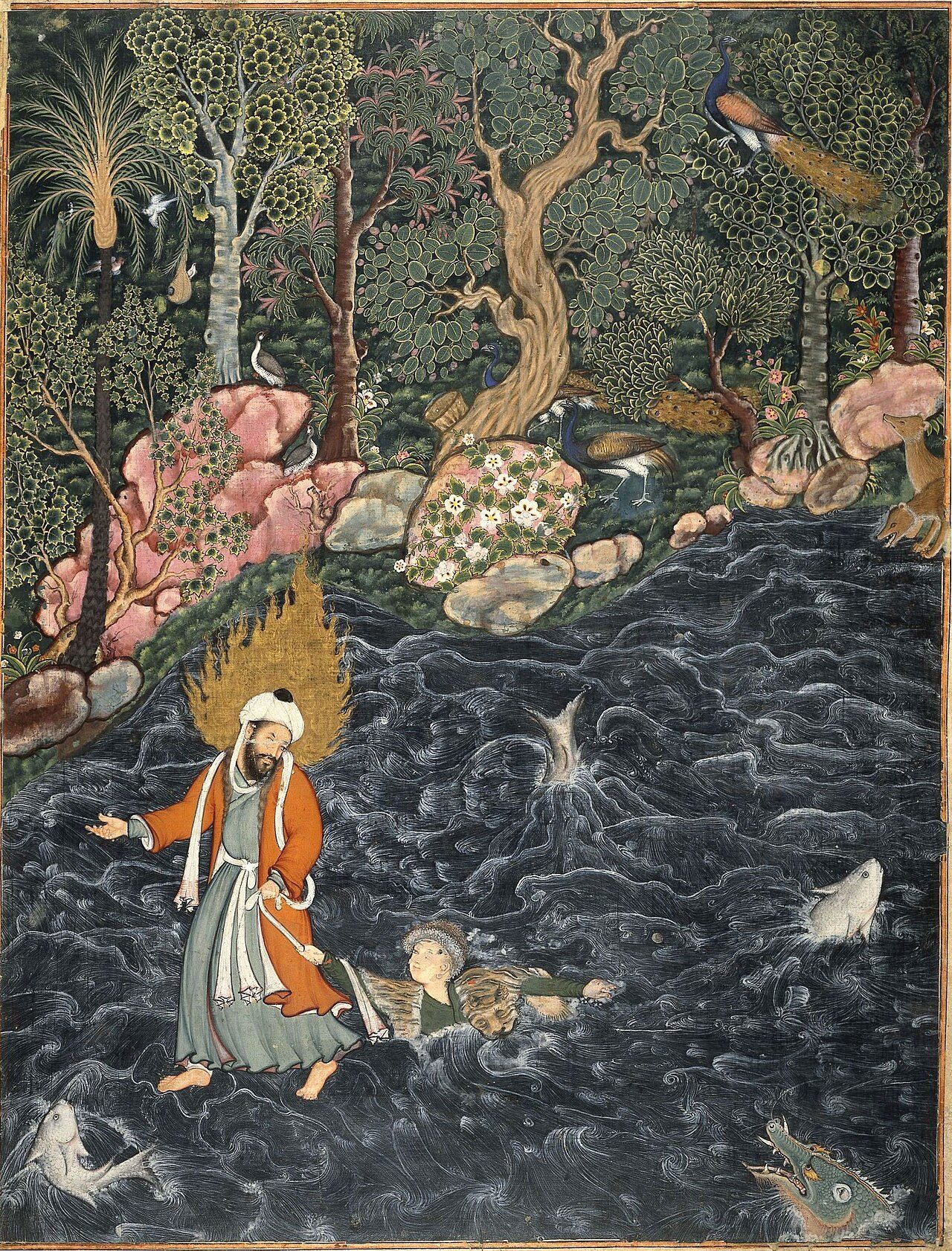
6 min read · 2 sourcesThe Hamzanama (Persian/Urdu: حمزهنامه Hamzenâme, lit. 'Epic of Hamza') or Dastan-e-Amir Hamza (Persian/Urdu: داستان امیر حمزه, Dâstân-e Amir Hamze, lit. 'Adventures of Amir Hamza') narrates the legendary exploits of Hamza ibn Abdul-Muttalib, an uncle of Muhammad. Most of the stories are extremely fanciful, "a continuous series of romantic interludes, threatening events, narrow escapes, and violent acts". The Hamzanama chronicles the fantastic adventures of Hamza as he and his band of heroes fight the enemies. The stories, from a long-established oral tradition, were written down in Persian, the language of the courts of Persianate societies, in multiple volumes, presumably in the era of Mahmud of Ghazni (r. 998–1030). In the West, the work is best known for the enormous illustrated manuscript, the Akbar Hamzanama, commissioned by the Mughal emperor Akbar about 1562. The written text augmented the story as traditionally told orally in dastan performances. The dastan (storytelling tradition) about Amir Hamza persists far and wide up to Bengal and Arakan, as the Mughal Empire controlled those territories. The longest version of the Hamzanama exists in Urdu and contains 46 volumes comprising over 45,000 pages. 1
Iranian origins
In Persian and Arabic, dastan and qissa both mean "story," and the narrative genre they refer to goes back to medieval Iran. William L. Hanaway, who has made a close study of Persian dastans, describes them as "popular romances" that were "created, elaborated, and transmitted" by professional storytellers. At least as early as the ninth century, the dastan was a widely popular form of story-telling. Dastan-narrators told tales of heroic romance and adventure—stories about gallant princes and their encounters with evil kings, enemy champions, demons, magicians, jinns, divine emissaries, tricky secret agents called ayyars, and beautiful princesses who might be human or of the pari ("fairy") race. Their ultimate subject matter was always simple: "razm o bazm," the battlefield and the elegant courtly life, war and love. Hanaway mentions five principal dastans surviving from the pre-Safavid period (that is, from the 15th-century and earlier): those that grew up around the adventures of the world-conqueror Alexander (Alexander Romance), the great Persian king Darius, the Prophet Muhammad's uncle Hamza, the legendary king Firoz Shah, and a trickster-hero named Samak the Ayyar. Of all the early dastans, the Hamza romance is thought to be the oldest. The romance of Hamza claims to go back to the life of its hero, Hamza ibn Abdul-Muttalib, the paternal uncle of the Prophet, who was slain in the Battle of Uhud (625 CE) by a slave instigated by a noblewoman named Hind bint Utbah, whose relatives Hamza had killed at Badr. Hind bint Utbah then went to the battlefield and mutilated the dead Hamza's body, cutting off his ears and nose, cutting out his liver and chewing it to fulfill the vow of vengeance she had made. 1
Spread down to the 15th century
The Hamza story soon grew, ramified, traveled and gradually spread over immense areas of the Muslim world. It was translated into Arabic (Sīrat Amīr Ḥamza); there is a twelfth-century Georgian version, and a fifteenth-century Turkish version twenty-four volumes long. Moreover, even in Iran the story continued to develop over time: by the mid-nineteenth century the Hamza romance had grown to such an extent that it was printed in an edition comprising about twelve hundred very large pages. By this time the dastan was often called Rumuz-e Hamza (The Subtleties of Hamza), and had also made itself conspicuously at home in India. 1
Persian
Annemarie Schimmel judges that the Hamza story must have been popular in the Indian subcontinent from the days of Mahmud of Ghazni in the early eleventh century. The earliest solid evidence, however, seems to be a late-fifteenth-century set of paintings that illustrate the story; these were crudely executed, possibly in Jaunpur, perhaps for a not-too-affluent patron. In 1555, Babur noted with disapproval that the leading literary figure of Khurasan had recently "wasted his time" in composing an imitation of the cycle. The great emperor Akbar (1556–1605), far from sharing his grandfather's attitude, conceived and supervised the immense task of illustrating the whole romance, producing a manuscript now known as the Akbar Hamzanama. As Akbar's court chronicler tells us, Hamza's adventures were "represented in twelve volumes, and clever painters made the most astonishing illustrations for no less than one thousand and four hundred passages of the story." The illustrated manuscript thus created became the supreme achievement of Mughal art: "of all the loot carried off from Delhi by Nadir Shah in 1739 (including the Peacock Throne), it was only the Hamza-nama, 'painted with images that defy the imagination,' that Emperor Muhammad Shah pleaded to have returned." The Hamza story left traces in the Deccan as well. One Persian romance-narrator, Haji Qissah-Khvan Hamadani, records his arrival in 1612 at Hyderabad, at the court of Sultan Abdullah Qutb Shah (1611-72) of Golconda. The Haji writes, "I had brought with me a number of manuscripts of the Rumuz-e Hamza. 1
Urdu
The Hamza romance spread gradually, usually in its briefer and less elaborate forms, into a number of the modern languages of South Asia. Pashto and Sindhi were particularly hospitable to the Hamza story, and at least in Pashto it continues to flourish today, with printed pamphlet versions being produced. In Bengali it was popular among Muslims as early as the 18th-century, in a long verse romance called Amirhamjar puthi, which its authors, Fakir Garibullah and Saiyad Hamja, described as a translation from the Persian. This romance was printed repeatedly in pamphlet form in the nineteenth century, and even occasionally in the twentieth. Various Hindi versions were produced too—but above all, the story of Hamza flourished in Urdu. The earliest Hamza retelling in Urdu exists in a late Dakhani prose version called Qissa-e Jang-e Amir Hamza (Qissa of the War of Amir Hamza) (1784). Very little is known about this work's background. It was probably translated from a Persian text. In 1801, Khalil Ali Khan Ashk, a member of the Hindustani department of the famous Fort William College in Calcutta, composed the earliest printed version of the dastan in Urdu: the 500-page Dastan-e Amir Hamza, consisting of twenty-two dastans, or chapters, grouped into four "volumes." Ashk claims that the story he is telling goes back to the time of Mahmud of Ghazni, in the early eleventh century; he implies that his present text is a translation, or at least a rendering, of the written, presumably Persian text that the distinguished dastan-narrators of Mahmud's court first set down. Ashk also claims that his sources, the narrators of Mahmud's court, compiled fourteen volumes of Hamza's adventures. However, we have no evidence that Mahmud of Ghazni ever sponsored the production of such a work. 1
1881–1905 Kishore Dastan-e Amir Hamza
In 1881, Nawal Kishore finally began publ… 1
The text above is adapted from the Wikipedia article “Hamzanama”, available under the Creative Commons Attribution-ShareAlike 4.0 licence. 1
Hamzanama is literary work, according to the structured record cited below. This entry was generated automatically from that record and has not yet been reviewed by a person familiar with the tradition. 2
The source record links this tradition to 14 external registers, which can be verified through the citation. 2