The tradition & historical record
3 min read · 2 sourcesHand knitting is a form of knitting, in which the knitted fabric is produced by hand using needles. 1
Flat knitting
Flat knitting involves working back and forth in rows to create a two-dimensional fabric. At the end of each row, the piece is turned and worked across. This technique produces individual fabric panels, which can be used for flat items such as scarves, shawls, dishcloths, blankets, and afghans. A single panel can be joined at the ends to form continuous or circular items like an infinity scarf, a snood scarf, or a knit hat. Multiple panels can be sewn together to construct garments such as sweaters (pullovers or jumpers), combining separate pieces for the back, front, and sleeves. Flat knitting can be done with straight needles or circular needles. 1
Circular knitting
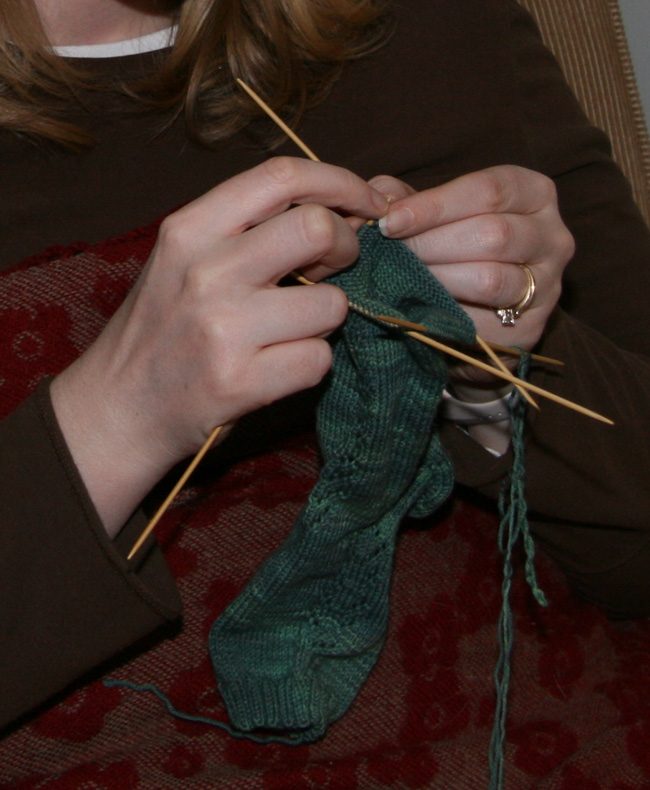
Circular knitting (also referred to as "knitting or working in the round") creates a seamless tube of knitted fabric. Knitting is worked in continuous rounds (the equivalent of rows in flat knitting). Circular knitting is used to create pieces that are circular or tube-shaped, such as hats, socks, mittens, sleeves, and entire sweaters. Originally, circular knitting was done using a set of four or five double-pointed knitting needles. In 1918, Frank L. Sessions was issued a patten for circular knitting needles. This invention made knitting tubular forms easier and more ergonomic. A circular needle resembles two short knitting needles connected by a cable of varying length between them. 1
Two-at-a-time
Two-at-a-time is a method of knitting two items, such as socks, at the same time. Traditionally, this was done on two sets of double-pointed needles. Other approaches include knitting on two circular needles, and the "magic loop" technique, which involves using a circular needle with a long flexible cable. 1
Felting
Felting is the hand-knitters' term for fulling, a technique for joining knitted or woven animal-fibres. The finished product is put in hot water and agitated until it starts to shrink. The result typically has a felt-like appearance but has reduced dimensions. Bags, mittens, vests, socks, slippers, and hats are just a few items that can be felted. 1
Needle felting
Needle felting is a technique used to add decoration to a knitted or felted piece, where raw roving is applied using a very sharp barbed felting needle by repeatedly piercing the roving and background together. Once washed in hot water, the appliqued decoration is fused with the background. Felted knitting can be cut with scissors without concern about fraying. 1
The text above is adapted from the Wikipedia article “Hand knitting”, available under the Creative Commons Attribution-ShareAlike 4.0 licence. 1
hand knitting is form of knitting, in which the knitted fabric is produced by hand using needles, according to the structured record cited below. This entry was generated automatically from that record and has not yet been reviewed by a person familiar with the tradition. 2
The source record links this tradition to 5 external registers, which can be verified through the citation. 2