The tradition & historical record
6 min read · 2 sourcesHardstone carving, in art history and archaeology, is the artistic carving of semi-precious stones (and sometimes gemstones), such as jade, rock crystal (clear quartz), agate, onyx, jasper, serpentinite, or carnelian, and for objects made in this way. Normally the objects are small, and the category overlaps with both jewellery and sculpture. Hardstone carving is sometimes referred to by the Italian term pietre dure; however, pietra dura (with an "a") is the common term used for stone inlay work, which causes some confusion. From the Neolithic period until about the 19th century such objects were among the most highly prized in a wide variety of cultures, often attributed special powers or religious significance, but today coverage in non-specialist art history tends to be relegated to a catch-all decorative arts or "minor arts" category. The types of objects carved have included those with ritual or religious purposes, engraved gems as signet rings and other kinds of seal, handles, belt hooks and similar items, vessels and purely decorative objects. 1
Scope of the term
Hardstone carving falls under the general category of glyptic art, which covers small carvings and sculpture in all categories of stone. The definition in this context of "hardstone" is unscientific and not very rigid, but excludes "soft" stones such as soapstone (steatite) and minerals such as alabaster, both widely used for carving, as well as typical stones for building and monumental sculpture, such as marble and other types of limestone, and sandstone. These are typically not capable of a fine finish in very small carvings, and would wear in prolonged use. In other contexts, such as architecture, "hard stone" and "soft stone" have different meanings, referring to actual measured hardness using the Mohs scale of mineral hardness and other measures. Some rocks used in architecture and monumental sculpture, such as granite, are at least as hard as the gemstones, and others such as malachite are relatively soft but counted as hardstones because of their rarity and fine colour. Essentially, any stone that is often used in jewellery is likely to count as a hardstone. Hard organic minerals such as amber and jet are included, as well as the mineraloid obsidian. Hardstones normally have to be drilled rather than worked with edged tools to achieve a fine finish. Geologically speaking, most of the gemstones traditionally carved in the West are varieties of quartz, including: chalcedony, agate, amethyst, sard, onyx, carnelian, heliotrope, jasper, and quartz in its uncoloured and transparent form, known as rock crystal. The various materials called jade have been dominant in East Asian and Mesoamerican carving. Stones typically used for buildings and large sculpture are not often used for small objects such as vessels, although this does occur. 1
Asia and the Islamic world
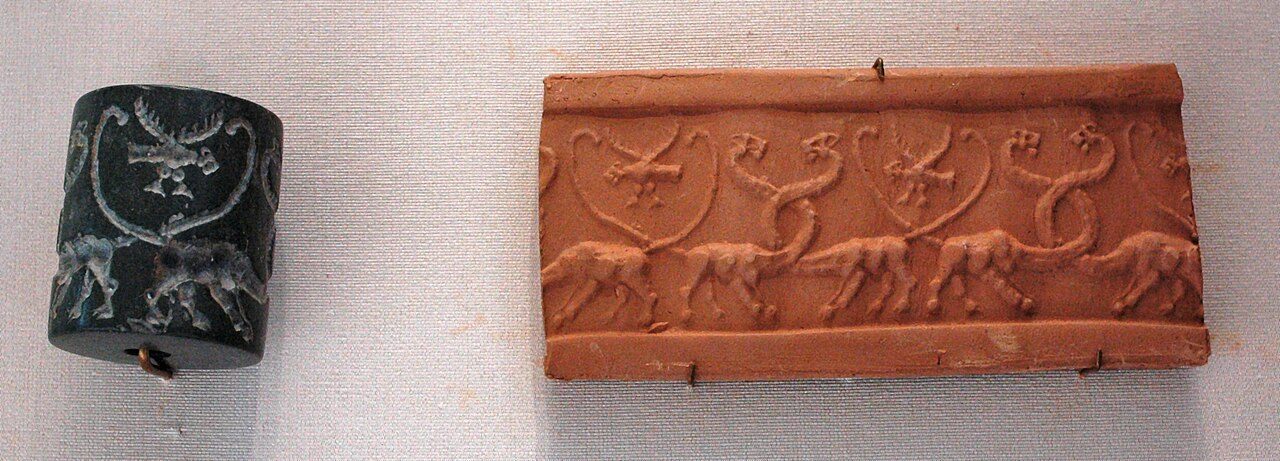
The art is very ancient, going back to the Indus Valley civilization and beyond, and major traditions include cylinder seals and other small carvings in the Ancient Near East, which were also made in softer stones. Inlays of semi-precious stones were often used for decoration or highlights in sculptures of other materials, for example statues often had eyes inlaid with white shell and blue lapis lazuli or another stone. Chinese jade carving begins with the carving of ritual objects, including blades for ji and dagger-axes clearly never intended for use, and the "Six Ritual Jades" including the bi and cong, which according to much later literature represented heaven and earth respectively. These are found from the Neolithic Liangzhu culture (3400-2250 BCE) onwards, and blades from the 2nd millennium BCE Shang dynasty on. Traditional Chinese culture attaches strong powers to jade; the jade burial suits in which aristocrats of the Han dynasty (206 BCE–220 CE) were buried were intended to preserve the body from decay. 1
The Chinese and other cultures often attributed specific properties for detecting and neutralizing poison to gemstones, a belief still alive in the European Renaissance, as shown by the works of Georgius Agricola, the "father of mineralogy". The English word "jade" derives (via the Spanish piedra de ijada) from the Aztec belief that the mineral cured ailments of the kidneys and sides. The Han period also saw the beginning of the tradition of fine decorative jade carving which has lasted until modern times, though the fine carving of other hardstones did not develop until the 17th century, and then appears to have been produced in different workshops and styles from those for jade. 1
Western traditions
From the early civilizations of the near East descended the carving of vessels and small statues in Ancient Greece, Ancient Rome and subsequent Western art, and also Sassanian Persia; however it is not very significant in the art of ancient Egypt, outside jewellery, as alabaster was a more common material. The jade signet ring of Tutankhamun has been called a "unique specimen" of Egyptian jade. Among the seals of the Minoan civilization during the Aegean Bronze Age, the Pylos Combat Agate dated circa 1450 BC is considered one of the finest works of that era, depicting naturalistic details of the human body comparable to works of the much later Classical period. Hardstone carving more often refers to vessels and figures than smaller engraved gems for seal rings or made as objéts d'art, which were the main artistic expression of hardstone carving in the Greek Classical and Hellenistic periods, and are regarded separately. From the Hellenistic period elaborate vessels in semi-precious stone begin to appear, mostly carved, some in cameo. The Cup of the Ptolemies and Farnese Cup both appear to have been made in Alexandria in Ptolemaic Egypt, as does a simpler fluted sardonyx cup in Washington which, like the Cup of the Ptolemies, was adapted to be a Christian chalice, and given elaborate gold and jewelled mounts by Abbot Suger for his Abbey of St Denis about 1140. The elaborately carved Rubens Vase, now in Baltimore, is thought to date from the 4th century. From the Late Antique plainer shapes for vessels appear, concentrating on showing the natural patterns of figured stones - survivals of these are hard to date, and mostly have survived in church treasuries with medieval mounts in goldsmith work. 1
Pre-Columbian and other traditions
Beyond the Old World, hardstone carving was important in various Pre-Columbian cultures, including jade in Mesoamerica and obsidian in Mesoamerica. Because its colour had associations with water and vegetation, jade was also a symbol of life to many cultures; the Maya placed jade beads in the mouths of the dead. Lacking iron, jade was the hardest material the Pre-Columbians were able to work with, apart from emery. A particular type of object running through the long history of Mesoamerican cultures from the Olmec to the Maya and Aztec is the face "mask" in semi-precious stone (they do not seem to have been for actually wearing), either carved from a single piece or of pieces inlaid on a backing of another material. 1
Techniques
Mo… 1
The text above is adapted from the Wikipedia article “Hardstone carving”, available under the Creative Commons Attribution-ShareAlike 4.0 licence. 1
hardstone carving is art of carving and engraving of stones or gems, according to the structured record cited below. This entry was generated automatically from that record and has not yet been reviewed by a person familiar with the tradition. 2
The source record links this tradition to 28 external registers, which can be verified through the citation. 2