The tradition & historical record
6 min read · 2 sourcesHispano-Moresque ware is a style of initially Islamic pottery created in Al-Andalus (Muslim Iberia), which continued to be produced under Christian rule in styles blending Islamic and European elements. It was the most elaborate and luxurious pottery being produced in Europe until the Italian maiolica industry developed sophisticated styles in the 15th century, and was exported over most of Europe. The industry's most successful period was the 14th and 15th centuries. Around 711, the Moors conquered part of Spain. Over the following centuries, they introduced two ceramic techniques to Europe: glazing with an opaque white tin-glaze, and lustreware, which imitates metallic finishes with iridescent effects. Hispano-Moresque wares use both processes, applying the paint as an overglaze which is then fired again. Lustreware was a speciality of Islamic pottery, at least partly because the use of drinking and eating vessels in gold and silver, the ideal in ancient Rome and Persia as well as medieval Christian societies, is prohibited by the Hadiths, with the result that pottery and glass were used for tableware by Muslim elites, when Christian medieval elites still normally used metal for both dishes and cups. At first centred on Málaga in the south, and using typical Islamic decoration, by the 15th century the largest production was around Valencia, which had long been reconquered by the Crown of Aragon. 1
Andalusian
The earliest major centre of fine pottery in Al-Andalus was Málaga in southern Spain. This is the major centre whose best-known wares were produced in a Muslim kingdom, as opposed to by a workforce presumed to be largely Muslim, or Morisco, under Christian rule. It was already celebrated for its gold lustrewares in the 14th century, and remained under Muslim rule until 1487, shortly before the fall of Granada, the last Muslim-ruled kingdom. Murcia, Almería, and perhaps Granada itself were also early centres of production. This pottery stayed much closer to styles seen in other Islamic countries, although much of it was being exported to Christian markets, as can be seen by the coats of arms on many pieces. Wares from Málaga were celebrated for their gold lustre on white enamel; they are distinguished from lustreware from Granada by the inclusion of blue paint with the gold lustre over a red clay that is characteristic of the region. At least one authority, Alan Caiger-Smith, excludes this pottery from the term "Hispano-Moresque", but most who use the term at all use it to include Malaga and other Andalusian wares from the Islamic period as well as the Valencian pottery. 1
Valencia
Valencia and its suburbs Manises and Paterna became important centres after potters migrated there from the south; the city had returned to Christian rule from 1238, and the immigration of skilled potters had been going on since at least the mid-14th century. In 1362 a cardinal commissioned floor-tiles in "obra de Malicha" ("Malaga work", probably meaning lustreware) for the Pope's Palais des Papes in Avignon from two masters in Manises, at least one with an Arabic name (though "Juan" as his forename). In 1484 a German traveller mentioned vessels "which are made by the Moorish potters". It seems that the local lords of Manises, the family of Buyl, encouraged the immigration, and may have acted as distributors and agents for the product; certainly when Maria of Castile, Queen of Aragon, wanted to order a large service in 1454, she wrote to the Buyl lord for him to arrange it. Several Buyl's had served as ambassadors, to Granada as well as Christian courts, giving them contacts in many markets. They seem to have taken a 10% royalty on all sales of pottery, and enjoyed a very high income from these. The largest deposit of Manises ware found by archaeology, apart from Manises itself, comes from Sluis in the Netherlands, then part of the territories of the wealthy Duchy of Burgundy. Manises also had clay and a cave nearby where a special sand used as a raw material for glazes was extracted. 1
Catalonia
Barcelona in Catalonia in northeastern Spain, which was under Muslim rule from 718 to 801, became a centre for pottery much later, probably receiving immigrant Christian potters from Al-Andalus, especially Valencia, during the later Reconquista period. It was important at first for wares resembling the brown and green decorated pottery of Paterna and in the 16th century for lustreware in a "warm silvery-gold", either reflecting different materials available, or a deliberate change in style. Several other towns began to produce lustreware in the same period. 1
Style
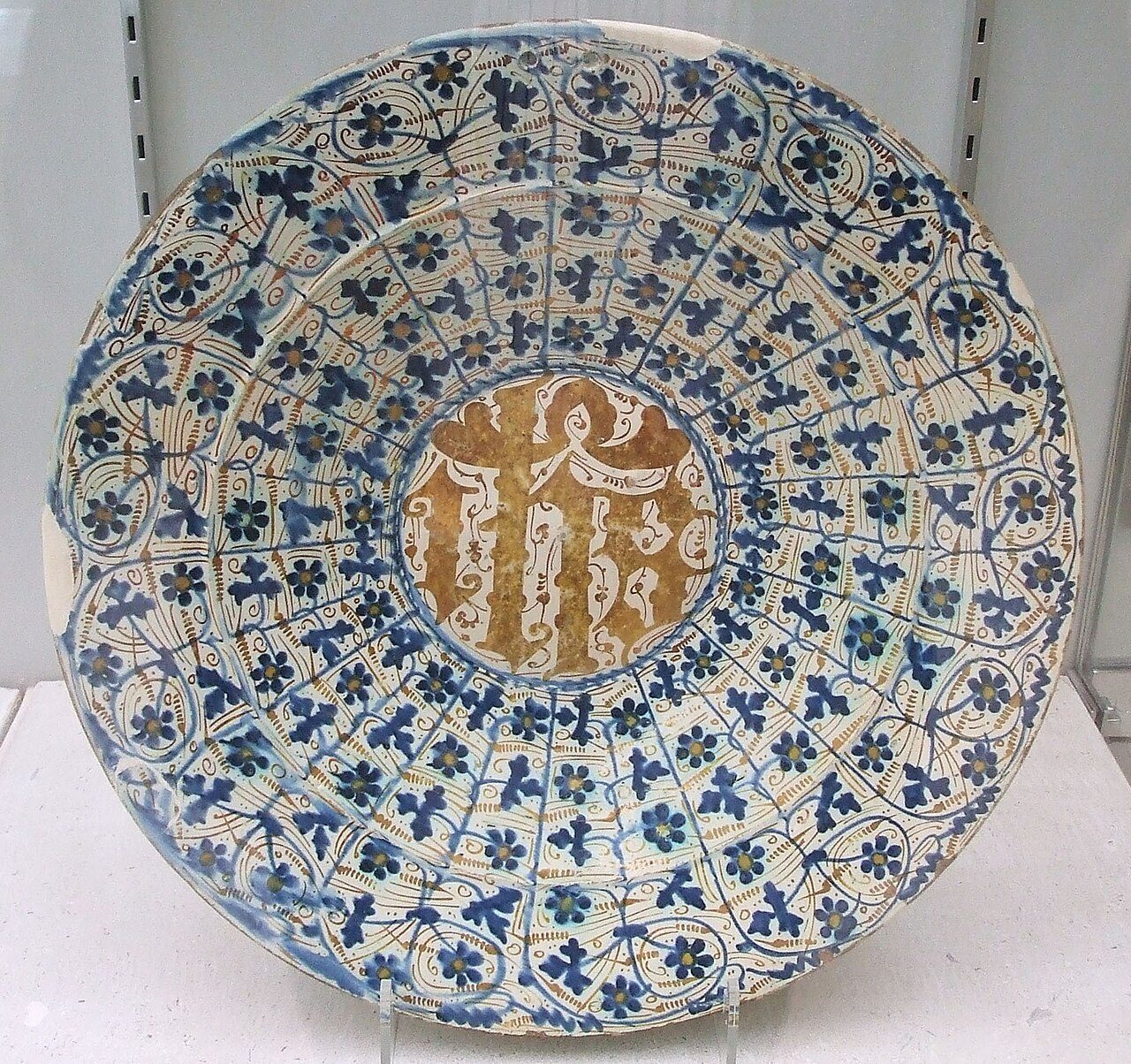
Much, in Valencia most, of the pottery was clearly made for a Christian market, as it includes coats of arms and other Western elements in the decoration. As well as the Christian IHS monogram in the centre, the naturalistic vine-leaf decoration of the dish shown at top is derived from Gothic art, probably via the border decoration of illuminated manuscripts. No pieces have yet been found that are signed (as many pieces from other Islamic regions are), and hardly any dated, so heraldry, especially when pieces are assumed to have been commissioned to celebrate a wedding, is important evidence for dating. The pieces "had to be spectacular and elegant, yet every category of vessel had a particular use" and on grand occasions all might be used, even though the largest platters spent most of the time on display propped up vertically on sideboards, as is shown in some contemporary paintings. Andalucian designs use a repertoire of geometric motifs, many of which probably had a religious significance of which Christian buyers remained unaware. These are usually contained in painted compartments. Pseudo-Kufic script is used, as well as inscriptions in proper Arabic. The dominant colours of gold and blue perhaps represent the sun and sky; other colours available, such as brown, green and yellow, are much less used. From about 1400 some elements, including the depiction of animals, which were probably first used for export wares seem to have become popular among local Muslim buyers also; two of the later "Alhambra vases" described above have pairs of gazelles. 1
Decline and revival
The Reconquista captured Valencia for the third and final time in 1238, and Malaga was one of the last cities to fall, after the Siege of Málaga (1487). The remaining Islamic Mudéjar and converted Morisco populations were expelled from Spain in 1496 and 1609 respectively, the latter Expulsion of the Moriscos involving a third of the population in the province of Valencia. But many of the craftsmen had long been Christians in any case, and the Hispano-Moresque style survived in the province of Valencia, although showing an immediate drop in quality. 1
The text above is adapted from the Wikipedia article “Hispano-Moresque ware”, available under the Creative Commons Attribution-ShareAlike 4.0 licence. 1
Hispano-Moresque ware is ceramics of Al-Andalus, according to the structured record cited below. This entry was generated automatically from that record and has not yet been reviewed by a person familiar with the tradition. 2
The source record links this tradition to 6 external registers, which can be verified through the citation. 2