The tradition & historical record
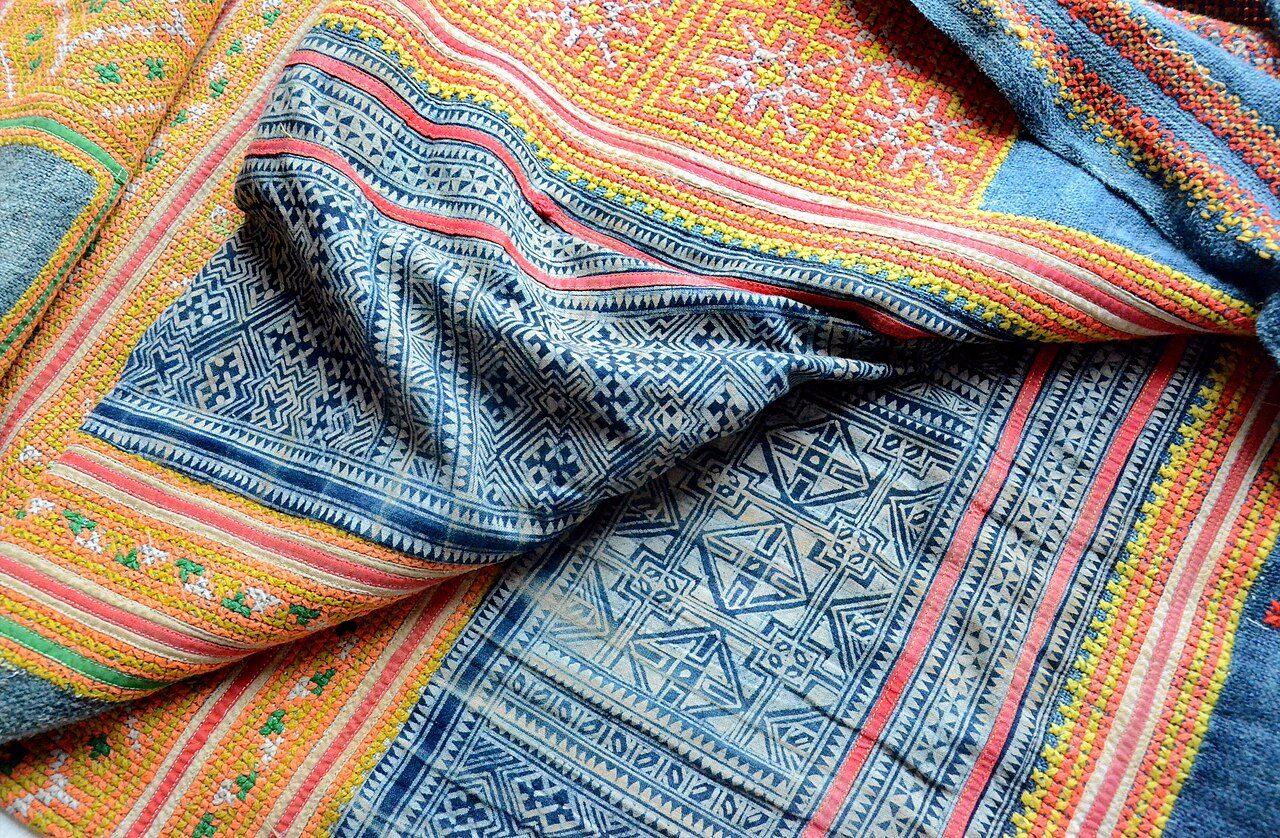
5 min read · 2 sourcesHmong textile art consists of traditional and modern textile arts and crafts produced by the Hmong people. Traditional Hmong textile examples include hand-spun hemp cloth production, basket weaving, batik dyeing, and a unique form of embroidery known as flower cloth or Paj Ntaub in the Hmong language RPA. The most widely recognized modern style of Hmong textile art is a form of embroidery derived from Paj Ntaub known as story cloth. Traditional Hmong textiles like Paj Ntaub play a significant role in Hmong daily life and are often directly associated with larger cultural concerns such as religion, gender, economics, and ethnic identity. Modern textiles like story cloths provide important historical and cultural context and are often used by scholars and educators within and outside of the Hmong community as a means to understand and engage with Hmong culture. 1
Hemp cloth
Most traditional forms of Hmong textiles were originally made with hand-spun hemp fabric. Hemp, a species of cannabis, would be grown in small family or community farming plots until the plants were ready to be harvested and processed by Hmong women. To prepare the hemp for textile production, the plants would be dried in the sun and the fibrous outermost layer of the plant stalk would be stripped and separated into short lengths of fiber which would then be joined by hand-twisting the individual pieces to create a length of material appropriate for weaving. The coarse hemp fabric would then be produced by hand using a large wooden loom. Due to the diasporic history of the Hmong, the inconsistent legality of marijuana, and the labor-intensive nature of hemp cloth production, most modern and contemporary Hmong textiles typically use either ready-made hemp fabric or other, lighter commercial fabrics. 1
Basket weaving
Hmong carrying baskets, known as kawm in the Hmong language RPA, were traditionally used to transport farming goods or as general containers and were hand-made using available materials like bamboo and rattan (a type of tree palm). Basket weaving as a Hmong textile art is unique in that it is often produced by men. Although scholarship is limited in terms of Hmong basketry, examples can often be seen on display in folk art museums or depicted in Hmong story cloths. 1
Batik
Batik is a resist-dyeing technique in which hot wax is applied to cloth to create a pattern. The cloth is then dyed, typically using a single color (traditionally indigo), and the wax is removed. The waxed areas of the cloth resist the dye and the desired pattern remains. Traditional Hmong batik, known as Paj Ntaub nraj ciab/cab in the Hmong language RPA, is created using white hemp fabric, beeswax, indigo dye, and a tjanting tool. Aesthetically, Hmong batik is similar to other Hmong visual design and often features bold and contrasting geometric designs. These designs are achieved by holding the handle of the tjanting tool with the copper nib positioned closer to the wrist which allows straight strokes to be drawn. To reveal the designs, the fabric is soaked in indigo dye several times and left to dry before being boiled in water to melt off the wax. This technique is utilized by Blue and Green Hmong to decorate skirts, baby carriers, and other typical Hmong textiles but is not seen amongst White Hmong. 1
Paj Ntaub or Flower cloth
Paj Ntaub or flower cloth is a traditional form of Hmong embroidery practiced exclusively by women. This unique form of embroidery utilizes a wide variety of stitching techniques such as cross-stitch, chain-stitch, running-stitch, and satin-stitch and often features applique, reverse-applique, and batik elements in the design. Aesthetically, traditional Paj Ntaub is composed of highly stylized, non-representational geometric motifs that are developed both collectively and individually and vary according to region and tribe. These designs are often used to decorate traditional Hmong clothing including skirts, head dresses, shirt collars, and sashes worn by both men and women and other textiles such as baby carriers, pillows, and funerary textiles. 1
Death and religion
In traditional Hmong culture, the women prepare traditional funeral textiles adorned with Paj Ntaub for their close relatives such as their parents, in-laws, and spouse. This is typically done well in advance of their relatives' death and are gifted to them as a token of filial endearment. These special textiles consist of a funeral robe, known as a tsho laus or khaub ncaws laus, a large sailor collar called a dab tsho laus attached to the back of a White Hmong woman's funeral robe, a funerary pillow square called a noob ncoos for the Blue and Green Hmong, and a pair of slippers called khau noog in the Hmong language RPA.It is believed in traditional Hmong culture that dressing the deceased in these Paj Ntaub textiles will allow them to join and be recognized by their deceased ancestors in the spirit world. The symbolic meaning behind specific motifs and patterns seen on funeral textiles have a variety of interpretations, however, conventions are generally held about the size, cut, and colors used for them by each Hmong clan or subgroup. Regardless of these diverse interpretations, the textiles are used very practically to care for the body of the deceased. For example, in the White Hmong funeral tradition, the large sailor collar known as a dab tsho laus is sometimes used to support the head of the deceased while transporting the body to the burial site. In the Blue and Green Hmong funeral tradition, the funerary pillow square, known as a noob ncoos, acts as a cushion for the head of the deceased. 1
The text above is adapted from the Wikipedia article “Hmong textile art”, available under the Creative Commons Attribution-ShareAlike 4.0 licence. 1
Hmong textile art is Asian textile art, according to the structured record cited below. This entry was generated automatically from that record and has not yet been reviewed by a person familiar with the tradition. 2
The source record links this tradition to 1 external register, which can be verified through the citation. 2