The tradition & historical record
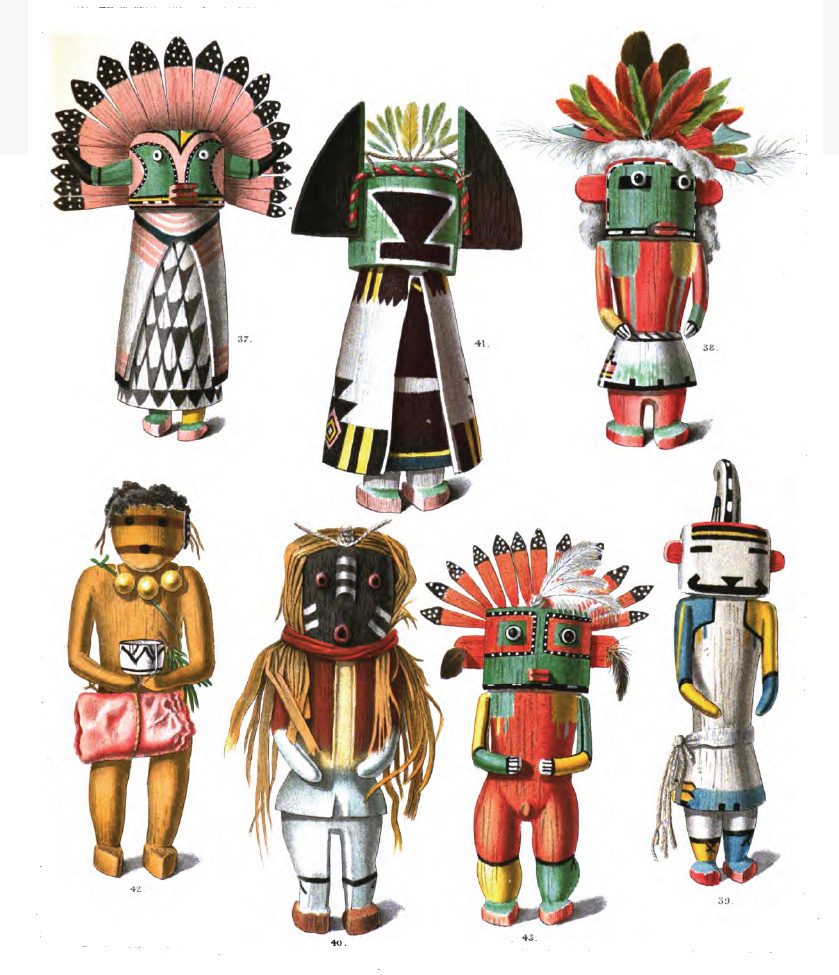
5 min read · 2 sourcesHopi kachina figures or Hopi kachina dolls (also spelled katsina (plural: katsinam); Hopi: tithu or katsintithu) are figures carved, typically from cottonwood root, by Hopi people to instruct young girls and new brides about kachinas or katsinam, the immortal beings that bring rain, control other aspects of the natural world and society, and act as messengers between humans and the spirit world. These figures are still made and used within the Hopi community, while other kachina figures are carved and sold as artworks to the public. Other Pueblo peoples and later Navajo sculptors carve figures similar to kachina tihu as artworks. 1
Cultural context
Hopi people live primarily on three mesas in northeastern Arizona, about 70 miles from Flagstaff. In Hopi cosmology, the majority of katsinam reside on the Humphreys Peak, approximately 60 miles west of the Hopi Reservation. Each year, throughout the period from winter solstice to mid-July, these spirits, in the form of kachinas, come down to the villages to dance and sing, to bring rain for the upcoming harvest, and to give gifts to the children. The katsinam are known to be the spirits of deities, natural elements or animals, or the deceased ancestors of the Hopi. Prior to each kachina ceremony, the men of the village will spend days studiously making figures in the likeness of the katsinam represented in that particular ceremony. The figures are then passed on to the daughters of the village by the Giver Kachina during the ceremony. Following the ceremony, the figures are hung on the walls of the pueblo and are meant to be studied in order to learn the characteristics of that certain Kachina. Edward Kennard, co-author of Hopi Kachinas, says concerning the purpose of the Kachina figure, "Essentially it is a means of education; it is a gift at dance-time; it is a decorative article for the home, but above all it is a constant reminder of the Kachinas." 1
History of the Kachina figure
Except for major ceremonial figures, most kachina figures originated in the late 19th century. The oldest known surviving figure dates back to the 18th century. It was a flat object with an almost indistinguishable shape that suggested a head and contained minimal body paint. Kachina figures are generally separated into four stylistic periods: the Early Traditional, Late Traditional, Early Action, and Late Action periods. 1
Early Traditional era (1850–1910)
The early forms of the kachina figure belonged to the Early Traditional Period. Only one piece of cottonwood root was used to carve the body, although facial features made from varying sources were occasionally glued on. The figures were no taller than 8 to 10 inches and only somewhat resembled human proportions. Sandpaper and wood finishing tools were generally unavailable to the Hopi in this era. In order to smooth out the rough carved surfaces, the figures were rubbed smooth with sandstone and the flaws in the cottonwood root were coated with kaolin clay. Their surfaces were not as smooth as in later periods, and the paint was made of non water-resistant mineral and vegetable pigments. The figures in this period were stiff and only meant to be hung on the wall after ceremonies. Starting around 1900, the figures began to have a more naturalistic look to them as a result of the white man’s interest and trade. The price of dolls in this period was on average about $0.75 (adjusted for today’s currency). 1
Late Traditional era (1910–1930)
During the Late Traditional Period subtle changes began to take place towards the creation of more realistic–looking figures. They were more proportional and the carving and painting was much more detailed. Eastern tourist attraction to the Hopi reservation increased in popularity from 1910–1920 due to the increased interest in Native American culture. The elders restricted the tourists from seeing the religious kachina ceremonies, and consequently there was a notable decline in figures carving for commercial purposes. 1
Early Action era (1930–1945)
In the beginning of the 20th century, oppressive agents such as Charles Burton tried to restrict the Hopis' religious and cultural rights. However, in 1934, due to the Indian Reorganization Act, the Hopi people got back their religious freedom, and this thus renewed their interest in kachina figures carving. The dolls began to have a slightly different look than that of the stiff figures from earlier periods. The arms were starting to become separated from the body and the heads became slightly overturned, putting the dolls in more of an action pose. Commercial and poster paints were used and the regalia became more organic, as some of the dolls were dressed in real clothing instead of clothing that was merely painted on. The average price of a kachina figure during this period was about $1 an inch. 1
The text above is adapted from the Wikipedia article “Hopi Kachina figure”, available under the Creative Commons Attribution-ShareAlike 4.0 licence. 1
Hopi Kachina doll is dolls in the Hopi religious tradition, according to the structured record cited below. This entry was generated automatically from that record and has not yet been reviewed by a person familiar with the tradition. 2
The source record links this tradition to 5 external registers, which can be verified through the citation. 2