The tradition & historical record
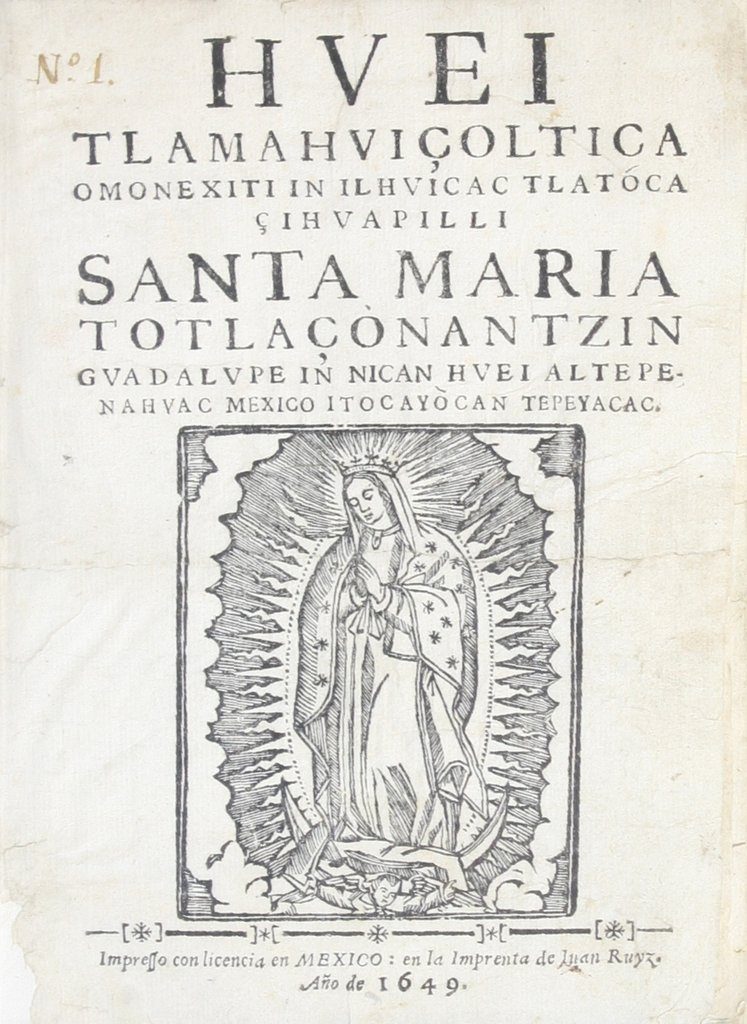
6 min read · 2 sourcesHuei Tlamahuiçoltica ("The Great Event") is a tract in Nahuatl comprising 36 pages and was published in Mexico City, Mexico, in 1649 by Luis Laso de la Vega, the vicar of the chapel of Our Lady of Guadalupe at Tepeyac outside the same city. In the preface Luis Laso de la Vega claimed authorship of the whole work, but this claim is the subject of an ongoing difference of scholarly opinion. The tract is written almost entirely in Nahuatl and includes the Nican Mopohua, which narrates the Marian apparitions of Our Lady of Guadalupe at Tepeyac in 1531. It also includes the Nican Motecpana, which enumerates the miracles attributed by some to Fernando de Alva Ixtlilxóchitl; Luis Laso de la Vega does not mention either him or Antonio Valeriano as authors. The traditions recounted in the 1649 tract were first published in the Spanish book Imagen de la Virgen María, Madre de Dios de Guadalupe ("Image of the Virgin Mary, Mother of God of Guadalupe"), written by Miguel Sánchez in 1648 and being a theological dissertation linking the Guadalupan Image to Revelation 12:1. There is an equally contentious and much shorter manuscript in Nahuatl preceding the Nican Mopohua, which is titled the Inin Huey Tlamahuiçoltzin ("This Is the Great Marvel"), also known as "The Primitive Relation" of the apparitions. It is in The National Library of México. 1
Preface
The first section, a preface, is titled in Nahuatl "Noble Queen of Heaven, Forever Virgin, Mother of God". In it Lasso addresses the Virgin directly, and after an introduction of four to five lines proceeds to the reason why he took up Nahuatl in order to publish the history of the apparitions: 1
"You yourself spoke in Nahuatl to a poor Indian and painted yourself in his ayate, thus showing you are not displeased with many languages". "That the Indians of this land remember and keep in their language all you did for them and how it happened". "Christ on the Cross had His sentence in three languages". "You were with the apostles in Pentecost to receive the Holy Spirit" (a remembrance of the miracle of Diaspora Jews understanding each in his own language Acts 2:1–6) The preface ends with a short prayer in two lines pleading the Virgin's intercession for the assistance of the Holy Spirit in writing in Nahuatl. 1
Nican Mopohua
The second section, the Nican Mopohua ("Here Is Recounted") constitutes the narrative in Nahuatl of the apparitions, including the Virgin's apparition to St. Juan Diego's uncle Juan Bernardino. It is probable that the Nahuatl manuscript used by Lasso was the original by Valeriano, which is presently in the New York Public Library. Most authorities, including Edmundo O'Gorman, agree on this and on the dating of its authorship, namely c. 1556. 1
Content, style, and structure
The Nican Mopohua, which has been described as "A Jewel of Nahuatl literature", whose beauty and depth of thought make it worthy of renown the world over, relies on the beauty of the dialogues between the Holy Virgin and St. Juan Diego to express the most tender feelings to be found in world literature. Her promise to grant the wishes of the locals who beseech her is prominent, as is her demand for a temple on the very spot. The Nican Mopohua section by Valeriano of Lasso de la Vega's account is related in a poetic style, typical of the most elegant formal classical Nahuatl in its full beauty. The other parts are clearly different and with greater Spanish influence. The Nican Mopohua is unique for presenting a blending between the deepest Nahuatl thought with the Christian message. Scholar Richard Nebel insists that the Nican Mopohua is not necessarily a historical account, but a document designed to convert the Nahua and "bring about a state of harmony between different peoples, cultures, and religions, in order that, during a period of radical change, new possibilities of coexistence could be envisaged". It is precisely on this point that a difference exists with other dialogues which invoke elements of the dramatic writings (called autos), many of which were used for the purposes of proselytization during the Spanish colonization of Mexico. The autos reflect only Spanish Christian thinking, while the main characteristic of the Nican Mopohua is the exceptional blending of the best of two cultures. Leon-Portilla suggests, "That there is in [the Nican Mopohua] an exposition of key ideas in Christian thinking, wrapped up in the language and form conceived from the world of the Nahua. 1
Critical response
In authorizing the publication of the Huei tlamahuiuçoltica, in an "opinion" published as part of the front matter to the main text, Baltazar González, a Jesuit professor, Nahuatl speaker, and contemporary of Laso de la Vega, asserted that the Huei tlamahuiuçoltica "...agrees with what is known of the facts from tradition and the annals." Some contemporary scholars have written skeptical or critical texts about the origin of the image and the texts. Sousa, Poole and Lockhart, in their 1998 edition and translation, suggested that the most reasonable hypothesis was that Laso de la Vega's core narrative was based on Sánchez's earlier Image of the Virgin Mary, with an early 17th-century engraving by Samuel Stradanus as a secondary source. Today, Catholics, especially those in Mexico and the rest of Latin America, accept the Nican Mopohua, whether written by Laso de la Vega, Valeriano, or another, unknown author, as the primordial telling of the Virgin Mary's personal evangelism to the indigenous peoples of the Americas. 1
The Nican Mopohua and liberation theology
According to Cambridge professor of Mexican history David Brading, "...the romantic engagement with folk culture that characterized the revolutionary years was eventually taken up by the clergy. Equally important, the effect of the Second Vatican Council (1962–1965) and the rise of Liberation Theology was to convert the text into a potent catechetical instrument, since its emphasis on a poor peasant and his willing acceptance of the Virgin's message, not to mention [Bishop] Zumárraga's initial disdain, responded perfectly to the new-found 'option for the poor'." 1
The text above is adapted from the Wikipedia article “Huei tlamahuiçoltica”, available under the Creative Commons Attribution-ShareAlike 4.0 licence. 1
Huei tlamahuiçoltica is religious tract written in Nahuatl, published in Mexico City in 1649, according to the structured record cited below. This entry was generated automatically from that record and has not yet been reviewed by a person familiar with the tradition. 2
The source record links this tradition to 3 external registers, which can be verified through the citation. 2