The tradition & historical record
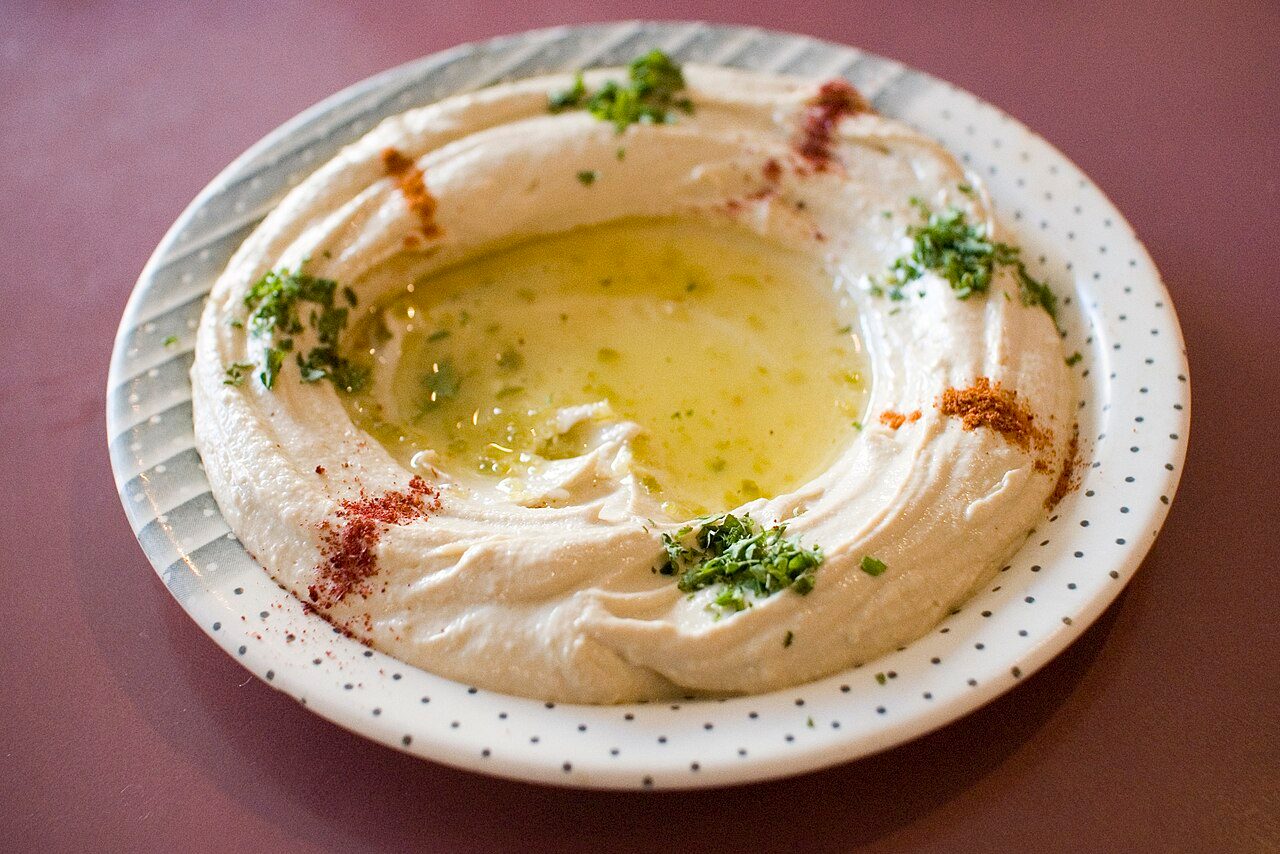
6 min read · 2 sourcesHummus (, ; Arabic: حُمُّص, romanized: ḥummuṣ, lit. 'chickpeas', also spelled hommus or houmous) (full name: Hummus Bi Tahini) is a Levantine dip, spread, or savory dish made from cooked, mashed chickpeas blended with tahini, lemon juice, and garlic. The standard garnish includes olive oil, a few whole chickpeas, parsley, and paprika. The earliest mention of hummus was in a 13th century cookbook attributed to the historian Ibn al-Adim from Aleppo in present-day Syria. Commonly consumed in Levantine cuisine, it is usually eaten as a dip with pita bread. In the West, it is produced industrially and consumed as a snack or appetizer with crackers or vegetables. 1
Etymology and spelling
The word hummus is Arabic: حُمُّص, romanized: ḥummuṣ 'chickpeas'. The full name of the prepared spread in Arabic is ḥummuṣ bi ṭaḥīna 'chickpeas with tahini'. The colloquial Arabic word ḥummuṣ is a variant of the Arabic ḥimmaṣ or ḥimmiṣ which may be derived from the Aramaic language (חמצי ḥemṣīn, ḥemṣāy), corresponding to the Syriac word for chickpeas: ḥem(m)ṣē. The word entered the English language around the mid-20th century from the Arabic ḥummuṣ or via its borrowing for the name of the dish in Turkish: humus. Spelling of the word in English can be inconsistent, though most major dictionaries from American and British publishers give hummus as the primary spelling. Some American dictionaries give hommos as an alternative, while British dictionaries give houmous or hoummos. The major British supermarkets use houmous. Other spellings include homous, houmos, houmus, and similar variants. While humus (as it is spelled in Turkish) is sometimes found, it is avoided as a heteronym of humus, organic matter in soil. 1
Origin and history
Although multiple different theories and claims of origins exist in various parts of the Middle East, evidence is insufficient to determine the precise location or time of the invention of hummus. Its basic ingredients—chickpeas, sesame, lemon, and garlic—have been combined and eaten in Egypt and the Levant for centuries. Though regional populations widely ate chickpeas, and often cooked them in stews and other hot dishes, puréed chickpeas eaten cold with tahini do not appear in records before the Abbasid Caliphate in Egypt and the Levant. The earliest mention of a dish equivalent to hummus comes from Syria, in a 13th-century cookbook attributed to Ibn al-Adim. The recipe, which the cookbook calls chickpea kisāʾ (garment), includes chickpeas, lemon, sesame, and olive oil, but omits garlic. Other early written recipes for a dish resembling ḥummuṣ bi ṭaḥīna are recorded in cookbooks written in Cairo in the 14th-century. A cold purée of chickpeas with vinegar and pickled lemons with herbs, spices, and oil, but no tahini or garlic, appears in the Treasure Trove of Benefits and Variety at the Table (كنز الفوائد في تنويع الموائد); and a purée of chickpeas and tahini called hummus kasa appears in Muhammad bin Hasan al-Baghdadi's The Book of Dishes: it is based on puréed chickpeas and tahini, and acidulated with vinegar (not lemon), but it also contains many spices, herbs, and nuts, and no garlic. It is also served by rolling it out and letting it sit overnight. According to food historian Nawal Nasrallah, no records of recipes for hummus exist after the 14th century until an 1885 Lebanese cookbook, by which time garlic is established as a standard ingredient. 1
Regional preparations
As an appetizer and dip, diners scoop hummus with flatbread, such as pita. It is also served as part of a meze or as an accompaniment to falafel, grilled chicken, fish, or eggplant. Hummus is a common dip in Egypt where it is eaten with pita, and frequently flavored with cumin or other spices. In the Levant, hummus has long been a staple food, often served as a warm dish, with bread for breakfast, lunch or dinner. All of the ingredients in hummus are easily found in gardens, farms and markets, thus adding to the availability and popularity of the dish. Hummus is usually garnished with olive oil, "nana" mint leaves, paprika, and parsley. Hummus is a common part of everyday meals in Israel. It is made from ingredients that, following Kashrut (Jewish dietary laws), can be combined with both meat and dairy meals. Chickpea dishes have long been part of the cuisine of Jews who lived in the Middle East and Northern Africa. The many Mizrahi Jewish immigrants from these countries brought their own unique variations, such as hummus with fried eggplant and boiled eggs prepared by Iraqi Jews. Israeli versions use large amounts of tahini for a creamier texture. One author calls hummus "one of the most popular and best-known of all Syrian dishes" and a "must on any mezzeh table". Syrian and Lebanese in Canada's Arab diaspora prepare and consume hummus along with other dishes like falafel, kibbeh and tabbouleh, even among the third- and fourth-generation offspring of the original immigrants. In Cyprus, hummus is part of the local cuisine in both Turkish Cypriot and Greek Cypriot communities where it is called "humoi" (Greek: χούμοι). 1
Nutrition
Commercial hummus is 59% water, 15% carbohydrates, 7% protein, and 16% fat (table). In a reference amount of 100 grams (3.5 oz), commercial hummus supplies 243 calories of food energy, and is a rich source (20% or more of the Daily Value, DV) of copper (39% DV), manganese (45% DV), and selenium (29% DV, table). Hummus is a moderate source (10–20% DV) of thiamine, vitamin E, vitamin K, and several dietary minerals (table). 1
United Kingdom
In the 1980s, the supermarket Waitrose was the first British supermarket to stock hummus, spelled houmous. Hummus was popularized in the UK by chefs such as Yotam Ottolenghi, Claudia Roden and Anissa Helou. As of 2013, £60 million worth of hummus was sold in the UK each year, and one survey found that 41% of British respondents had hummus in their fridge, twice as many as the rest of Europe. A Waitrose spokesperson said it had become a grocery staple. 1
The text above is adapted from the Wikipedia article “Hummus”, available under the Creative Commons Attribution-ShareAlike 4.0 licence. 1
hummus is Levantine and Middle Eastern chickpea puree, according to the structured record cited below. This entry was generated automatically from that record and has not yet been reviewed by a person familiar with the tradition. 2
The source record links this tradition to 21 external registers, which can be verified through the citation. 2