The tradition & historical record
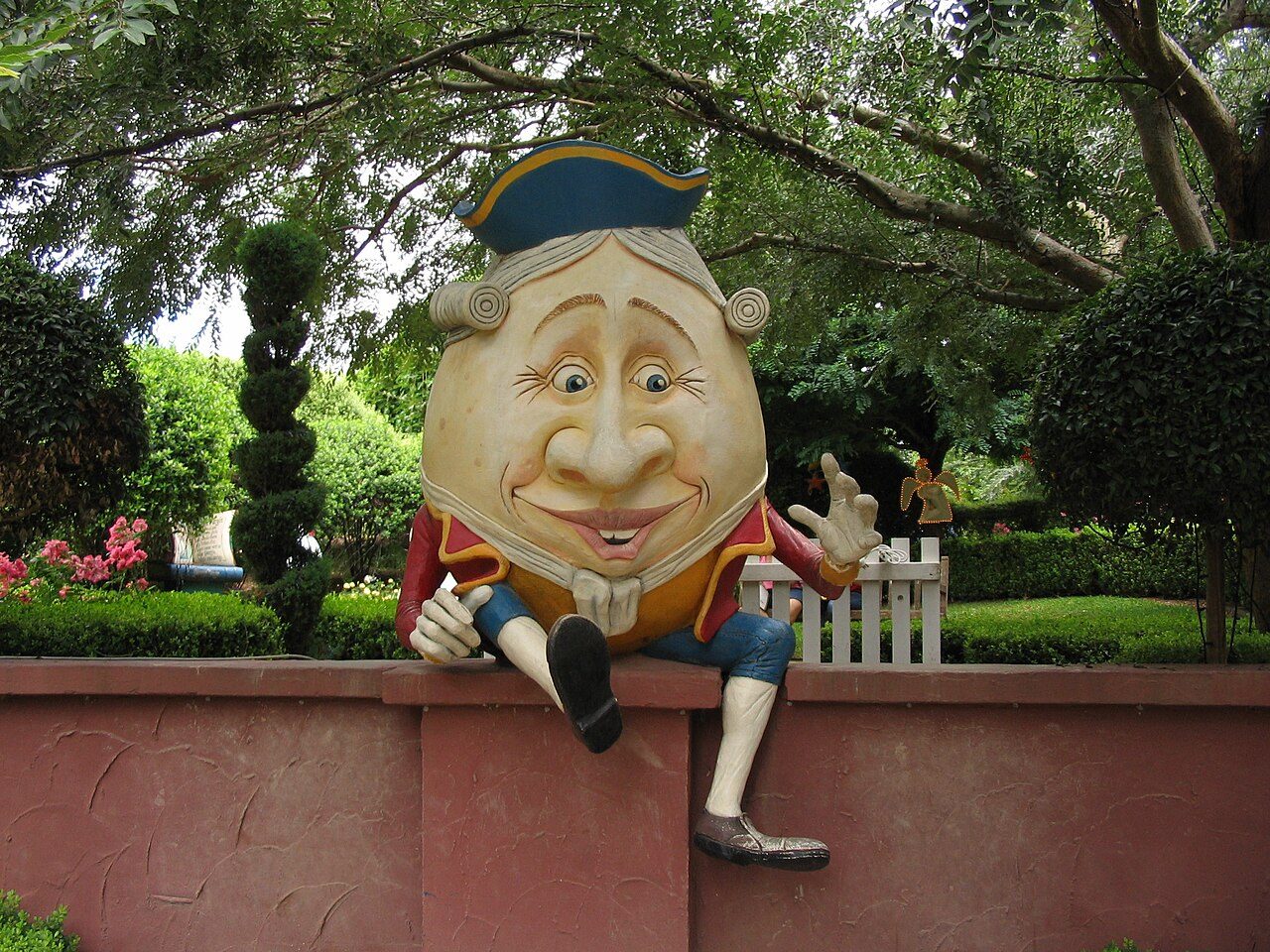
6 min read · 2 sourcesHumpty Dumpty is a character in an English nursery rhyme, probably originally a riddle, and is typically portrayed as an anthropomorphic egg, though he is not explicitly described as such. The first recorded versions of the rhyme date from late eighteenth-century England and the tune from 1870 in James William Elliott's National Nursery Rhymes and Nursery Songs. Its origins are obscure, and several theories have been advanced to suggest original meanings. The rhyme is listed in the Roud Folk Song Index as No. 13026. As a figure in nursery culture, the character appears under a variety of near-rhyming names, such as Lille Trille (Danish), Wirgele-Wargele (German), Hümpelken-Pümpelken (German) and Hobberti Bob (Pennsylvania Dutch). As a character and literary allusion, Humpty Dumpty was referred to in several works of literature and popular culture in the nineteenth century. Lewis Carroll in particular made him an animated egg in his 1871 book Through the Looking-Glass, while in the United States the character was popularised by George L. Fox as a clown of that name in the Broadway pantomime musical Humpty Dumpty (1868). 1
Lyrics and melody
The rhyme is well known in the English language. The common text from 1882 is: 1
It is a single quatrain with external rhymes that follow the pattern of AABB and with a trochaic metre, which is common in nursery rhymes. The melody commonly associated with the rhyme was first recorded by composer and nursery rhyme collector James William Elliott in his National Nursery Rhymes and Nursery Songs (London, 1870), as outlined below: 1
Origins
The earliest known version was published in Samuel Arnold's Juvenile Amusements in 1797 with the lyrics: 1
A manuscript addition to a copy of Mother Goose's Melody published in 1803 has the modern version with a different last line: "Could not set Humpty Dumpty up again". It was published in 1810 in a version of Gammer Gurton's Garland. (Note: Original spelling variations left intact.) 1
In 1841 an anthology of Latin and Greek translations of popular literature was published under the title Arudines Cami which included a version of the rhyme in Latin translation by Henry Drury. The final two English lines translated in this case now read 1
Not all the king's horses, nor all the queen's men, Could put Humpty Dumpty on the wall again. In 1842, James Orchard Halliwell published an alternative version in his collection of The Nursery Rhymes of England: 1
Evidence of an alternative American version closer to the modern received rhyme quoted above is given by William Carey Richards in the issue of a children's magazine for 1843, where he comments that he had come across it as a riddle when he was five years old and that the answer was "an egg". According to the Oxford English Dictionary, in the seventeenth century, the term "humpty dumpty" referred to a drink of brandy boiled with ale. The riddle probably exploited, for misdirection, the fact that "humpty dumpty" was also eighteenth-century reduplicative slang for a short and clumsy person. The riddle may depend upon the assumption that a clumsy person falling off a wall might not be irreparably damaged, whereas an egg would be. The rhyme is no longer posed as a riddle, since the answer is now so well known. 1
Meaning
The rhyme does not explicitly state that the subject is an egg, possibly because it may have been originally posed as a riddle. There are also various theories of an original "Humpty Dumpty". One, advanced by Katherine Elwes Thomas in 1930 and adopted by Robert Ripley, posits that Humpty Dumpty is King Richard III of England, depicted as hunchbacked in Tudor histories and particularly in Shakespeare's play, and who was defeated, despite his armies, at Bosworth Field in 1485. In 1785, Francis Grose's Classical Dictionary of the Vulgar Tongue noted that a "Humpty Dumpty" was "a short clumsey [sic] person of either sex, also ale boiled with brandy"; no mention was made of the rhyme. The name is also commonly applied to a person in an insecure position, something that would be difficult to reconstruct once broken, or a short and fat person. 1
Professor David Daube suggested in The Oxford Magazine of 16 February 1956 that Humpty Dumpty was a "tortoise" siege engine, an armored frame, used unsuccessfully to approach the walls of the Parliamentary-held city of Gloucester in 1643 during the Siege of Gloucester in the English Civil War. This was on the basis of a contemporary account of the attack, but without evidence that the rhyme was connected. The theory was part of an anonymous series of articles on the origin of nursery rhymes and was widely acclaimed in academia, but it was derided by others as "ingenuity for ingenuity's sake" and declared to be a spoof. 1
Adaptations
American actor George L. Fox helped to popularise the nursery rhyme character in a nineteenth-century pantomime on Broadway, where he figures as a clown. During the nineteenth century, too, Humpty Dumpty gave his name to a number of musical items, dependent either on the nursery rhyme or on the pantomime. They include Alfred Caldicott's glee of 1878 and E. P. Sweeting's round of 1893, as well as Walford Davies' 1907 Humpty Dumpty, described as "a short cantata for children, consisting of a prelude, four short settings of the old nursery rhyme, and part of the scene between Alice and Humpty Dumpty (from Alice Through the Looking-Glass)". There were also purely musical items in the US, such as the 1875 galop by Harry R. Williams, the 1876 polka by E. Jullian Gray and the 1900 schottische by H. Engelmann. 1
Lewis Carroll's Through the Looking-Glass
Humpty Dumpty makes an appearance in Lewis Carroll's Through the Looking-Glass (1871). There Alice remarks that Humpty is "exactly like an egg", which Humpty finds to be "very provoking". Alice clarifies that she said he looks like an egg, not that he is one. They then go on to discuss semantics and pragmatics when Humpty Dumpty says, "my name means the shape I am". A. J. Larner suggested that Carroll's Humpty Dumpty had prosopagnosia on the basis of his description of his finding faces hard to recognise: 1
"The face is what one goes by, generally," Alice remarked in a thoughtful tone. 1
"That's just what I complain of," said Humpty Dumpty. "Your face is the same as everybody has—the two eyes,—" (marking their places in the air with his thumb) "nose in the middle, mouth under. It's always the same. Now if you had the two eyes on the same side of the nose, for instance—or the mouth at the top—that would be some help." 1
The text above is adapted from the Wikipedia article “Humpty Dumpty”, available under the Creative Commons Attribution-ShareAlike 4.0 licence. 1
Humpty Dumpty is fictional character from the nursery rhyme and derivative works, according to the structured record cited below. This entry was generated automatically from that record and has not yet been reviewed by a person familiar with the tradition. 2
The source record links this tradition to 8 external registers, which can be verified through the citation. 2