The tradition & historical record
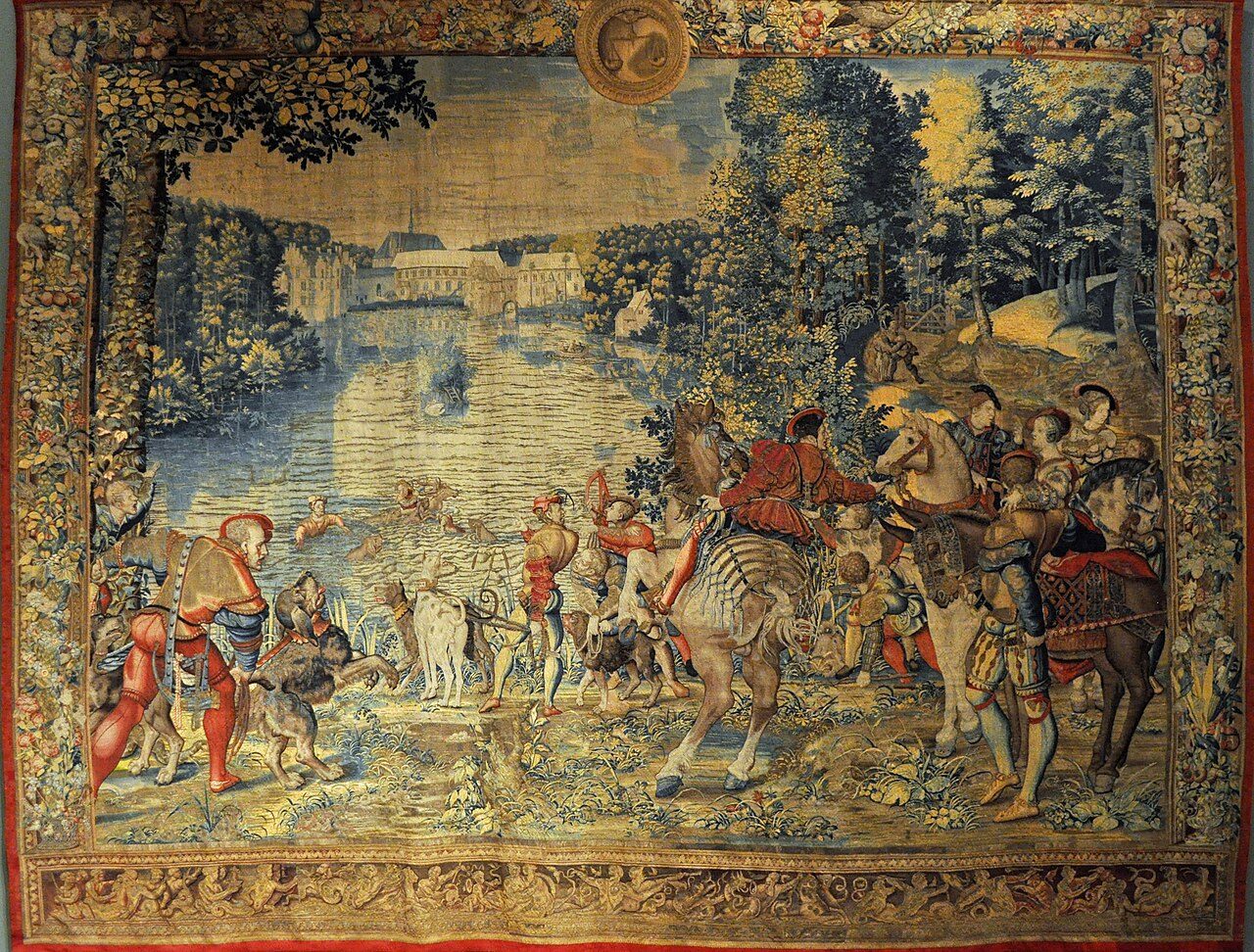
3 min read · 2 sourcesThe Hunts of Maximilian or Les Chasses de Maximilien, also Les Belles chasses de Guise (The Beautiful Hunts of Guise) are a set of twelve tapestries, one per month, depicting hunting scenes in the Sonian Forest, south of Brussels, by the court of Maximilian I, Holy Roman Emperor (d. 1519). They were produced in a Brussels workshop, and several tapestries are given identifiable locations that were then around the outskirts of the city, but are now mostly engulfed by it. The set is now in the Louvre. The original set, completed in the 1530s, were commissioned by a member of the Habsburg family: either Charles V (Maximilian's grandson), or his aunt Margaret of Austria (Maximilian's daughter), or Charles's sister Mary of Hungary. Both princesses governed the Low Countries in Charles' name, Mary taking over after Margaret's death in 1530. A contract of 1533 probably refers to these tapestries. 1
They were almost certainly designed by Bernard van Orley, the leading tapestry designer of the day, perhaps between 1528 and 1533. Jan Cornelisz Vermeyen has been suggested as a possibility in the past. Both of these designed other tapestries for the Habsburgs. Jan and Willem Dermoyen are credited as leading the weaving. Each tapestry has a roundel at centre top containing the astrological symbol for the month. They probably contain portraits of individuals from Maximilian's court; attempts have been made to identify these. 1
Copies
Well over a century after the originals, copies of the original set were made at the Gobelins factory in Paris, initially for Louis XIV of France, who commissioned two sets at different times. There are Gobelins copies in the Musée national du Château de Pau (1680s), the Musée Condé in Chantilly (19th century), and the Metropolitan Museum of Art (1690s). Though the Metropolitan pieces are the same as the originals, the Pau and Chantilly sets have different borders, and the astrological symbols are replaced by coats of arms. Various copies were made in Brussels in the late 17th century, signed by Evraert Leyniers. Six are in Château of Franc-Waret in Belgium (1665–1676), and three in the Musée de Brou in Bourg-en-Bresse. A set of six was until 1950 in the Château de Keriolet in Finistère. 1
The text above is adapted from the Wikipedia article “Hunts of Maximilian”, available under the Creative Commons Attribution-ShareAlike 4.0 licence. 1
Hunts of Maximilian is series of tapestries representing the months of the year, extant in several editions, according to the structured record cited below. This entry was generated automatically from that record and has not yet been reviewed by a person familiar with the tradition. 2
The source record links this tradition to 7 external registers, which can be verified through the citation. 2