The tradition & historical record
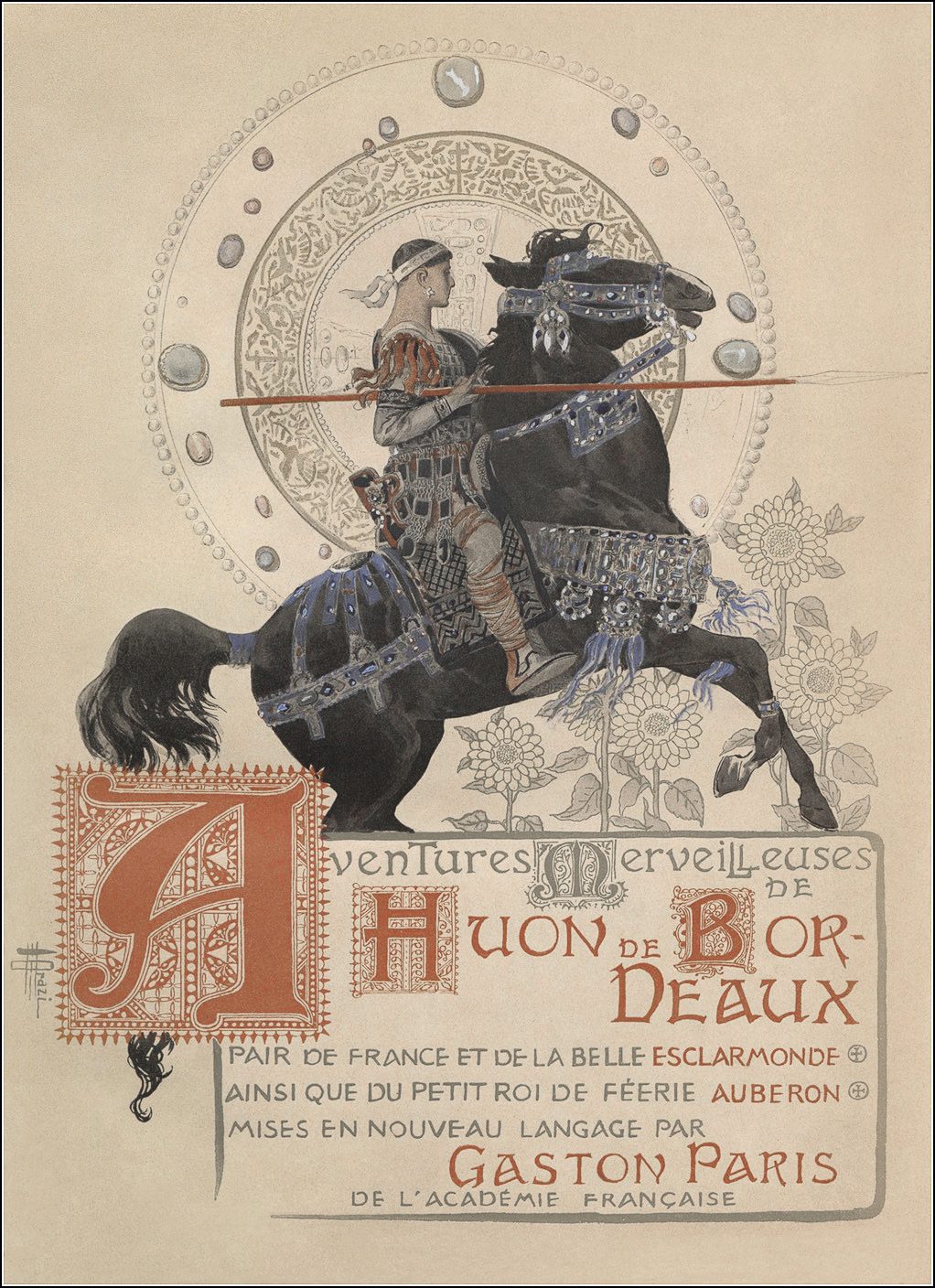
5 min read · 2 sourcesHuon of Bordeaux is a popular character of French romance. He is the title character of a late 13th-century chason de geste, a French epic poem with romance elements. Huon is a knight in the court of Charlemagne and son of Seguin de Bordeaux. Tales of his adventures tell of his exploits both at home and in the East, where he fights Saracens (the term used in the chansons de geste but rejected in contemporary criticism) and wins the heart of the Princess Escalarmonde, and eventually inherits the throne of the fairy king, Auberon. Huon continues to be a folk hero. His adventures were adapted in the 15th and 16th centuries. The late 19th and early 20th centuries saw a renewed interest in romance characters of the Middle Ages, Huon among them, with the first modern editions by scholars like Gaston Paris, as well as retellings for both adult and young readers. 1
Huon de Bordeaux
The poem tells of Huon, a knight who unwittingly kills Charlot, the son of Emperor Charlemagne. He is given a reprieve from death on condition that he fulfil a number of seemingly impossible tasks: he must travel to the court of the Emir of Babylon and return with a handful of the Emir's hair and teeth, slay the Emir's mightiest knight, and three times kiss the Emir's daughter, Esclarmonde. Huon eventually accomplishes all these feats with the assistance of the fairy king Auberon. The poem is an example of late chansons de geste and recalls tropes and motifs of earlier generations of the French epics, such as the conflicts with Saracens, the Saracen Princess who converts to Christianity, and the association with the "epic of revolt". However, because of the lateness of the poem and its romance undertones, William Kibler has classified it as a "chanson d'aventure". 1
Editions and Continuations
The oldest version of the chanson de geste that survives (in varying degrees of completeness) in three manuscripts and two short fragments. In its most complete version, it comprises 10,553 decasyllable verses grouped in 91 assonanced laisses. Presumed dates for its composition vary, but 1216 and 1268 are generally given as terminus post quem (earliest possible date) and terminus ante quem (latest possible date). The success of the Huon story gave rise to six continuations or "sequels" and one prologue, which triple its length. Editors have not to date come up with a collective title for the Huon de Bordeaux Sequel Cycle. The "episodes" in the cycle have been divided and titled thus by editors: 1
Roman d'Aubéron – the Turin manuscript of the romance (the only manuscript to contain all of the continuations) contains the only version of this 14th-century prologue in the shape of a separate romance of Auberon. Auberon also refers to the title of another chanson de geste, Auberon, written as the prologue to Huon de Bordeaux. No prose version exists. Huon Roi de Féérie Chanson d'Esclarmonde Chanson de Clarisse et Florent Chanson d'Yde et d'Olive – summarized in the alexandrine version of the poem. Chanson de Croissant Chason d'Yde et Olive II – the story of Yde and Olive picks up again after the interlude of the story of their son, Croissant. Chanson de Godin – the Turin manuscript of the romance contains the only version of this 13th–14th century continuation. No prose version exists. 1
Historical Sources
The Charlot of the story has been identified by Auguste Longnon (Romania vol. viii) with Charles the Child, one of the sons of Charles the Bald and Ermentrude of Orléans, who died in 866 in consequence of wounds inflicted by a certain Aubouin in precisely similar circumstances to those related in the romance. The father of Huon may safely be identified with Seguin, who was count of Bordeaux under Louis the Pious in 839, and died fighting against the Vikings six years later. Huon himself is probably based on Hunald I, duke of Aquitaine in the 8th century, who was defeated by Charlemagne's father. 1
Translations
Catherine M. Jones and William W. Kibler, ed. (2021). Huon of Bordeau. New York: Italica Press. p. 354. ISBN 978-1-59910-402-7. 1
General and Cited References
Frederick J. Furnivall, ed. (1871). Captain Cox, His Ballads and Books. Ballad Society. pp. xvii–xix. Esclarmonde. François Guessard; Charles Loizeau de Grandmaison, eds. (1860). Huon de Bordeaux; chanson de geste (in French). Paris: F. Vieweg. M. Lens (2000). "Huon de Bordeaux". In W. P. Gerritson; A. G. Van Melle (eds.). Dictionary of Medieval Heroes. Boydell Press. p. 150. ISBN 0-85115-780-7. Huon de Bordeaux. Lens, M. (2004). Huge van Bordeeus. Olifant, 23(1), 79–94. C. S. Lewis (1954). English Literature in the Sixteenth Century, Excluding Drama. Oxford History of English Literature. Oxford University Press. p. 152. Jean-Louis Picherit (1995). "Huon de Bordeaux". In William W. Kibler; Grover A. Zinn (eds.). Medieval France: An Encyclopedia (2nd ed.). New York: Garland. p. 4677. ISBN 0-8240-4444-4. Michel J. Raby, ed. (1998). Le Huon de Bordeaux en prose du XVème siècle (in French). New York: Lang. ISBN 0-8204-3301-2. 1
The text above is adapted from the Wikipedia article “Huon of Bordeaux”, available under the Creative Commons Attribution-ShareAlike 4.0 licence. 1
Huon of Bordeaux is 13th-century French epic poem, according to the structured record cited below. This entry was generated automatically from that record and has not yet been reviewed by a person familiar with the tradition. 2
The source record links this tradition to 5 external registers, which can be verified through the citation. 2