The tradition & historical record
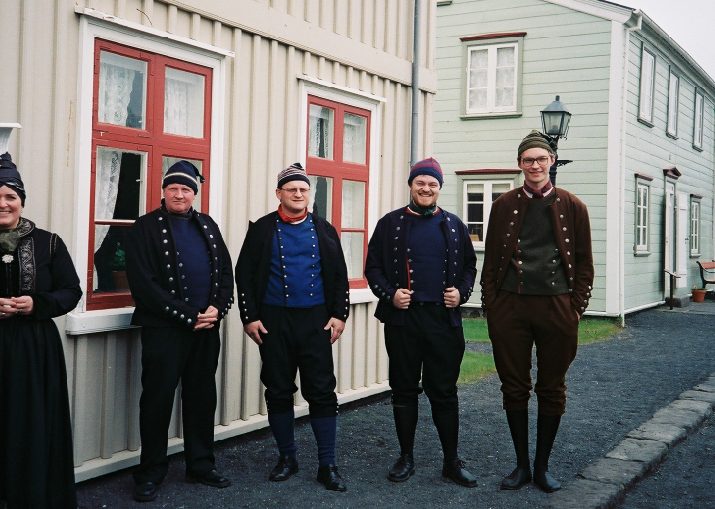
3 min read · 2 sourcesIcelandic national costume, collectively known in Icelandic as Þjóðbúningurinn has enjoyed various levels of popularity since the term was coined in Iceland in the 19th century, during the struggle for independence. Since 2001 the national costume is regulated by Þjóðbúningaráð (The National Costume Authority), which preserves the correct techniques of making them and instructs people. 1
Women's costume
The five following types of costume are all recognized as Icelandic National costumes. However both the kyrtill and skautbúningur were designed in the 19th century from scratch as ceremonial costumes, while the faldbúningur, peysuföt and the upphlutur are traditional daily wear of Icelandic women in olden times. 1
Faldbúningur
The Faldbúningur is an older type of costume worn by women since at least the 17th century and well into the 19th. In its most recognized form it incorporated a hat decorated with a curved sheet-like ornament protruding into the air and exists in two variants. One of which is the krókfaldur and the other is the spaðafaldur. Previously a large hat decorated with gold-wire bands was worn with it, as well as ruff which is the reason for the faldbúningur's wide collar, which was designed to support it. Later, around the start of the 18th century women started to wear the much simpler tail-cap with it. 1
Peysuföt
The Peysuföt are black woollen clothes commonly worn by women in the 18-19th century. They usually consisted of a twill skirt and a jacket of fine knitted woollen yarn with a black tail cap. It is believed that this costume was invented when women, desiring simpler working clothes than the faldbúningur, started to use male articles of clothing. This includes both the tail-cap and the peysa which originally was a jacket with a single row of buttons, but evolved into this costume and eventually discarded with the buttons. 1
Upphlutur
The Upphlutur is a woman's costume, consisting of bodice that can be coloured in bright colours such as red or blue, but often black. Its headpiece is a tail cap. The costume is basically the undergarment of the faldbúningur which evolved into a costume of its own right. 1
Kyrtill
The Kyrtill is a costume for women, designed by the artist Sigurður Guðmundsson in the 19th century. It was designed to look like Viking Age costumes. It however incorporates a hat similar to the one on the skautbúningur. While Sigurður's vision of the Viking Age costume remains popular, costumes designed to more closely resemble archaeological finds have gained some popularity as well. 1
The text above is adapted from the Wikipedia article “Icelandic national costume”, available under the Creative Commons Attribution-ShareAlike 4.0 licence. 1
Icelandic national costume is Nne, according to the structured record cited below. This entry was generated automatically from that record and has not yet been reviewed by a person familiar with the tradition. 2
The source record links this tradition to 1 external register, which can be verified through the citation. 2