The tradition & historical record
4 min read · 2 sourcesIga ware (伊賀焼, Iga-yaki) is a style of Japanese pottery traditionally produced in Iga, Mie, former Iga Province, central Japan. 1
History
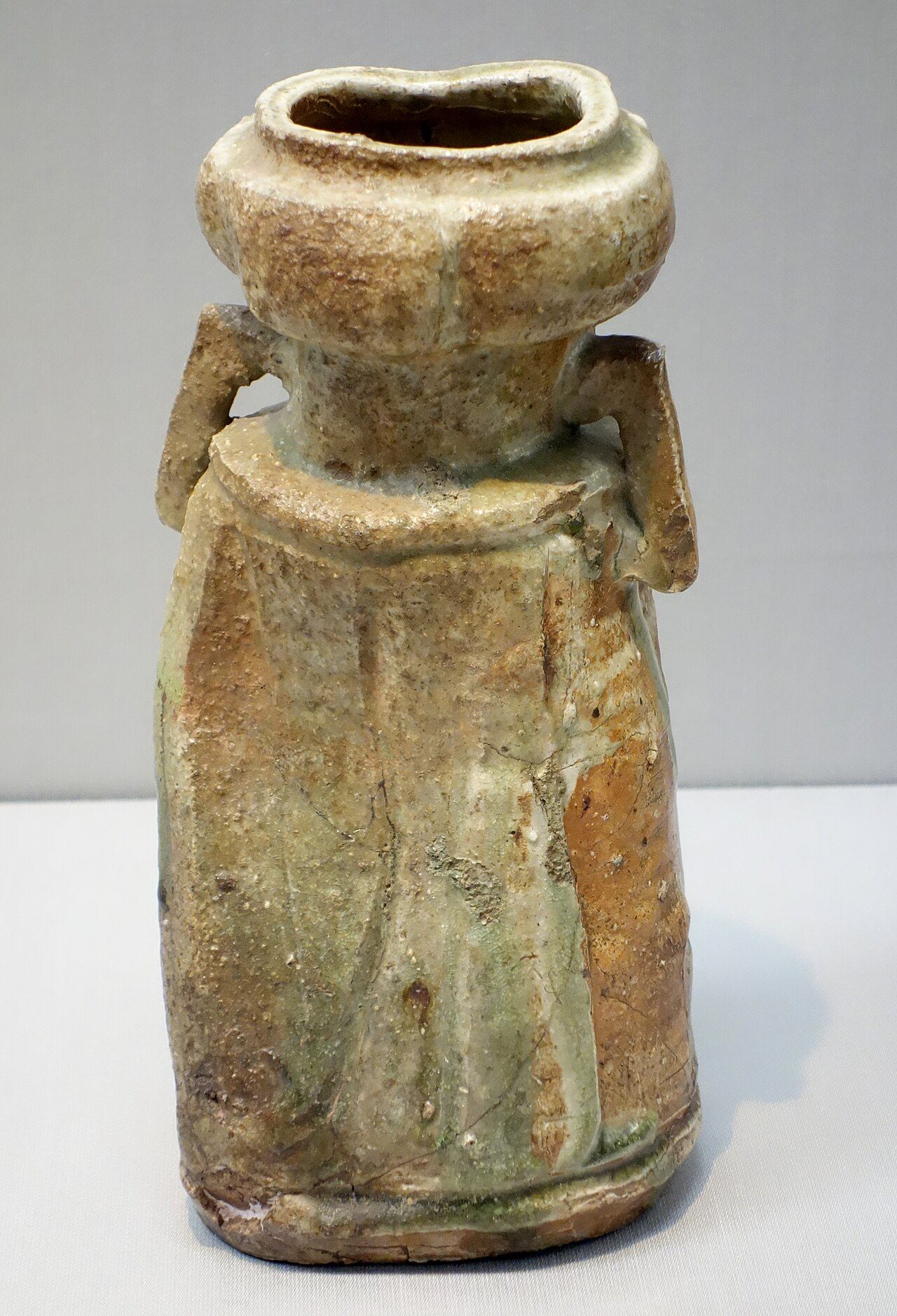
Iga ware's origins are believed to date to the second half of the 7th century and 8th century CE. The area has long produced a clay known for its high resistance to fire. In the early phase it did not differ from nearby Shigaraki ware. The kilns are thought to have been established during the Keichō era (1596–1615) under the rule of Lords Tsutsui Sadatsugu (1562–1615) and later Tōdō Takatora (1556–1630) and Tōdō Takatsugu (1602–1676) of Iga Province. The most well-known kilns were at Makiyama and Marubashira, in the Ayama district of Iga city. Historically, in a Japanese tea ceremony room, vases used to be made out of cut bamboo in order to match the ambiance of the room. Precious vases were offered as gifts to feudal daimyō lords. Starting in the late 16th century Momoyama period, Iga ware water vases with characteristic "ear" lugs appeared. The ear lugs added prestige to a vessel and thus became the popular norm. Since then the ears have become a mark of not only Iga flower vessels but also mizusashi water jars. They were used as Japanese tea utensils under master Sen no Rikyu and others. Old Iga ware, which is known as Ko-Iga, generally reflects wabi-sabi aesthetics with a rustic appearance and purposefully deformed shapes, given extra character by the addition of "ear" lugs (katamimi) and intentional gouges and dents (herame). Many pieces are finished with the classic, glass-like bidoro glaze formed by ash. A number of pieces from this period have been registered by the government. The mizusashi called "Broken Pouch" (破袋, yabure-bukuro) has been registered as an Important Cultural Property. Kishimoto Kennin (b. 1934) is an artist who makes Oribe and Shino ware; it is, however, his Iga ware that is considered some of his most outstanding work. Tanimoto Kei (谷本景) (b. 1
Characteristics
Iga ware uses local clay which is extremely resistant to heat, reacts well to repeated firing, and is fired over three days in a kiln dug into the ground. The clay tends to have a high level of hardness and is created on a pottery wheel. The potter delicately uses a spatula to give curvature. This distinctive curve lets the flames lick over the round edge. Furthermore, tiny pebbles in the clay give it additional surface texture. The lugs on an Iga ware vase are called "ears" (耳付, mimitsuki). Vases tend to be made out of rough clay, sometimes with tiny white stones added. In the past these were kneaded by hand, which gave it a distorted form and thus character, but later production by wheel also developed. The ear lugs at the end of the production are what define the quality of a vase. They are shaped and formed to balance the vessel; they express the strength and energy of the piece. Iga ware does not use applied glaze. Instead it is fired at a very high temperature in a kiln causing it to crystallize in a reddish hue, often with brown-grey scorch marks caused by log ashes called koge, and a translucent green ash glaze from the burning wood forms. This occurs when firewood ash melts at 1400 Celsius. Since they are free of impurities, a clear jade translucent feldspathic glass called biidoro, after the Portuguese word for glass vidro, results. Sometimes the biidoro glass coagulates to form a globule called a "dragonfly eye." The clay's durability means it can be fired multiple times without cracking, sometimes up to three times. The ash glaze builds up in layers and produces a translucence. It does not form in modern gas-fired kilns. Modern artists like Tsuneoka Mitsuoki (恒岡光興) (b. 1
The text above is adapted from the Wikipedia article “Iga ware”, available under the Creative Commons Attribution-ShareAlike 4.0 licence. 1
Iga ware is style of Japanese pottery, according to the structured record cited below. This entry was generated automatically from that record and has not yet been reviewed by a person familiar with the tradition. 2
The source record links this tradition to 7 external registers, which can be verified through the citation. 2