The tradition & historical record
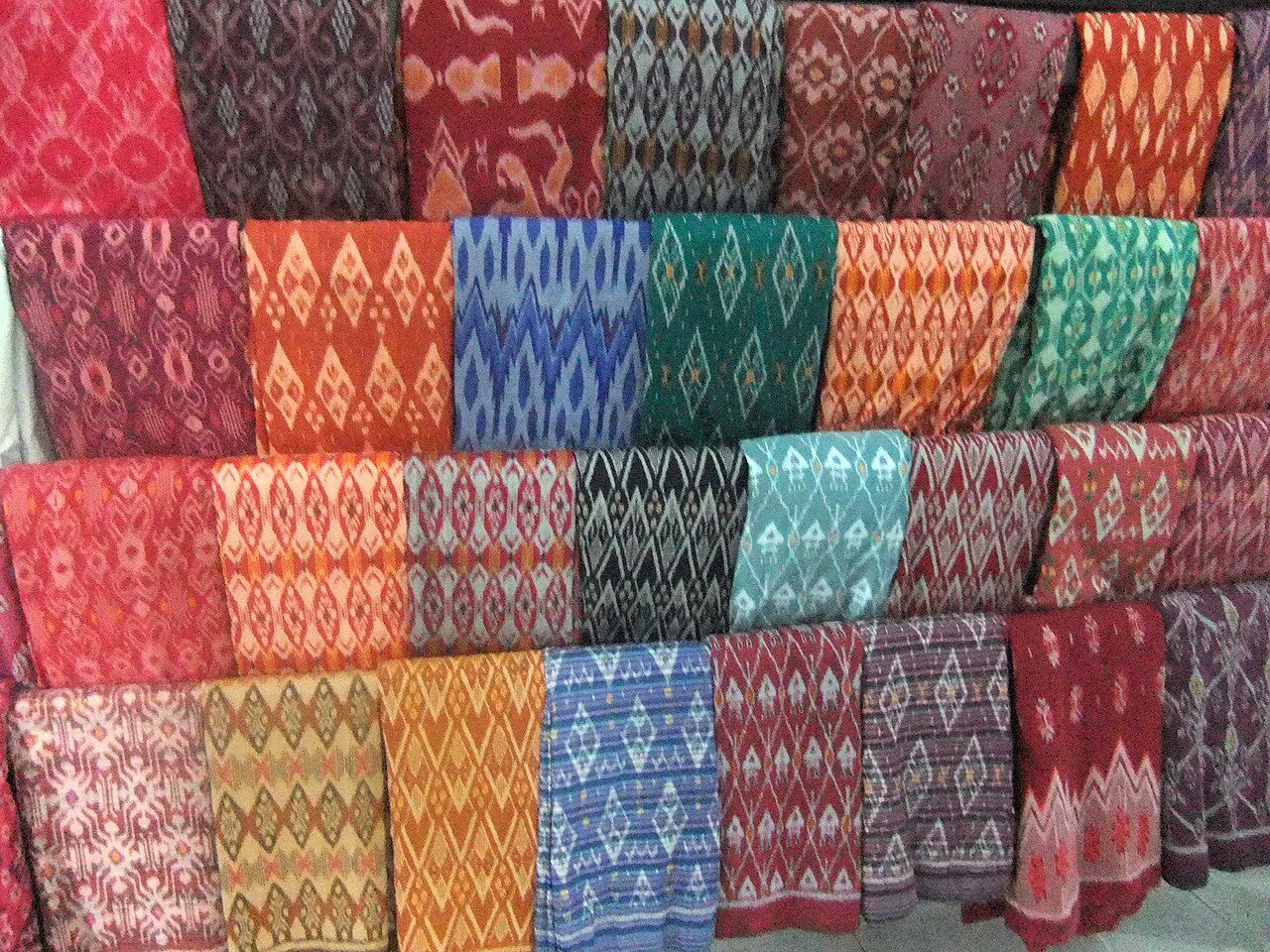
6 min read · 2 sourcesIkat (literally "to bind" in Malayo-Polynesian languages) is a dyeing technique from Southeast Asia used to pattern textiles that employs resist dyeing on the yarns before dyeing and weaving the fabric. In Southeast Asia, ikat weaving traditions can be divided into two general groups of related traditions. The first is found among Daic-speaking peoples (Laos, northern Vietnam, and Hainan). The second, larger group is found among the Austronesian peoples (Indonesia, Philippines, Malaysia, Brunei, and Timor-Leste) and spread via the Austronesian expansion as far as Madagascar. In modern times, it is mostly associated with the textile traditions of Indonesia, from where the term ikat originates. Similar, but unrelated, dyeing and weaving techniques have developed independently in other regions of the world, including India (especially Khandua in Odisha, which had extensive maritime trade with Southeast and East Asia; see this for more types), Central Asia, Ryukyu Islands (where it is called Iichiiri or Tucciri), Japan (where it is called kasuri), Africa, and the Americas. In ikat, the resist is formed by binding individual yarns or bundles of yarns with a tight wrapping applied in the desired pattern. The yarns are then dyed. The bindings may then be altered to create a new pattern and the yarns dyed again with another colour. This process may be repeated multiple times to produce elaborate, multicolored patterns. 1
Etymology
Ikat is a Malay word, which depending on context, can be a noun meaning cord, thread, knot, or bundle, and also the finished ikat fabric; it also translates as verbs "to tie" or "to bind"; the term ikatan is a noun for bond or tie. It has a direct etymological relation to cognates in various Indonesian languages from Sumatra, Borneo, Java, Bali, Sulawesi, Sumba, Flores, Timor, and Maluku. Thus, the name of the finished ikat woven fabric originates from the tali (threads, ropes) being ikat (tied, bound, knotted) before they are being put in celupan (dyed by way of dipping), then berjalin (woven, intertwined) resulting in a berjalin ikat- reduced to ikat. The introduction of the term ikat into European language is attributed to Rouffaer. Ikat is now a generic English loanword used to describe the process and the cloth itself regardless of where the fabric was produced or how it is patterned. In Indonesian, the plural of ikat remains ikat. While in English, a suffix plural 's' is commonly added, as in ikats. However, these terms are interchangeable and both are correct. 1
History
Warp ikat traditions in Southeast Asia are believed to have originated in Neolithic weaving traditions (older than at least 6000 BP) somewhere in mainland Asia, and are associated with the Austronesian and Daic-speaking peoples. This is based on a 2012 comparative study on loom technologies, textile patterns, and linguistics. These traditions spread outwards along with the Austronesian expansion to maritime Southeast Asia, reaching as far as Madagascar by the 1st millennium BC. Previously, ikat traditions were suggested by some authors to be originally acquired by Austronesians from contact with the Dong Son culture of Vietnam, but this was deemed unlikely in the 2012 study. Elsewhere, particularly in India and Central Asia, very similar traditions have also developed which are also known as "ikat". These likely developed independently. Uyghurs call it atlas (IPA [ɛtlɛs]) and use it only for woman's clothing. The historical record indicates that there were 27 types of atlas during Qing Chinese occupation. Now only four types of Uyghur atlas remain: qara-atlas, a black ikat used for older women's clothing; khoja'e-atlas, a yellow, blue, or purple ikat used for married women; qizil-atlas, a red ikat used for girls; and Yarkent-atlas, a khan or royal atlas. Yarkent-atlas has more diverse styles; during the Yarkent Khanate (1514–1705), there were ten different styles of Yarkent-atlas. 1
Types
In warp ikat it is only the warp yarns that are dyed using the ikat technique. The weft yarns are dyed a solid colour. The ikat pattern is clearly visible in the warp yarns wound onto the loom even before the weft is woven in. Warp ikat is, amongst others, produced in Indonesia; more specifically in Kalimantan, Sulawesi, and Sumatra by respectively the Dayaks, Torajans and Bataks. In weft ikat it is the weaving of weft yarn that carries the dyed patterns. Therefore, the pattern only appears as the weaving proceeds. Weft ikats are much slower to weave than warp ikat because the weft yarns must be carefully adjusted after each passing of the shuttle to maintain the clarity of the design. Double ikat is a technique in which both warp and the weft are resist-dyed prior to weaving. It is the most difficult to make and therefore the most expensive. Double ikat is only produced in three countries: India, Japan and Indonesia. The double ikat made in Patan, Gujarat in India is the most complicated. Called "patola", it is made using fine silk yarns and many colours. It may be patterned with a small motif that is repeated many times across the length of a six-meter sari. Sometimes the Patan double ikat is pictorial with no repeats across its length. That is, each small design element in each colour was individually tied in the warp and weft yarns. These much sought after textiles were traded by the Dutch East India Company for exclusive spice trading rights with the sultanates of Indonesia. The double ikat woven in the small Bali Aga village, Tenganan in east Bali in Indonesia reflects the influence of these prized textiles. Some of the Tenganan double ikat motifs are taken directly from the patola tradition. 1
Distribution
Although resist dyeing techniques like ikat are common to many world cultures, it is most prevalent in Indonesia, India and Japan. In South America, Central and North America, ikat is still common in Argentina, Bolivia, Ecuador, Guatemala and Mexico, respectively. In the 19th century, the Silk Road desert oases of Bukhara, Samarkand, Hotan and Kashgar (in what is now Uzbekistan and Xinjiang in Central Asia) were famous for their fine silk Uzbek/Uyghur ikat. India, Japan, Indonesia and many other Southeast Asian nations including Cambodia, Myanmar, Philippines and Thailand have weaving cultures with long histories of ikat resist dyeing. Double ikat textiles are still found in India, Japan and Indonesia. In Indonesia, ikat textiles are produced throughout the islands from Sumatra in the west to Timor and New Guinea in the east and Kalimantan and Sulawesi in the north. Ikat is also found in Iran, where the Persian name is daraee. Daraee means wealth, and this fabric is often included in a bride's dowry during wedding ceremonies; the people who bought these fabrics were rich. 1
Warp ikat
Ikat created by dyeing the warps (warp ikat) is simpler to make than either weft ikat or double ikat. First the yarns--cotton, silk, wool or other fibres—are wound onto a tying frame. Then they are separated into bundles. 1
The text above is adapted from the Wikipedia article “Ikat”, available under the Creative Commons Attribution-ShareAlike 4.0 licence. 1
Ikat is Decorative technique in which warp or weft threads, or both, are tie-dyed before weaving, according to the structured record cited below. This entry was generated automatically from that record and has not yet been reviewed by a person familiar with the tradition. 2
The source record links this tradition to 12 external registers, which can be verified through the citation. 2