The tradition & historical record
5 min read · 2 sourcesIndigenous Australian art includes art made by Aboriginal Australians and Torres Strait Islanders, including collaborations with others. It includes works in a wide range of media including painting on leaves, bark painting, wood carving, rock carving, watercolour painting, sculpting, ceremonial clothing and sandpainting. The traditional visual symbols vary widely among the differing peoples' traditions, despite the common mistaken perception that dot painting is representative of all Aboriginal art. 1
Traditional Aboriginal art
There are many types of and methods used in making Aboriginal art, including rock painting, dot painting, rock engravings, bark painting, carvings, sculptures, weaving, and string art. Australian Aboriginal art is the oldest unbroken tradition of art in the world. 1
Stone art
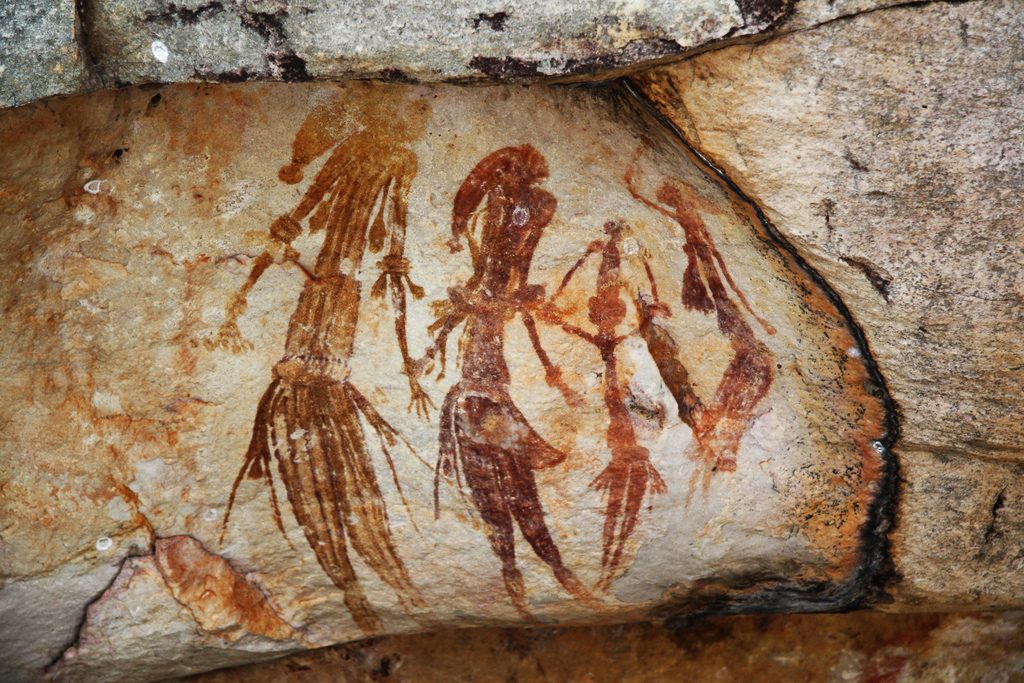
Rock art, including painting and engraving or carving (petroglyphs), can be found at sites throughout Australia. Examples of rock art have been found that are believed to depict extinct megafauna such as Genyornis and Thylacoleo in the Pleistocene era as well as more recent historical events such as the arrival of European ships. The oldest examples of rock art, in Western Australia's Pilbara region and the Olary district of South Australia, are estimated to be up to around 40,000 years old. The oldest firmly dated evidence of rock art painting in Australia is a charcoal drawing on a small rock fragment found during the excavation of the Narwala Gabarnmang rock shelter in south-western Arnhem Land in the Northern Territory. Dated at 28,000 years, it is one of the oldest known pieces of rock art on Earth with a confirmed date. It is thought this decorated fragment may have once formed part of a larger ceiling artwork, however, the shape of the original motif is unknown. The oldest reliably dated unambiguous, in-situ rock art motif in Australia is a large painting of a macropod from a rock shelter in Western Australia's Kimberley region, radiometrically dated in a February 2021 study at approximately 17,300 years old. Gwion Gwion rock art (the "Bradshaw rock paintings", also referred to as Giro Giro"), initially named after Joseph Bradshaw, who first reported them in 1891, consists of a series of rock paintings on caves in the Kimberley region of Western Australia. A 2020 study puts this art at about 12,000 years old. The Maliwawa Figures were documented in a study led by Paul Taçon and published in Australian Archaeology in September 2020. 1
Stone arrangements
Aboriginal stone arrangements are a form of rock art constructed by Aboriginal Australians. Typically they consist of stones, each of which may be about 30 cm in size, laid out in a pattern extending over several metres or tens of metres. Each stone is well-embedded into the soil, and many have "trigger-stones" to support them. Particularly fine examples are in the state of Victoria, where some examples have very large stones. For example, the stone arrangement at Wurdi Youang consists of about 100 stones arranged in an egg-shaped oval about 50 metres (160 ft) across. The appearance of the site is similar to that of the megalithic stone circles found throughout Britain (although the function and culture are presumably completely different). Although its association with Aboriginal Australians is well-authenticated and beyond doubt, the purpose is unclear, although it may have a connection with initiation rites. It has also been suggested that the site may have been used for astronomical purposes. Smaller stone arrangements are found throughout Australia, such as those near Yirrkala, which depict accurate images of the praus used by Macassan Trepang fishermen and spear throwers. 1
Wood carvings
Wood carving has long been an essential part of Aboriginal culture, requiring wood, sharp stone to carve, wire and fire. The wire and fire were used to create patterns on the object by heating the wire with the fire and placing it on the wood carving. Wood carvings such as those by Central Australian artist Erlikilyika shaped like animals, were sometimes traded to Europeans for goods. The reason Aboriginal people made wood carvings was to help tell their Dreaming stories and pass on their group's lore and essential information about their country and customs. They were also used in ceremonies, such as the ilma. Aboriginal people from the Tiwi Islands traditionally carved pukumani grave posts, and since the 1960s have been carving and painting iron wood figures. 1
Bark painting
Bark painting, where painting is done using ochres on the dried bark stripped off trees, is an old tradition. The earliest European find was in a shelter in Tasmania around 1800, and other painted bark shelters were found in Victoria and NSW. These were drawn with charcoal, and then painted or scratched onto bark which had been blackened by smoke. Painted bark baskets were used in death rituals on Melville and Bathurst Islands, and bark coffins and belts were painted in northeast Arnhem Land. Bark painting has continued into contemporary times. Styles in bark painting in Northern Australia, especially in Arnhem Land, include cross-hatching, or rarrk, and x-ray style. 1
The text above is adapted from the Wikipedia article “Indigenous Australian art”, available under the Creative Commons Attribution-ShareAlike 4.0 licence. 1
Indigenous Australian art is art made by Aboriginal and Torres Strait Islander peoples of Australia, according to the structured record cited below. This entry was generated automatically from that record and has not yet been reviewed by a person familiar with the tradition. 2
The source record links this tradition to 10 external registers, which can be verified through the citation. 2