The tradition & historical record
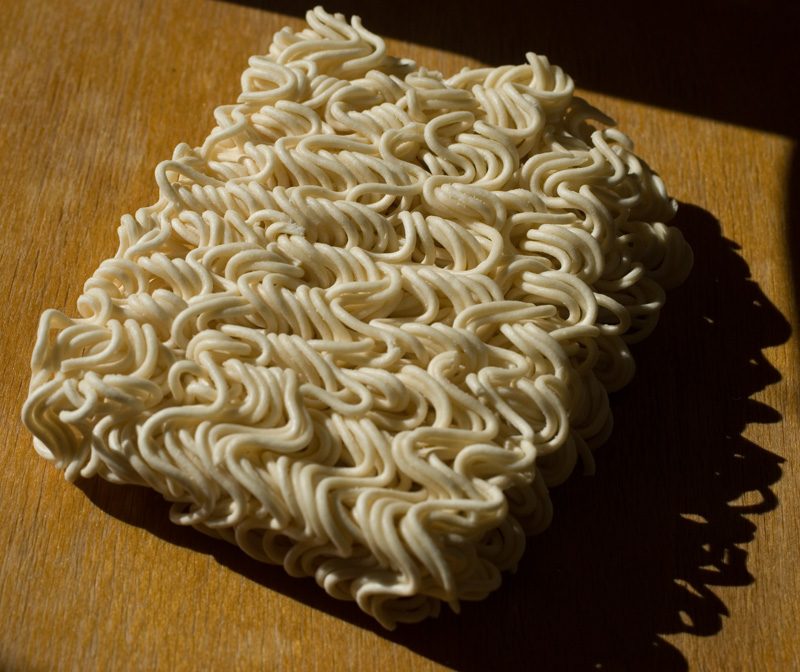
6 min read · 2 sourcesInstant noodles, or instant ramen, is a type of food consisting of noodles sold in a precooked and dried block with flavoring powder and/or seasoning oil. The dried noodle block was originally created by flash-frying cooked noodles, which is still the dominant method used in Asian countries; air-dried noodle blocks are favored in Western countries. Dried noodle blocks are designed to be cooked or soaked in boiling water before eating. Ramen, a Japanese adaptation of Chinese noodle soup, is sometimes used as a descriptor for instant noodle flavors by some Japanese manufacturers. It has become synonymous in the United States with all instant noodle products. Instant noodles were invented by Momofuku Ando of Nissin Foods in Japan. They were launched in 1958 under the brand name Chikin Ramen. In the 1960s, they became popular in the United States, and a subsidiary of Nissin Foods was established there. In 1971, Nissin introduced Cup Noodles, the first cup noodle product. Instant noodles are marketed worldwide under many brand names. The main ingredients in instant noodles are flour, starch, water, salt and/or kansui (かん水), a type of alkaline mineral water containing sodium carbonate and usually potassium carbonate, and sometimes a small amount of phosphoric acid. Common ingredients in the flavoring powder are salt, monosodium glutamate, seasoning, and sugar. The flavoring is typically in a separate packet. In cup noodles, flavoring powder is often loose in the cup. 1
History
The history of noodles in China dates back many centuries, and there is evidence that a noodle that is boiled and then fried and served in a soup, similar to Yi noodle, dates to ancient China. According to legend, during the Qing dynasty, a chef put already-cooked egg noodles in to boil. To rescue them from becoming soggy, he scooped them out and fried them in hot oil, serving them as a soup. According to the Journal of Ethnic Foods, early instant noodle packaging was labeled "Yi noodles". Modern instant noodles were created by Momofuku Ando in Japan. They were first marketed on 25 August 1958 by Ando's company, Nissin, under the brand name Chikin Ramen. Before Ando invented instant noodles, the process of mechanically curving noodles into a wavy shape had already been invented by Yoshio Murata in 1953. Murata's invention made it possible to curl noodles dozens of times faster, paving the way for the mass production of instant noodles. Curving noodles into a wave shape presents numerous advantages, including more noodles fitting into a small package, lower likelihood of sticking together during cooking, more even cooking, improved flavor, lower fragility during transport and handling, easier malleability, improved elasticity, and decreased likelihood of slipping off chopsticks or forks during consumption. Ando developed the entire production method of creating "instant" noodles, from the processes of noodle-making, steaming, and seasoning, to dehydrating through flash-frying in hot oil. This dried the noodles and gave them a longer shelf life, exceeding that of frozen noodles. Each noodle block was pre-seasoned and sold for ¥35. The instant noodles became ready to eat in two minutes by adding boiling water. 1
Composition
There are three key ingredients in wheat-based noodles: wheat flour, water, and salt. Other than the three main ingredients, USDA regulations allow instant noodles to contain palm oil, seasoning, sodium phosphates, potato starches, gums, and other ingredients. 1
Flour Noodles can be made from different kinds of flours, such as wheat, rice, and buckwheat flour. For instant noodles, flours that have 8.5–12.5% protein are optimal because noodles must be able to withstand the drying process without breaking apart, which requires a higher amount of protein in flour, and during frying, high protein content can help decrease the fat uptake. Gluten, which is made up of glutenin and gliadin, is the most important wheat protein that forms the continuous viscoelastic dough of noodles. Water The hydration of dough determines the development of gluten structure, which affects the viscoelastic properties of dough. The water absorption level for making noodles is about 30%–38% of flour weight; if the water absorption level is too high, hydration of flour cannot be completed, and if the water absorption level is too low, the dough will be too sticky to handle during processing. For instant noodles, dehydration is an important step after noodles are made because water can offer a hospitable environment for microorganisms. The USDA uses different regulations of moisture content, depending on dehydration method: for instant noodles dehydrated by frying, moisture content cannot exceed 8%, and for those dehydrated by methods other than frying, moisture content cannot exceed 14.5%. Salt Salt is added when making the flour dough to strengthen gluten structures and enhance the sheeting properties of dough, and it can make the noodles softer and more elastic. 1
Production
Noodle production starts with dissolving the salt, starch, and flavoring in water to form a mixture that is then added to the flour. The dough is then left for a period of time to mature, then for even distribution of the ingredients and hydration of the particles in the dough, it is kneaded. After it is kneaded, the dough is made into two sheets compounded into one single noodle belt by being put through two rotating rollers. This process is repeated to develop gluten more easily as the sheet is folded and passed through the rollers several times. This will create the stringy and chewy texture found in instant noodles. When the noodle belt is made to the desired thickness by adjusting the gap in the rolls, it is then cut right away. Wavy noodles are made in a slow-paced conveyor belt and are hindered by metal weights when coming out of the slitter, which gives the noodle its wavy appearance. If the strands are to be molded into other shapes, liquid seasoning can be added as well. Once the noodles are shaped, they are ready to be steamed for 1–5 minutes at 100 °C (212 °F) to improve texture by gelatinizing the starch of the noodles. When steaming, the addition of water and heat breaks up the helix structure and crystallinity of amylose. Amylose begins to diffuse out of the starch granule and forms a gel matrix around the granule. Noodles can be dried by frying or using hot air. Fried instant noodles are dried by oil frying for 1–2 minutes at a temperature of 140–160 °C (284–320 °F). The frying process decreases the moisture content from 30–50% to 2–5%. Common oils used for frying in North America include canola, cottonseed, and palm oil mixtures, while only palm oil or palm olein are used in Asia. 1
Physical properties
Although dry instant noodles may not appear elastic, they generally have higher elasticity than other types of noodles once they are cooked. The characteristic wavy form also differentiates instant noodles from other common noodles, such as udon or flat noodles. 1
Health and nutrition
Instant noodles are often crit… 1
The text above is adapted from the Wikipedia article “Instant noodles”, available under the Creative Commons Attribution-ShareAlike 4.0 licence. 1
instant noodles is noodles sold in a precooked and dried block with flavoring, according to the structured record cited below. This entry was generated automatically from that record and has not yet been reviewed by a person familiar with the tradition. 2
The source record links this tradition to 9 external registers, which can be verified through the citation. 2