The tradition & historical record
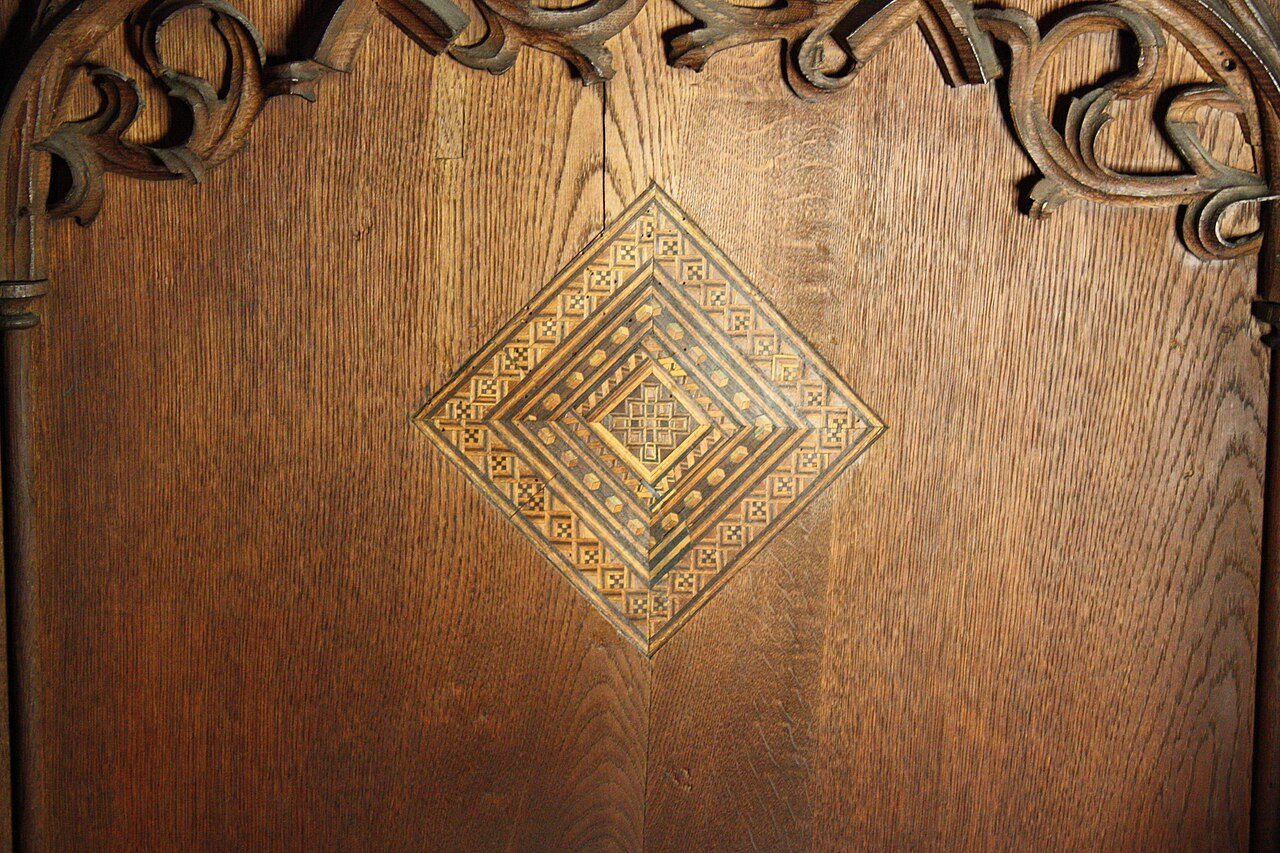
4 min read · 2 sourcesIntarsia is a form of wood inlaying that is similar to marquetry. The practice dates from before the 7th century AD. The technique inserts sections of wood (at times with contrasting ivory or bone, or mother-of-pearl) within the solid wood matrix of floors and walls or of tabletops and other furniture; by contrast marquetry assembles a pattern out of veneers glued upon the carcass. Certosina is a variant also using pieces of ivory, bone or mother of pearl. Intarsia is mostly used in Italian, or at least European work. Similar techniques are found over much of Asia and the Middle East. The word is from the Italian, derived from Arabic. 1
Overview
When Egypt came under Arab rule in the seventh century, indigenous arts of intarsia and wood inlay, which lent themselves to non-representational decors and tiling patterns, spread throughout the Maghreb. The technique of intarsia was already perfected in Islamic North Africa before it was introduced into Christian Europe through Sicily and Andalusia. The art was further developed in Siena and by Sienese masters at the cathedral of Orvieto, where figurative intarsia made their first appearance, c. 1330 and continuing into the 15th century and in northern Italy in the fifteenth and sixteenth centuries, spreading to German centers and introduced into London by Flemish craftsmen in the later sixteenth century. The most elaborate examples of intarsia can be found in cabinets of this period, which were items of great luxury and prestige. Multiple colors could be used by exploiting differently-colored spalted woods. After about 1620, marquetry tended to supplant intarsia in urbane cabinet work. Intarsia gained popularity in the United States in the 1980s as a wooden art technique using a band saw or scroll saw. Early practitioners made money both by selling their art, and by selling patterns for others to use. In France Georges Vriz proposed a new method for marquetry. Contrary to other techniques, based on a decoration "flat" made of wood or other material, Vriz superimposed the layers of wood using thin, transparent elements that impart color and depth. 1
Masters of perspective in Florence
With the success of linear perspective in Florence, intarsia altered its decorative repertoire, turning toward geometric solids and perspectival views, becoming one of the principal vehicles for transmitting the new perspectival revolution. 1
The Certosa di Pavia
Given the high compositional quality, it is believed that important painters active at the Certosa, including Ambrogio Bergognone, Iacopino de Mottis and Bernardo Zenale, supplied the models for the intarsia. 1
The workshop of the Canozi of Lendinara
Giovanni Maria Platina, the most accomplished pupil of Cristoforo Canozi, was active in Cremona, producing a reliquary cabinet between 1477 and 1480 and, between 1483 and 1490, the choir of Cremona Cathedral. 1
Giovanni da Verona and the Veneto–Neapolitan manner
In Venice worked Fra Sebastiano da Rovigo and his pupil Fra Giovanni da Verona. Between 1491 and 1499 they executed the choir of Santa Maria in Organo in Verona, where the inlays moved beyond the classical geometric repertoire to more intricate compositions. The 27 upper stalls feature backs separated by pilasters: below are Renaissance grotesque motifs, while above arches frame saints, ideal perspective views, or half-open cupboards revealing sacred and secular objects. The work, produced with numerous collaborators including Raffaele da Brescia, was signed by the artist. Between 1503 and 1505 Fra Giovanni executed the choir of the Abbey of Monte Oliveto Maggiore in Siena; from 1506 to 1511 he worked at the Sant'Anna dei Lombardi convent in Naples, and between 1511 and 1512 on the panelling of the Sala della Segnatura in Rome (lost). 1
The text above is adapted from the Wikipedia article “Intarsia”, available under the Creative Commons Attribution-ShareAlike 4.0 licence. 1
intarsia is decorative inlay technique using precisely fit pieces of material, most often veneer, to produce a design, according to the structured record cited below. This entry was generated automatically from that record and has not yet been reviewed by a person familiar with the tradition. 2
The source record links this tradition to 22 external registers, which can be verified through the citation. 2