The tradition & historical record
3 min read · 2 sourcesIpswich lace is a historical fashion accessory, the only known American hand-made bobbin lace to be commercially produced. Centered in the coastal town of Ipswich, Massachusetts north of Boston, a community of lacemaking arose in the 18th century. Puritan settlers to the area likely made and wore lace as early as 1634, because Sumptuary laws from the early colonial records indicate this activity. A drawn thread lace embroidery in the Peabody Essex Museum survives from the earliest colonists, the work of Anne Gower Endicott. The earliest known record of the act of bobbin lacemaking in the region comes from a court case in 1654 associated with the home of Governor John Endicott. An indentured servant in the household accused the governor's son Zerubbabel with assault, which occurred while she was working at her lace cushion. Earliest known records of the commercial production indicate that lace produced by local women was used to barter for goods in the 1760s, as denoted by ledger account books belonging to local merchants. These laces were sold in the region from Boston to Maine. Although some references presume that Ipswich lace represents an offshoot of the styles of British laces such as that known today as Bucks point lace, and originated with English immigration, other evidence points to continental influence. Bucks point is theorized to have developed from Mechlin, Lille, and other lace styles brought to England with Huguenot refugees. 1
History
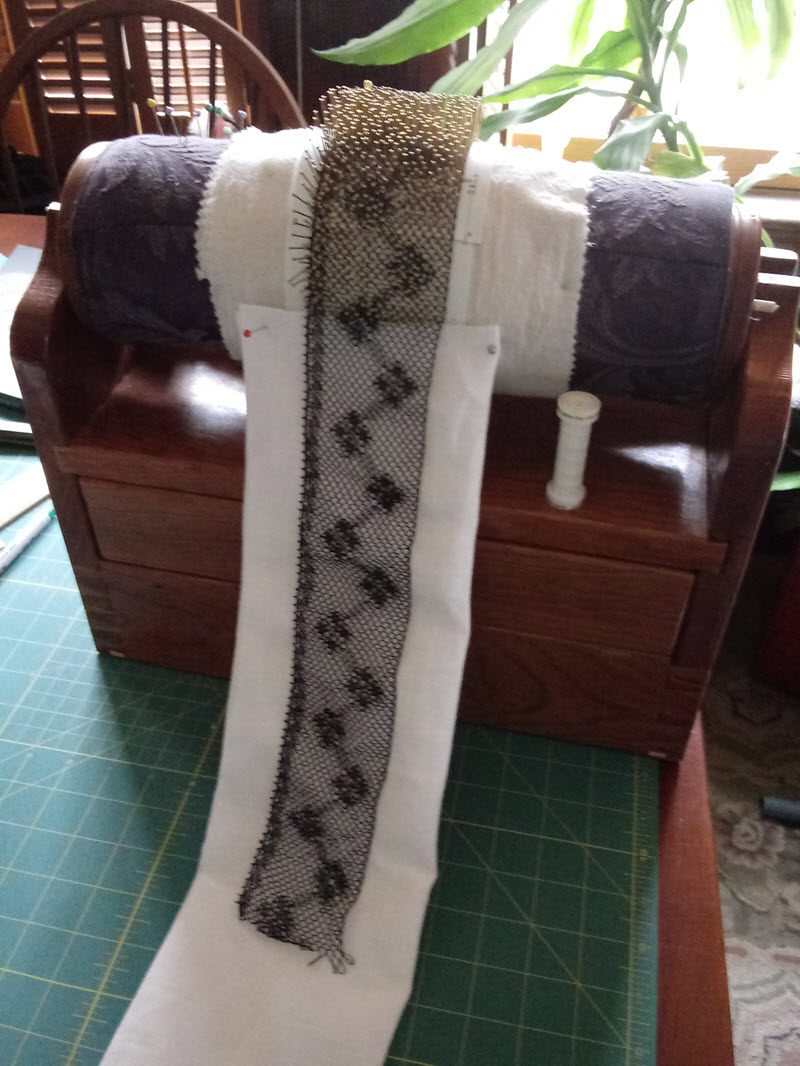
Typically the lace was produced from "prickings" or patterns created on parchment or pasteboard that were attached to a round bolster-style lace pillow. Bobbins whittled from local wood or reeds were used to provide the thread repository and the appropriate tension for constructing the lace. Linen or silk thread was the material commonly used in the early period with cotton employed only later after the development of mercerised cotton improved thread characteristics. Imported and individually handmade pins provided the structural support for the patterns, until pin-making machines became available in the 1840s. Known lace examples are largely white linen or black silk threads. 1
Preceding and during the American Revolutionary War, the purchase of luxury imported goods was problematic from social, political, and logistical perspectives. Hannah Adams of Medfield, who later became an eminent writer, described making bobbin lace herself during these years. The style or type of lace she made is unknown, but confirms that lace making was underway and profitable during this period in Massachusetts.During the American revolutionary war, I learned to weave bobbin lace, which was then saleable, and much more profitable to me than spinning, sewing or knitting, which had previously been my employment. At this period I found but little time for literary pursuits. But at the termination of the American war, this resource failed, and I was again left in a destitute situation. By the 1790s, over 600 women in the Ipswich area were producing significant quantities of lace for sale. Stored in the Library of Congress with the papers of Alexander Hamilton, a report of this activity was submitted to the Secretary of the Treasury with actual samples of Ipswich lace. 1
The text above is adapted from the Wikipedia article “Ipswich lace”, available under the Creative Commons Attribution-ShareAlike 4.0 licence. 1
Ipswich lace is type of bobbin lace made in Ipswich, Massachusetts in the 18th century, according to the structured record cited below. This entry was generated automatically from that record and has not yet been reviewed by a person familiar with the tradition. 2
The source record links this tradition to 1 external register, which can be verified through the citation. 2