The tradition & historical record
5 min read · 2 sourcesIrish mythology is the body of myths indigenous to the island of Ireland. It was originally passed down orally in the prehistoric era. In the early medieval era, myths were written down by Christian scribes, who revised it considerably in order to fit the history and religion according to Christianized learning. Irish mythology is the best-preserved branch of Celtic mythology. The myths are conventionally grouped into 'cycles'. The Mythological Cycle consists of tales and poems about the god-like Tuatha Dé Danann, who are based on Ireland's pagan deities, and other mythical races like the Fomorians. Important works in the cycle are the Lebor Gabála Érenn ("Book of Invasions"), a legendary history of Ireland, the Cath Maige Tuired ("Battle of Moytura"), and the Aided Chlainne Lir ("Children of Lir"). The heroic cycles and even the Historical Cycle (Cycle of the Kings) are also considered repositories of mythological texts. The Ulster Cycle consists of heroic legends relating to the Ulaid, the most important of which is the epic Táin Bó Cúailnge ("Cattle Raid of Cooley"). The Fenian Cycle focuses on the exploits of the mythical hero Finn and his warrior band the Fianna, including the lengthy Acallam na Senórach ("Tales of the Elders"). 1
Figures
Myles Dillon and Nora K. Chadwick classify Irish gods into four main groups. Group one encompasses the older gods of Gaul and Britain. The second group is the main focus of much of the mythology and surrounds the native Irish gods with their homes in burial mounds. The third group are the gods that dwell in the sea and the fourth group includes stories of the Otherworld. The gods that appear most often are the Dagda and Lugh. 1
Tuatha Dé Danann
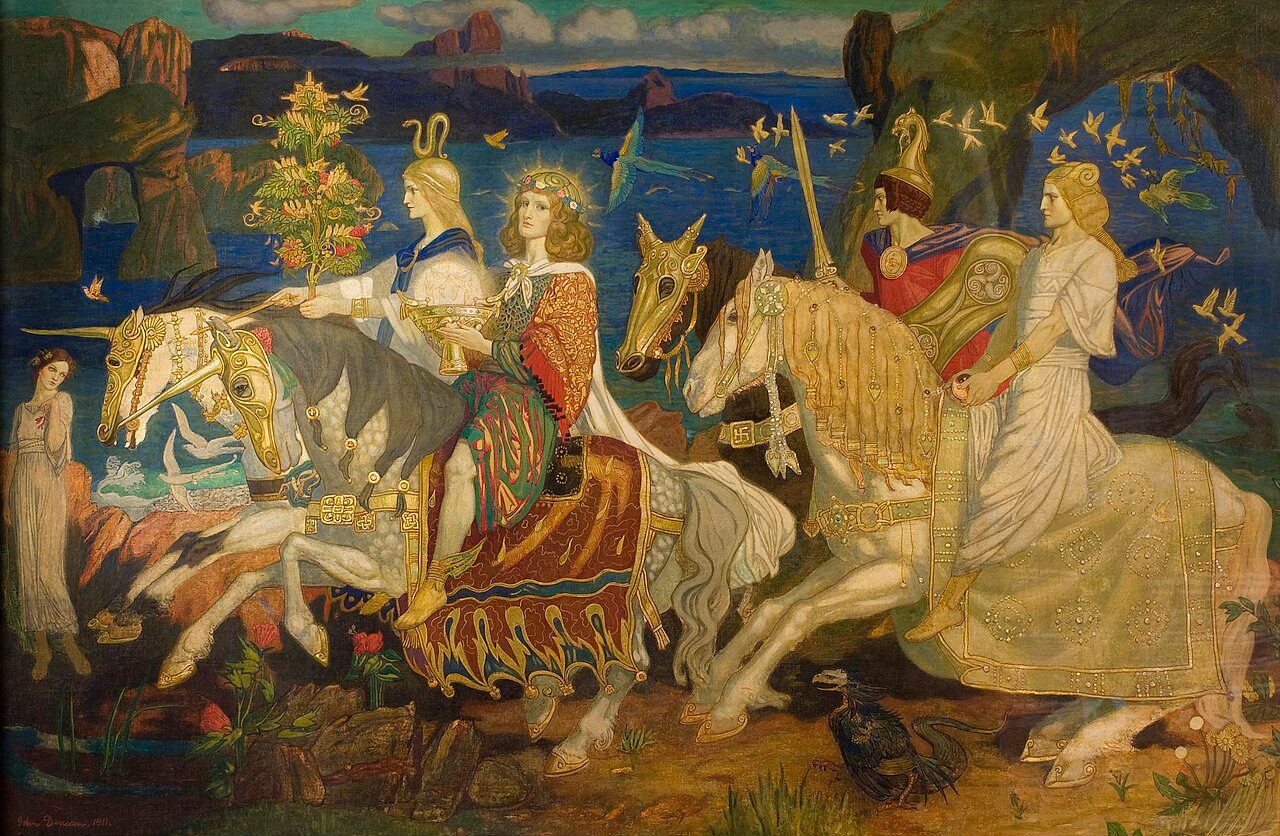
The main supernatural beings in Irish mythology are the Tuatha Dé Danann. 1
Terminology
Tuatha Dé Danann is construed to mean "the folk of the goddess Danann or "people/tribe/nation of the god Ana[?]" Ana or Anu is an attested name of a goddess (with genitive form Annan); Danann is only found in later attestations; reconstructed (nominative) forms *Danu or *Dana are unattested and are speculative. The solution may be that Dana is merely a d-added variant of the goddess Ana/Anu However, others suggest it was a later scholarly invention, an extension added to the original appellation which was simply Tuath Dé (god-folk), until the simpler version became inconveniently ambiguous with Tuath Dé used to denote the "People of God" (i.e., Israelites). Whatever the origin, Dana/Danu/Danand is treated as just a variant form of Ana/Anu/Anand in certain scholarly circles, and thus a bona fide goddess, e.g., Macalister's translation of the Lebor Gabala. A Welsh goddess Dôn is mentioned as possibly connected, insinuating the plausibility of the Dana/Danu goddess in Irish myth. 1
General description
Prominent male deities include The Dagda ("the great god"); the long-armed Lugh; the silver-armed Nuada; Aengus; the sea god Manannán; Dian Cécht the healer. There are also Goibniu the smith, Creidhne the goldsmith/brazier, and Luchta the carpenter. There is also Ogma, a god of eloquence and a warrior, as well as Nét (Neit) a "god of war". The Warrior goddesses are often depicted as a triad: The Morrígan, Macha, and Badb while Keating's History has little to say about these three deities. The warrior goddesses appear in the saga Táin Bó Cúailnge, meddling in the human wars between the Ulstermen and Connacht. The Morrígan appears in the guise of a crow (badb, namesake of her sister goddess) before Cú Chulainn. In a later encounter, she transforms into an eel, wolf, and cow. Brigit a "goddess of poets" and daughter of the Dagda. Ana/Anu aka Dannan/Dana/Danu is as aforementioned, the "mother of the Irish gods", and possibly an alias of The Morrígan. The Tuatha Dé Danann live in the Otherworld, which is described as either a parallel world or a heavenly land beyond the sea or under the earth's surface. Many of them are associated with specific places in the landscape, especially the sídh mounds; the ancient burial mounds and passage tombs which are entrances to Otherworld realms. The Tuath Dé can hide themselves with a féth fíada ('magic mist') and appear to humans only when they wish to. The Tuatha Dé intermarried with their adversaries, the Fomorians, so that when Nuada became disqualified from kingship due to his debility (loss of arm), Bres who had a Fomorian father took over the kingship of the Tuatha Dé. There ensued the Second Battle of Mag Tuired where Lug led the victory by slaying the Fomorian champion Balor, his own grandfather. 1
Fomorians
The Fomorians or Fomori (Old Irish: Fomóire) are a supernatural race, who are often portrayed as hostile and monstrous beings. Originally, they were said to come from under the sea or the earth. Later, they were portrayed as sea raiders, which was probably influenced by the Viking raids on Ireland around that time. Later still they were portrayed as giants. They are enemies of Ireland's first settlers and opponents of the Tuatha Dé Danann, although some members of the two races have offspring. The Tuath Dé defeat the Fomorians in the Battle of Mag Tuired. This has been likened to other Indo-European myths of a war between gods, such as the Æsir and Vanir in Norse mythology and the Olympians and Titans in Greek mythology. 1
The text above is adapted from the Wikipedia article “Irish mythology”, available under the Creative Commons Attribution-ShareAlike 4.0 licence. 1
Irish mythology is body of myths indigenous to the island of Ireland, according to the structured record cited below. This entry was generated automatically from that record and has not yet been reviewed by a person familiar with the tradition. 2
The source record links this tradition to 10 external registers, which can be verified through the citation. 2