The tradition & historical record
5 min read · 2 sources"Iron John" (also "Iron Hans"; German: Der Eisenhans) is a German fairy tale found in the collections of the Brothers Grimm, tale number 136, about an iron-skinned wild man and a prince. The original German title is Eisenhans, a compound of Eisen "iron" and Hans (like English John, a common short form of the personal name Johannes). It represents Aarne–Thompson type 502, "The wild man as a helper". Most people see the story as a parable about a boy maturing into adulthood. The story also became the basis for the book Iron John: A Book About Men by Robert Bly which spawned the mythopoetic men's movement in the early 1990s. The book spent 62 weeks on The New York Times Best Seller list. 1
Origin
According to the Brothers Grimm, the source of Eisern Hans, in their compilation, was tale nr. 17 from Friedmund von Arnim's book. 1
Synopsis
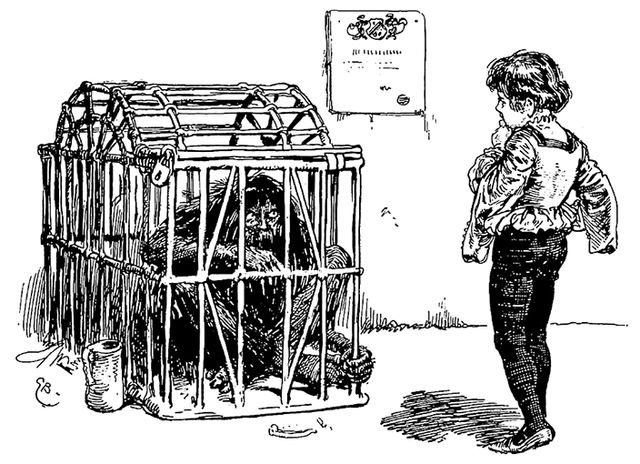
Once upon a time, there was a kingdom that was near a great forest that was filled with all types of wild animals. The King sends a huntsman into the forest nearby to hunt a deer and the huntsman never returns. The King sends more men into the forest where they each meet with the same fate. The King sends all his remaining huntsmen out as a group, but again, none return. The king proclaims the woods as dangerous and off-limits to all. Some years later, a wandering explorer accompanied by a dog hears of these dangerous woods and asks permission to hunt in the forest, claiming that he might be able to discover the fate of the other hunters. The man and his dog are allowed to enter. As they come to a lake in the middle of the forest, the dog is dragged under water by a giant bare arm. The hunter returns to the forest the next day with a group of men to empty the lake. They find lying down at the bottom of the lake a large and naked wild man with rusted iron-like skin (some versions show him in some article of clothing) and sporting a shaggy beard and hair that are long enough to go down to his knees. They capture him and he is locked in a cage in the courtyard as a curiosity. The king declares that no one is allowed to set the wild man free or they will face the penalty of death. Years later, the 8-year-old prince is playing with a ball in the courtyard. He accidentally rolls it into the cage where the iron-skinned man picks it up and will only return it if he is set free. He states further that the only key to the cage is hidden beneath the queen's pillow. Though the prince hesitates, he eventually builds up the courage to sneak into his mother's room and steal the key. 1
Tale type
The tale is classified in the international Aarne-Thompson-Uther Index as type ATU 502, "The Wild Man as Helper". The oldest variant to be preserved is the Italian Guerrino and the Savage Man. In chivalric romance the motif appears in recognizable if rationalized form in Roswall and Lillian. This in turn influenced the ballad The Lord of Lorn and the False Steward, too closely related not to be derived. 1
Related tales
A more widespread variant, found in Europe, Asia, and Africa, opens with the prince for some reason being the servant of an evil being, where he gains the same gifts, and the tale proceeds as in this variant; one such tale is The Magician's Horse. These tales are classified in the Aarne-Thompson-Uther Index as ATU 314, "The Goldener": a youth with golden hair works as the king's gardener. In this regard, Germanist Günter Dammann, in Enzyklopädie des Märchens, suggested that tale type ATU 502 should be treated as an introductory episode, since both types (ATU 502 and ATU 314) "largely" have the same narrative sequence. Also, he noted that the type was marked by the release of the wild man prisoner by the hero. Similarly, German scholar Hans-Jörg Uther noted that type ATU 502 is "often" the first part to ATU 314, "Goldener". Another closely related tale is the former tale type AT 532, "I Don't Know" or Neznaiko (a sapient horse instructs the hero to play dumb). The former type happens in Hungarian tale Nemtutka and Russian tale Story of Ivan, the Peasant's Son. These three tale types (ATU 502, ATU 314 and AaTh 532), which refer to a male protagonist expelled from home, are said to be "widespread in Europe". 1
Variants
Tale type ATU 502 is known throughout Europe, in such variants as The Hairy Man. The tale type is said to be common in Russian and Ukraine, but "disseminated" in Western Europe. The type can also be found in India, Indonesia and Turkey. 1
The text above is adapted from the Wikipedia article “Iron John”, available under the Creative Commons Attribution-ShareAlike 4.0 licence. 1
Iron John is German fairy tale collected by the Brothers Grimm, according to the structured record cited below. This entry was generated automatically from that record and has not yet been reviewed by a person familiar with the tradition. 2
The source record links this tradition to 4 external registers, which can be verified through the citation. 2