The tradition & historical record
6 min read · 2 sourcesIslamic art is a part of Islamic culture and encompasses the visual arts produced since the 7th century CE by people who lived within territories inhabited or ruled by Muslim populations. Referring to characteristic traditions across a wide range of lands, periods, and genres, Islamic art is a concept used first by Western art historians in the late 19th century. Public Islamic art is traditionally non-representational, except for the widespread use of plant forms, usually in varieties of the spiralling arabesque. These are often combined with Islamic calligraphy, geometric patterns in styles that are typically found in a wide variety of media, from small objects in ceramic or metalwork to large decorative schemes in tiling on the outside and inside of large buildings, including mosques. Other forms of Islamic art include Islamic miniature painting, artefacts like Islamic glass or pottery, and textile arts, such as carpets and embroidery. The early developments of Islamic art were influenced by Roman art, Early Christian art (particularly Byzantine art), and Sassanian art, with later influences from Central Asian nomadic traditions. Chinese art had a significant influence on Islamic painting, pottery, and textiles. 1
Terminology
Although the concept of "Islamic art" has been put into question by some modern art historians as a construct of Western cultural views, the similarities between art produced at widely different times and places in the Muslim world, especially in the Islamic Golden Age, have been sufficient to keep the term in wide use as a useful classification since the late 19th century. Scholars such as Jacelyn K. Kerner have drawn attention to its wide-ranging scope referring to more than 40 nations and to the growing public interest both in Western as well as, more recently, in Muslim societies. Further, the List of Islamic museums bears witness to this art historical term having found wide acceptance. The Encyclopædia Britannica defines "Islamic arts" as including visual arts, literature, performing arts and music that "virtually defies any comprehensive definition". In a strict sense, the term might only refer to artistic manifestations that are closely related to religious practice. Most often, however, it is meant to include "all of the arts produced by Muslim peoples, whether connected with their religion or not." 1
Calligraphy
Calligraphic design is omnipresent in Islamic art, where, as in Europe in the Middle Ages, religious exhortations, including Qur'anic verses, may be included in secular objects, especially coins, tiles and metalwork, and most painted miniatures include some script, as do many buildings. Use of Islamic calligraphy in architecture extended significantly outside of Islamic territories; one notable example is the use of Chinese calligraphy of Arabic verses from the Qur'an in the Great Mosque of Xi'an. Other inscriptions include verses of poetry, and inscriptions recording ownership or donation. Two of the main scripts involved are the symbolic kufic and naskh scripts, which can be found adorning and enhancing the visual appeal of the walls and domes of buildings, the sides of minbars, and metalwork. Islamic calligraphy in the form of painting or sculptures is sometimes referred to as Quranic art. The various forms of traditional Arabic calligraphy and decoration of the manuscripts used for written versions of the Qur'an represent a central tradition of Islamic visual art. The arabesque is often used to symbolize the transcendent, indivisible and infinite nature of God. Mistakes in repetitions may be intentionally introduced as a show of humility by artists who believe only God can produce perfection, although this theory has also been disputed. East Persian pottery from the 9th to 11th centuries, decorated only with highly stylised inscriptions and called "epigraphic ware", has been described as "probably the most refined and sensitive of all Persian pottery". Large inscriptions made from tiles, sometimes with the letters raised in relief, or the background cut away, are found on the interiors and exteriors of many important buildings. 1
Painting
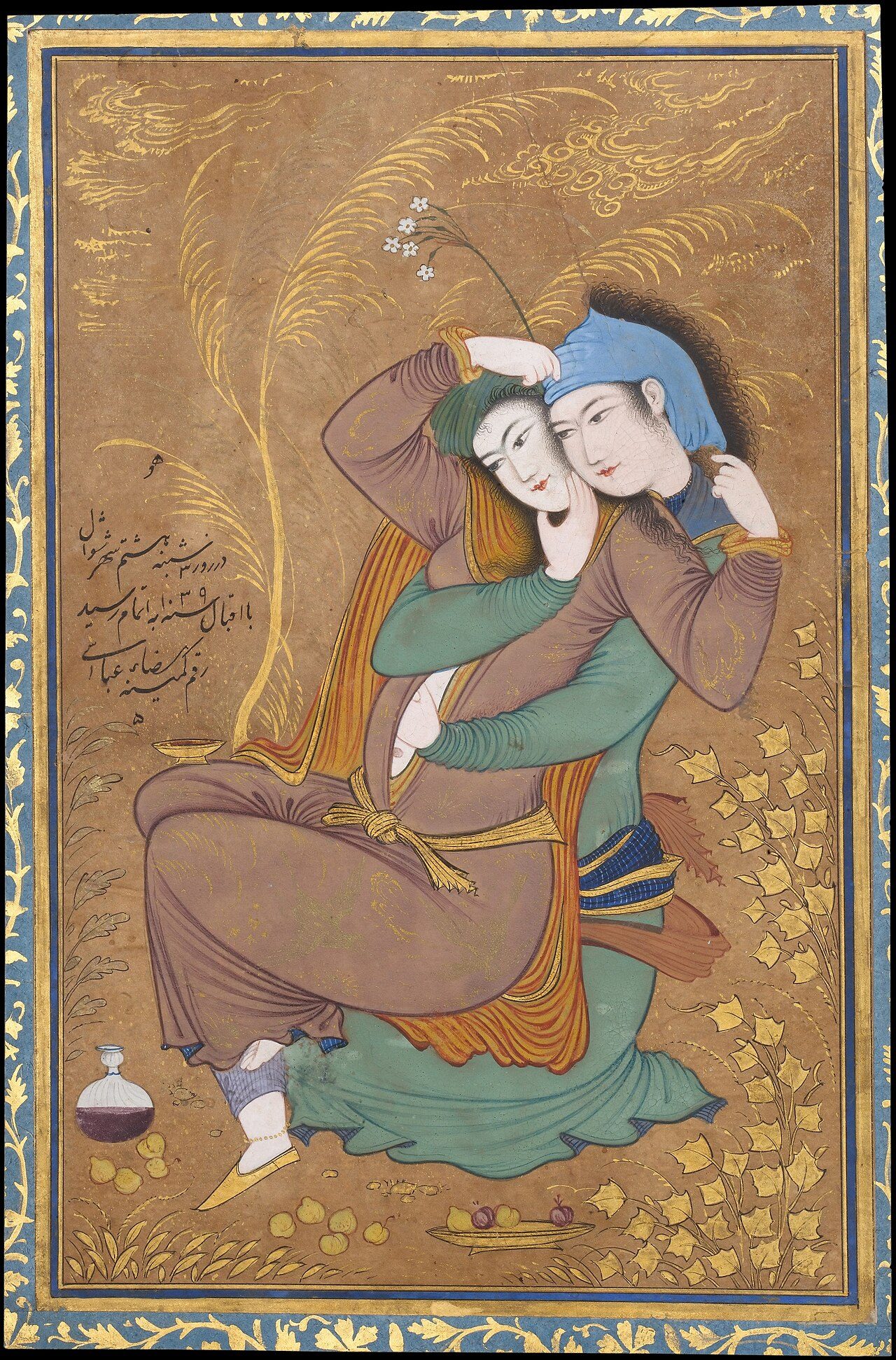
For a long time, Islam was considered aniconic. Existing pictures among the Muslim royalty have been described as an "aberration" by Thomas Walker Arnold and ascribed to only a later Persinate and Turkic cultural period. However, figurative arts existed since the formative stage of Islam. Such arts have been boasted by Arabic speaking caliphats of Baghdad, Cairo, and Cordova, inspired by Sasanid and Byzantine models. Figurative arts enjoyed prestige among both orthodox Sunni circles as well as Shia Muslims. The disappearance of royal-sponsored figurative arts in Arabic-speaking lands at a later period is best explained by the overthrow of their ruling dynasties and reduction of most their territories to Ottoman provincial dependencies, not by religious prohibition. Another drawback for Arnold's argument against the religious value of figurative arts in Islamic culture is, that a sizable number of rulers ordering figurative arts in the 14th-17th century, were religious zealots proclaiming to spread and enforce the laws of the sharia. Although not many early examples survived, human figurative art was a continuous tradition in Islamic lands, notably several of the Umayyad Desert Castles (c. 660–750), and during the Abbasid Caliphate (c. 749–1258). Prior to the early 14th century, a halo was a common symbol to designate rulers. Under Asian influence, the halo as a symbol of sacredness was replaced by a flame. Reminiscent of the Islamic prophet Solomon, rulers were often depicted as sitting on a throne endowed with religious symbols. An ivory casket carved in early eleventh century Cordova shows a Spanish Muslim ruler holding a cup seated upon a lion throne, similar to that of Solomon. 1
Rugs and carpets
No Islamic artistic product has become better known outside the Islamic world than the pile carpet, more commonly referred to as the Oriental carpet (oriental rug). Their versatility is utilized in everyday Islamic and Muslim life, from floor coverings to architectural enrichment, from cushions to bolsters to bags and sacks of all shapes and sizes, and to religious objects (such as a prayer rug, which would provide a clean place to pray). They have been a major export to other areas since the late Middle Ages, used to cover not only floors but tables, for long a widespread European practice that is now common only in the Netherlands. Carpet weaving is a rich and deeply embedded tradition in Islamic societies, and the practice is seen in large city factories as well as in rural communities and nomadic encampments. In earlier periods, special establishments and workshops were in existence that functioned directly under court patronage. 1
Very early Islamic carpets, i.e. those before the 16th century, are extremely rare. 1
Ceramics
Islamic art has very notable achievements in ceramics, both in pottery and tiles for walls, which in the absence of wall-paintings were tak… 1
The text above is adapted from the Wikipedia article “Islamic art”, available under the Creative Commons Attribution-ShareAlike 4.0 licence. 1
Islamic art is artistic production that developed from the hegira (year 622) to the nineteenth century, from Spain to India among populations of Islamic culture, according to the structured record cited below. This entry was generated automatically from that record and has not yet been reviewed by a person familiar with the tradition. 2
The source record links this tradition to 50 external registers, which can be verified through the citation. 2