The tradition & historical record
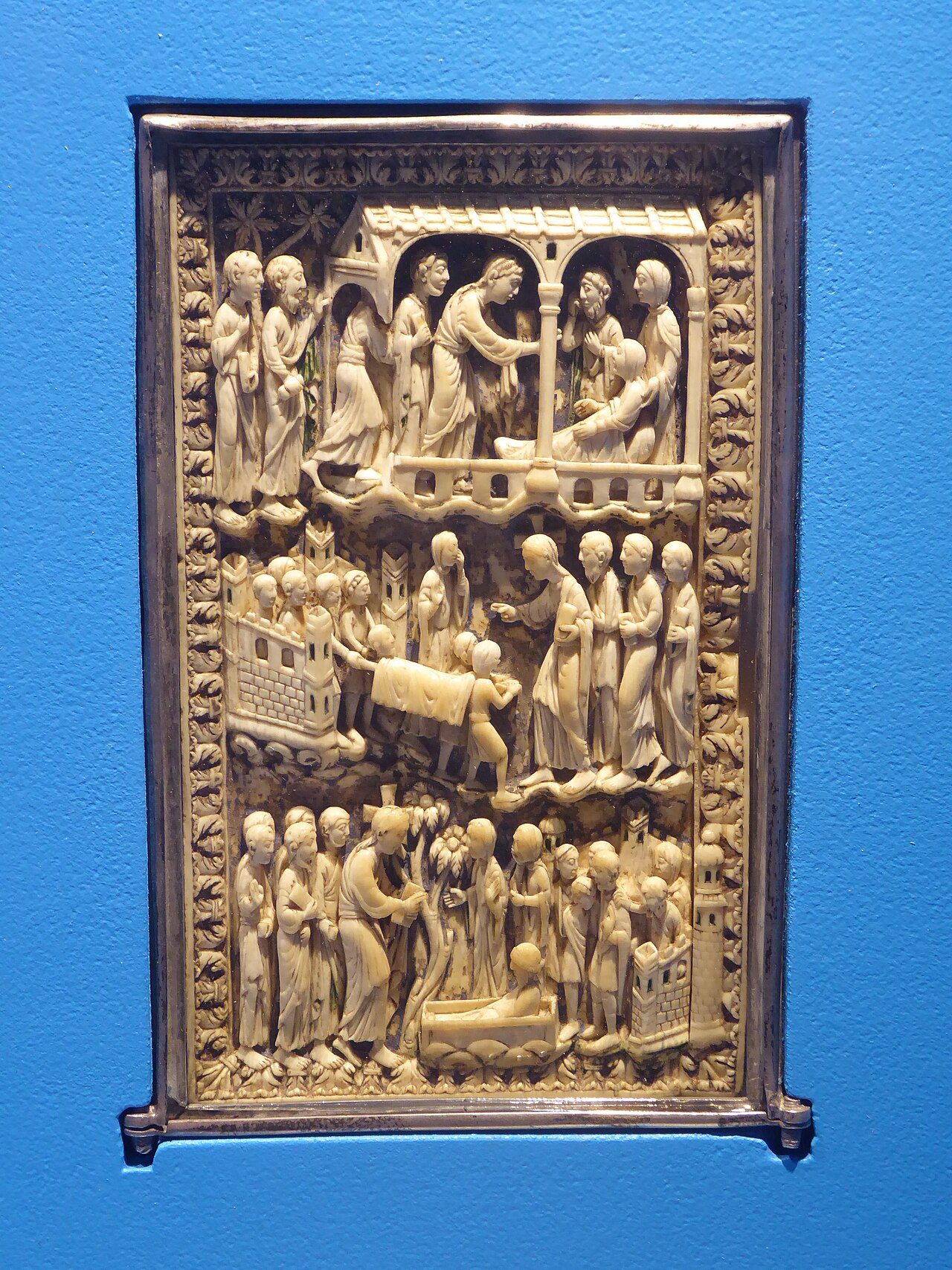
7 min read · 2 sourcesIvory carving is the carving of ivory, that is to say animal tooth or tusk, generally by using sharp cutting tools, either mechanically or manually. Objects carved in ivory are often called "ivories". Humans have ornamentally carved ivory since prehistoric times, though until the 19th-century opening-up of the interior of Africa, it was usually a rare and expensive material used for small luxury products. Very fine detail can be achieved, and as the material, unlike precious metals, has no bullion value and usually cannot easily be recycled, the survival rate for ivory pieces is much higher than for those in other materials. Ivory carving has a special importance to the medieval art of Europe because of this, and in particular for Byzantine art as so little monumental sculpture was produced or has survived. As the elephant and other ivory-producing species have become endangered, largely because of hunting for ivory, CITES and national legislation in most countries have reduced the modern production of carved ivory. 1
The material
Ivory is by no means exclusively obtained from elephants; any animal tooth or tusk used as a material for carving may be termed "ivory", though the species is usually added, and a great number of different species with tusks or large teeth have been used. Teeth have three elements: the outer dental enamel, then the main body of dentine, and the inner root of osteo-dentine. For the purposes of carving, the last two are in most animals both usable, but the harder enamel may be too hard to carve, and require removal by grinding first. This is the case with hippopotamus for example, whose tooth enamel (on the largest teeth) is about as hard as jade. Elephant ivory, as well as coming in the largest pieces, is relatively soft and even, and an ideal material for carving. The species of animal from which ivory comes can usually be determined by examination under ultra-violet light, where different types show different colours. Eurasian elephant ivory was usually obtained from the tusks of elephants in India, and in Roman times, from North Africa; from the 18th century sub-Saharan Africa became the main source. Ivory harvesting led to the extinction, or near-extinction of elephants in much of their former range. In early medieval Northern Europe, walrus ivory was traded south from as far away as Norse Greenland to Scandinavia, southern England and northern France and Germany. In Siberia and Arctic North America, mammoth tusks could be recovered from permafrost and used; this became a large business in the 19th century, with convicts used for much of the labour. The 25,000-year-old Venus of Brassempouy, arguably the earliest real likeness of a human face, was carved from mammoth ivory no doubt freshly killed. 1
Ancient Egypt and Near East
The Khufu Statuette may come from the Fourth Dynasty (Old Kingdom, c. 2613 to 2494 BC), when its subject lived, or it may have been carved much later, in the Twenty-Sixth Dynasty (664 BC–525 BC). The MacGregor plaque is more securely dated to around 2985 BC, and may have decorated a royal sandal. Thin ivory plaques were widely used throughout the ancient world as inlays to decorate palace furniture, musical instruments, gaming boards and other luxurious objects. The Tomb of Tutankhamun (1330s BC) contains many such ivory elements, the largest perhaps his carved headrest. The Nimrud ivories are a large group of such objects recovered from a furniture storeroom at the Assyrian capital. They date to around the 9th to 6th centuries BC, and have a number of different origins from around the Assyrian Empire, with the Levant the most common. The so-called Pratt Ivories are another smaller group of furniture attachments from the early second millennium BC, from the Assyrian karum at Acemhöyük in Anatolia. Ivory was used in the Palace of Darius in Susa in the Achaemenid Empire, according to an inscription by Darius I. The raw material was brought from Nubia in Africa and South Asia (Sind and Arachosia). 1
Antiquity and the Early Medieval period
Chryselephantine sculptures are figures made of a mixture of ivory, usually for the flesh parts, and other materials, usually gilded, for the clothed parts, and were used for many of the most important cult statues in Ancient Greece and other cultures. These included the huge Athena Parthenos, the statue of the Greek goddess Athena made by Phidias and the focus of the interior of the Parthenon in Athens. Ivory will survive very well if dry and not hot, but in most climates does not often long survive in the ground, so that our knowledge of Ancient Greek ivory is restricted, whereas a reasonable number of Late Roman pieces, mostly plaques from diptychs, have survived above ground, typically ending up in church treasuries. No doubt versions of figurines and other types of object that survive in ancient Roman pottery and other media were also made in ivory, but survivals are very rare. A few Roman caskets with ivory plaques with relief carvings have survived, and such objects were copied in the Early Middle Ages – the Franks Casket in bone is an Anglo-Saxon version from the 8th century, and the Veroli Casket a Byzantine one from about 1000. Both include mythological scenes, respectively Germanic and classical, that are found in few other works from these periods. 1
The most important Late Antique work of art made of ivory is the throne of Maximian. The cathedra of Maximianus, bishop of Ravenna (546–556), was covered entirely with ivory panels. It was probably carved in Constantinople and shipped to Ravenna. 1
High medieval onwards
Typical Byzantine ivory works after the Iconoclastic period were triptychs. Among the most remarkable examples is the Harbaville Triptych from the 10th century with many figurative panels. Such Byzantine triptychs could only have been used for private devotion because of their relatively small size. Another famous 10th century ivory triptych is the Borradaile Triptych in the British Museum, with only one central image (the Crucifixion). The Romanos Ivory is similar to the religious triptychs but its central panel shows Christ crowning Emperor Romanos and Empress Eudokia. There are different theories about which Byzantine ruler was made for the triptych. One possible solution is Romanos II that gives the date of production between 944 and 949. It seems that ivory carving declined or largely disappeared in Byzantium after the 12th century. Western Europe also made polytychs, which by the Gothic period typically had side panels with tiers of relief narrative scenes, rather than the rows of saints favoured in Byzantine works. These were usually of the Life of the Virgin or Life of Christ. If it was a triptych the main panel usually still featured a hieratic scene on a larger scale but diptychs just with narrative scenes were common. Western art did not share Byzantine inhibitions about sculpture in the round: reliefs became increasing high and small statues were common, representing much of the best work. 1
Islamic World
Ivory is a very suitable material for the intricate geometrical… 1
The text above is adapted from the Wikipedia article “Ivory carving”, available under the Creative Commons Attribution-ShareAlike 4.0 licence. 1
ivory carving is carving of animal tooth or tusk by using sharp cutting tools, according to the structured record cited below. This entry was generated automatically from that record and has not yet been reviewed by a person familiar with the tradition. 2
The source record links this tradition to 10 external registers, which can be verified through the citation. 2