The tradition & historical record
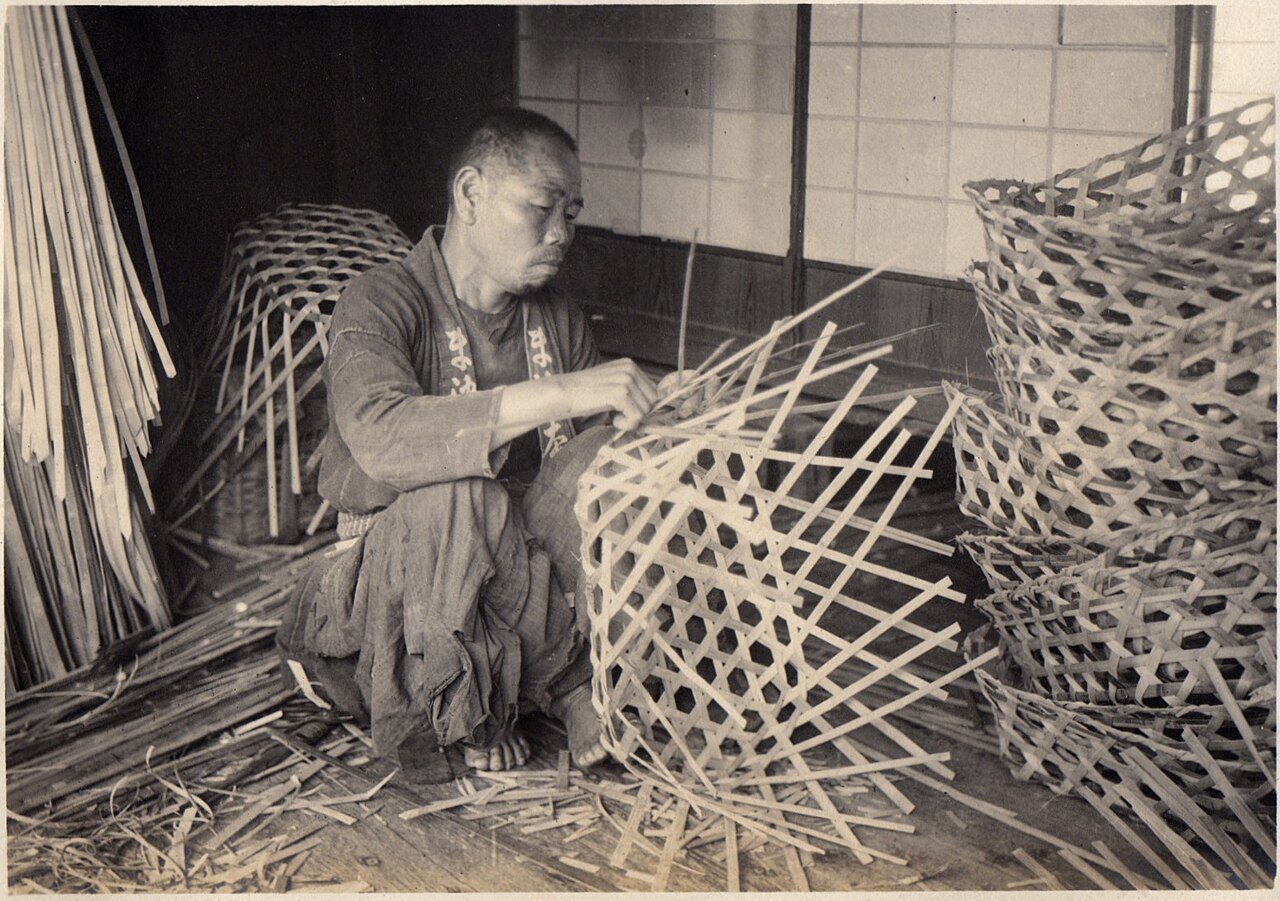
6 min read · 2 sourcesBamboo weaving (竹編み, takeami) is a form of bambooworking (竹細工, takezaiku) and a traditional Japanese craft (工芸, kōgei), with a range of different applications, weaving styles and appearances. Japanese bamboo weaving is particularly well known for its use in basket weaving. 1
History
More than six hundred species of bamboo, some endemic to the island, grow in Japan. Although defined as a subfamily of grasses, bamboo is characterized by its woody culm and a root system that can form either thick, slowly spreading clusters or more aggressive runners. Qualities such as the strength and flexibility of a bamboo variety differ widely, with some types considered more suitable for use in bamboo crafts than others. One such type especially used in bamboo weaving is Phyllostachys bambusoides, known as madake (真竹) or kashirodake (皮白竹), which is renowned for its combination of high strength and high flexibility. Bamboo has characteristics which, over time, have led to its frequent usage in Japanese culture and the development of symbolism associated with its qualities. It is a fast-growing, straight-limbed and flexible plant, does not decay quickly once cut, and can be used for building shelters, weapons, instruments and containers. Young bamboo shoots, which are edible, form a part of traditional Japanese cuisine, and bamboo is a common theme in Japanese literature and painting. Along with evergreen pine trees and plum blossoms – the first flower of spring – bamboo is a part of the traditional Three Friends of Winter motif, commonly seen on kimono worn for auspicious occasions as a symbol of perseverance and resilience. Japanese artists have often represented bamboo enduring inclement weather, such as rain or snow, reflecting its reputation for being flexible but unbreakable, and its association with steadfastness and loyalty. Flower baskets for ikebana called hanakago (花籠) and other types were imported from China or their style copied. These karamono (唐物, lit. 'Chinese style') baskets had formal, symmetrical structures with tightly plaited weaves. 1
Kansai artisans
Of items woven from bamboo in Japan, sophisticated sencha flower baskets and tea utensil baskets were historically in especially high demand in the western region of Kansai, with Osaka and Kyoto at its centre. In the late 19th century, master craftsmen in the region began combining technical perfection with artistic individuality to produce functional "art baskets" that were signed by the artist. The pioneering Kansai bamboo artist Hayakawa Shōkosai I (早川尚古斎; 1815–1897), is believed to be the first master to have signed his baskets, studied the traditional craft of rattan plaiting, and concentrated on sencha tea utensils. His eldest son, Shōkōsai II (1860–1905), followed him into the basketry trade but died at an early age. He was succeeded by his younger brother, Shōkosai III (1864–1922), who developed an advanced style of plaiting called "coarse weave", a departure from the family's signature techniques. After World War II, Shōkōsai IV (1902–1975) moved from Osaka to Kyoto, where he established the new family workshop. Shōkōsai V (1932–2011) explored further possibilities in armor plaiting, a type of parallel construction considered one of the traditional Hayakawa techniques. He exhibited his work at the annual Japanese Traditional Art Crafts Exhibitions beginning in 1966 and was designated a Living National Treasure in 2003. The Osaka-based bamboo artist Wada Waichisai I (和田和一斎; 1851–1901) established an important and long-lasting lineage of masters. He was known for his precise, delicate plaiting techniques, making primarily karamono (Chinese-style) baskets and utensils for the sencha tea ceremony. Among his numerous disciples was Tanabe Chikuunsai I (初代田辺竹雲斎; 1877–1937), who both perpetuated inherited traditions and began to modernize them. 1
Kantō artisans
Japanese bamboo art in the eastern region of Kantō around Tokyo underwent a process of modernization during the first half of the 20th century. Several masters rose to fame through their participation in newly reorganized domestic art international exhibitions and began producing "art baskets". Iizuka Hōsai II (二代飯塚鳳斎; 1872–1934) and his brother Iizuka Rōkansai (飯塚琅玕斎; 1890–1958, born Yanosuke) spearheaded the movement, pioneering new directions for the field and elevating bamboo craft to an art form. Emphasizing artistic freedom and individuality, Rōkansai experimented with the possibilities of the medium and developed several new techniques, including bundled plaiting (tabane-ami) and embroidered plaiting (take sashi-ami). He received an award in the 1925 International Exhibition of Modern Decorative and Industrial Arts in Paris. Iizuka Shōkansai (飯塚小玕斎) (1919–2004), who trained under his father, the famous Rōkansai, regularly exhibited his works at the annual Nitten exhibition and the Traditional Art and Crafts exhibitions, and was designated a Living National Treasure in 1982. The Iizuka family traditions were transmitted to Katsushiro Sōhō (勝城蒼鳳) (b. 1934) and Fujinuma Noboru (藤沼昇) (b. 1945), both Living National Treasures active in Tochigi Prefecture. Ishikawa Shōun (1895–1973) was a disciple of Iizuka Rōkansai, as was Yokota Hōsai (横田峰斎) (1899–1975). Hōsai was one of the seventeen founding members of the Japan Bamboo Artists Association in 1955, along with Kosuge Shōchikudo and Iizuka Shōkansai. Suzuki Kyokushōsai I (鈴木旭松斎, c. 1872–1936) might have been connected to the Hōsai lineage. 1
Chūbu artisans
An important Chūbu lineage, specifically in the Hokuriku region, is that of Honma Kazuaki (本間一秋) (b. 1930), from Sado Island and based in Niigata Prefecture. He studied under Hayashi Shōgetsusai (林尚月斎) (1911–1986) He specializes in bent-bamboo works and has won renown for his large-scale abstract compositions. He further developed Iizuka Shōkansai's idea of two-dimensional, framed bamboo works called "plaited paintings" and received two Special Recognition Awards (Tokusen) at the Nitten, one in 1983. His disciple Honma Hideaki (本間秀昭) (b. 1959), working on Sado Island, employs a flexible local variety of bamboo in works inspired by the island's flora and fauna. Another disciple of Honma Kazuaki was Ueno Masao (born 1949) from Iiyama, Nagano, who creates installation works. Another important lineage on Sado Island was founded by Kosuge Chikudō (1895–1966), continued by his sons Kosuge Shōchikudō (小管小竹堂) (1921–2003) and Kosuge Kōgetsu (小菅吼月) (b. 1932). Shōchikudō initially had no interest in becoming a bamboo artist and did not formally study under his father. He nevertheless submitted a work which was accepted by the Tokyo Craft Arts Exhibition when he was fourteen years old. Subsequently, he worked with bamboo and after the end World War II, the Niigata Prefectural government hired him to teach bamboo basketry. His work was admitted to the Nitten exhibitions, and in 1955 he became one of the seventeen founding members of the Japan Bamboo Artists Association. 1
Kyūshū artisans
With a warm southern climate ideal for bamboo cultivation, the is… 1
The text above is adapted from the Wikipedia article “Japanese bamboo weaving”, available under the Creative Commons Attribution-ShareAlike 4.0 licence. 1
Japanese bamboo weaving is traditional Japanese craft, according to the structured record cited below. This entry was generated automatically from that record and has not yet been reviewed by a person familiar with the tradition. 2
The source record links this tradition to 1 external register, which can be verified through the citation. 2