The tradition & historical record
6 min read · 2 sourcesJapanese dragons (日本の竜/龍, Nihon no ryū) are diverse legendary creatures in Japanese mythology and folklore. Japanese dragon myths amalgamate native legends with imported stories about dragons from China, Korea and the Indian subcontinent. The style and appearance of the dragon was heavily influenced by the Chinese dragon, especially the three-clawed long (龍) dragons which were introduced in Japan from China in ancient times. Like these other East Asian dragons, most Japanese ones are water deities or kami associated with rainfall and bodies of water, and are typically depicted as large, wingless, serpentine creatures with clawed feet. 1
Indigenous Japanese dragons
The c. 680 AD Kojiki and the c. 720 AD Nihongi mytho-histories have the first Japanese textual references to dragons. "In the oldest annals the dragons are mentioned in various ways," explains de Visser, "but mostly as water-gods, serpent- or dragon-shaped." The Kojiki and Nihongi mention several ancient dragons: 1
Yamata no Orochi (八岐大蛇; lit. 'eight-branched giant snake') was an eight-headed and eight-tailed dragon slain by the god of wind Susanoo, who discovered the Kusanagi-no-Tsurugi (legendary sword of the Imperial Regalia of Japan) in one of its tails. Watatsumi (海神; lit. 'sea god') or Ryūjin (龍神; lit. 'dragon god') was the ruler of seas and oceans, and described as a dragon capable of changing into human form. He lived in the undersea Ryūgū-jō (龍宮城; lit. 'dragon palace castle'), where he kept the magical tide jewels. Toyotama-hime (豊玉姫; lit. 'Luminous Pearl Princess') was Ryūjin's daughter. She purportedly was an ancestress of Emperor Jimmu, Japan's legendary first emperor. Wani (鰐) was a sea monster that is translated as both "shark" and "crocodile". Kuma-wani (熊鰐; 'bear (i.e., giant or strong) shark/crocodile') are mentioned in two ancient legends. One says the sea god Kotoshiro-nushi-no-kami transformed into an "8-fathom kuma-wani" and fathered Toyotama-hime, the other says a kuma-wani piloted the ships of Emperor Chūai and his Empress Jingū. Mizuchi (蛟 or 虯) was a river dragon and water deity. The Nihongi records legendary Emperor Nintoku offering human sacrifices to mizuchi angered by his river engineering projects. Raijū is Raijin's animal companion and messenger that commonly take form of a dragon, qilin or komainu. Kiyohime (清姫; lit. 'Purity Princess') was a teahouse waitress who fell in love with a young Buddhist priest. 1
Sino-Japanese dragons
Chinese dragon mythology is the source of Japanese dragon mythology. Japanese words for "dragon" are written with kanji ("Chinese characters"), either simplified shinjitai 竜 or traditional kyūjitai 龍 from Chinese long 龍. These kanji can be read tatsu in native Japanese kun'yomi, and ryū or ryō in Sino-Japanese on'yomi. Many Japanese dragon names are loanwords from Chinese. For instance, the Japanese counterparts of the astrological Four Symbols are: 1
Seiryū < Qinglong 青龍 "Azure Dragon" Suzaku < Zhuque 朱雀 "Vermilion Bird" Byakko < Baihu 白虎 "White Tiger" Genbu < Xuanwu 玄武 "Black Tortoise" Japanese Shiryū 四竜 "4 dragon [kings]" are the legendary Chinese Longwang 龍王 "Dragon Kings" who rule the four seas. 1
Gōkō < Aoguang 敖廣 "Dragon King of the East Sea" Gōkin < Aoqin 敖欽 "Dragon King of the South Sea" Gōjin < Aorun 敖閏 "Dragon King of the West Sea" Gōjun < Aoshun 敖順 "Dragon King of the North Sea" Some authors attempt to differentiate Japanese ryū and Chinese long dragons by the number of claws on their feet. In 1886 Charles Gould wrote that in Japan the dragon is "invariably figured as possessing three claws, whereas in China it has four or five, according to whether it is an ordinary or an Imperial emblem". A common belief in Japan is that the Japanese dragon was native to Japan and was fond of travelling, gaining claws as it walked further from Japan; e.g. when it arrived in Korea, it gained 4-claws; and when it finally arrived to China, it gained five-claws. However, contrary to the Japanese belief that the three-clawed dragons also originated in China and were introduced to Japan. Three-clawed dragons were depicted in China earlier in history and were the principal form of dragons which were used on the robes of the Tang dynasty. 1
Indo-Japanese dragons
When Buddhist monks from other parts of Asia brought their faith to Japan they transmitted dragon and snake legends from Buddhist and Hindu mythology. The most notable examples are the nāga ナーガ or 龍 "Nāga; rain deity; protector of Buddhism" and the nāgarāja ナーガラージャ or 龍王 "Nāgarāja; snake king; dragon king". de Visser (1913:179) notes that many Japanese nāga legends have Chinese features. "This is quite clear, for it was via China that all the Indian tales came to Japan. Moreover, many originally Japanese dragons, to which Chinese legends were applied, were afterwards identified with nāga, so that a blending of ideas was the result. Some additional examples of Buddhistic Japanese dragons are: 1
Hachidai ryūō 八大龍王 "8 great naga kings" assembled to hear the Buddha expound on the Lotus Sutra, and are a common artistic motif. Mucharinda ムチャリンダ "Mucalinda" was the Nāga king who protected the Buddha when he achieved bodhi, and is frequently represented as a giant cobra. Benzaiten 弁才天 is the Japanese name of the goddess Saraswati, who killed a 3-headed Vritra serpent or dragon in the Rigveda. According to the Enoshima Engi, Benzaiten created Enoshima Island in 552 CE in order to thwart a 5-headed dragon that had been harassing people. Kuzuryū 九頭龍 "9-headed dragon", deriving from the multi-headed Naga king シェーシャ or 舍沙 "Shesha", is worshipped at Togakushi Shrine in Nagano Prefecture. Gozuryū 五頭龍 "5-headed dragon" is worshipped at Ryuko Myojin Shrine in Kamakura. 1
Dragon temples
Dragon lore is traditionally associated with Buddhist temples. Myths about dragons living in ponds and lakes near temples are widespread. De Visser lists accounts for Shitennō-ji in Osaka, Gogen Temple in Hakone, Kanagawa, and the shrine on Mount Haku where the Genpei Jōsuiki records that a Zen priest saw a nine-headed dragon transform into the goddess Kannon. In the present day, the Lake Saiko Dragon Shrine at Fujiyoshida, Yamanashi has an annual festival and fireworks show. Temple names, like Japanese toponyms, frequently involve dragons. For instance, the Rinzai sect has Tenryū-ji 天龍寺 "Heavenly Dragon Temple", Ryūtaku-ji 龍沢寺 "Dragon Swamp Temple", Ryōan-ji 竜安寺 "Dragon Peace Temple". According to legend, when the Hōkō-ji 法興寺 or Asuka-dera 飛鳥寺 Buddhist temple was dedicated at Nara in 596, "a purple cloud descended from the sky and covered the pagoda as well as the Buddha hall; then the cloud became five-coloured and assumed the shape of a dragon or phoenix". The Kinryū-no-Mai "Golden Dragon Dance" is an annual Japanese dragon dance performed at Sensō-ji, a Buddhist temple in Asakusa. The dragon dancers twist and turn within the temple grounds and outside on the streets. 1
Dragon shrines
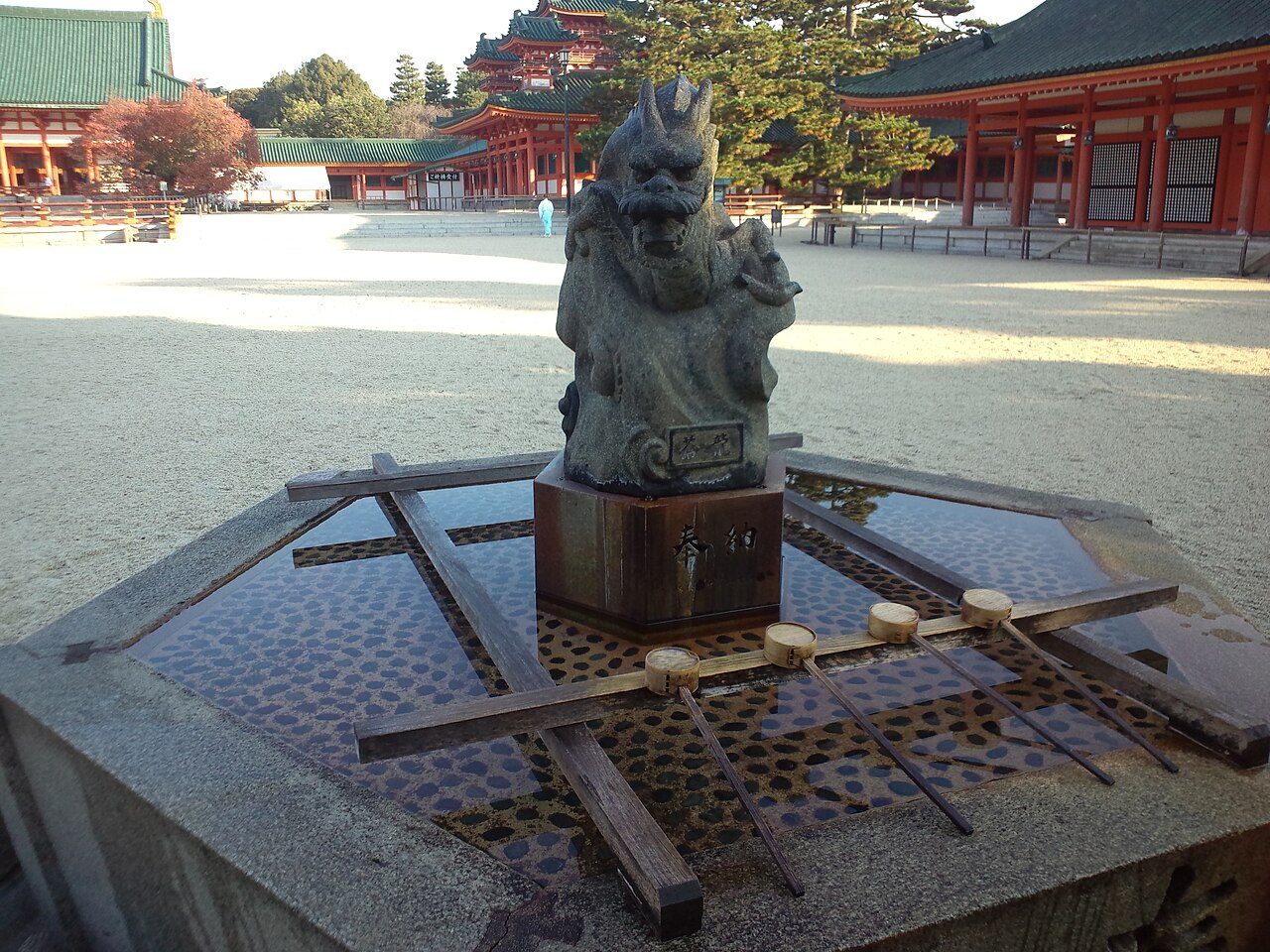
Japanese dragons are mostly associated with Shinto shrines as well as some Buddhist temples. Itsukushima Shrine on Miyajima or Itsukushima Island in Japan's Inland Sea was believ… 1
The text above is adapted from the Wikipedia article “Japanese dragon”, available under the Creative Commons Attribution-ShareAlike 4.0 licence. 1
Japanese dragon is serpentine creature in Japanese mythology, according to the structured record cited below. This entry was generated automatically from that record and has not yet been reviewed by a person familiar with the tradition. 2
The source record links this tradition to 2 external registers, which can be verified through the citation. 2