The tradition & historical record
6 min read · 2 sourcesJapanese folktales are traditional folk narratives of Japan, primarily transmitted orally. Among the best-known Japanese folktales are Momotarō, The Crab and the Monkey, Shita-kiri Suzume, Hanasaka Jiisan, and Kachi-kachi Yama, which are often collectively known as the "five great folktales" (五大昔話, Go-dai Mukashi banashi). In its strict sense, the term refers to orally transmitted folk narratives. However, it is commonly used more broadly to include literary tales, particularly those written during the Middle Ages, that have long been associated with Japanese folklore. Notable examples are The Tale of the Bamboo Cutter and medieval such as the Konjaku Monogatarishū and Uji Shūi Monogatari, which preserve early literary versions of many stories that also survive in oral tradition. The terminology used for Japanese folktales has changed over time. The systematic collection of Japanese folktales was pioneered by folklorist Kunio Yanagita. During the Edo period, they were commonly known as otogibanashi (お伽話). In the Meiji era, the loan translation minwa (民話) came into use. Yanagita preferred the term mukashibanashi (昔話; "tales of long ago") for orally transmitted folk narratives. Related genres such as kaidan (ghost stories) overlap with Japanese folktales but are generally treated separately. Many Japanese folktales incorporate motifs derived from Chinese and Indian traditions, particularly Buddhist narratives such as the Jataka tales. 1
Overview
A representative sampling of Japanese folklore would definitely include the quintessential Momotarō (Peach Boy), and perhaps other folktales listed among the so-called "five great fairy tales" (五大昔話, Go-dai Mukashi banashi): the battle between The Crab and the Monkey, Shita-kiri Suzume (Tongue-cut sparrow), Hanasaka Jiisan (Flower-blooming old man), and Kachi-kachi Yama. 1
History
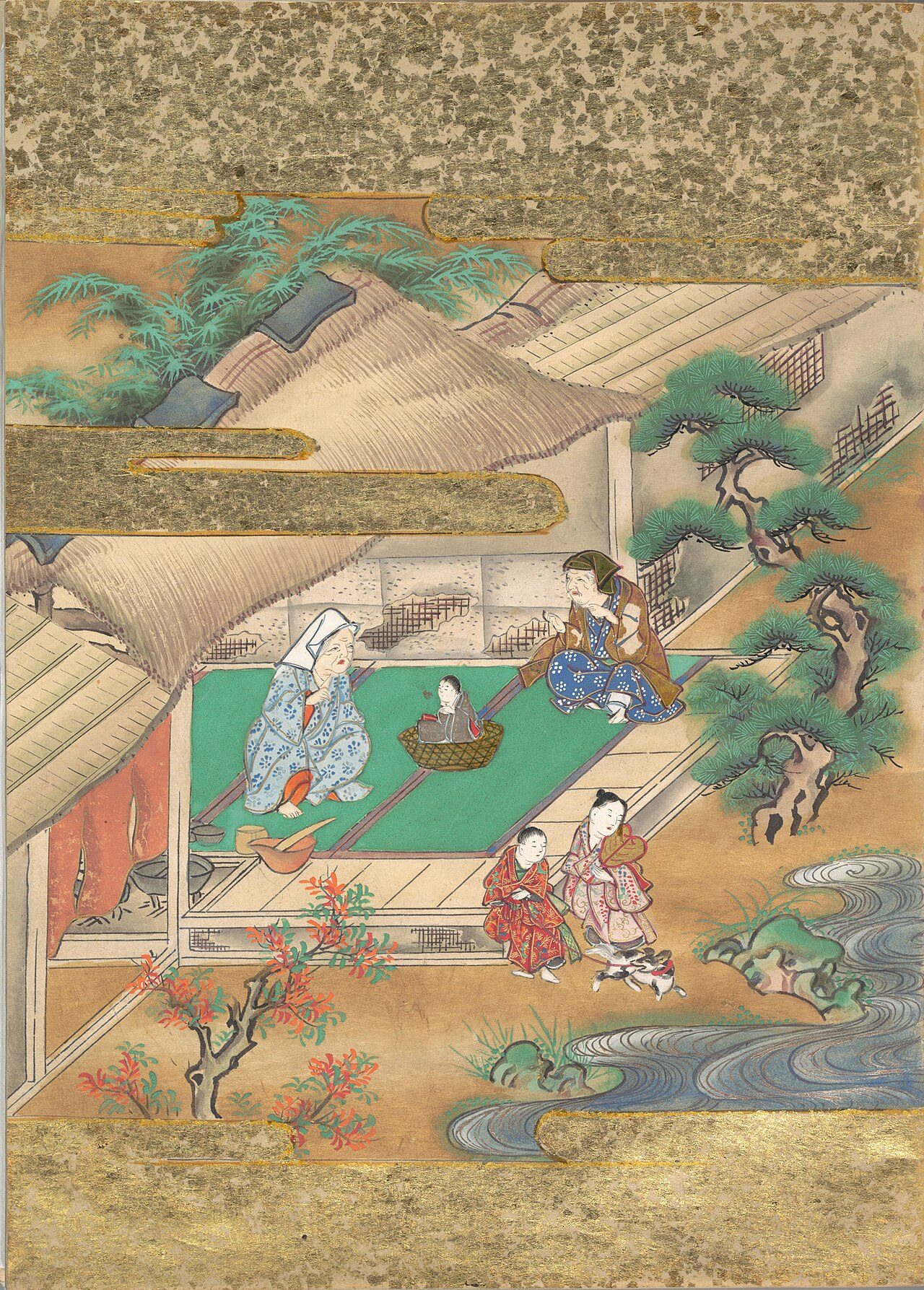
These stories just named are considered genuine folktales, having been so characterized by folklorist Kunio Yanagita. During the Edo period these tales had been adapted by professional writers and woodblock-printed in a form a called kusazōshi (cf. chapbooks), but a number of local variant versions of the tales have been collected in the field as well. As stated above, non-genuine folktales are those already committed to writing long ago, the earliest being the tale of Princess Kaguya (or The Tale of the Bamboo Cutter), an example of the monogatari type of romance dated to as early as the 10th century, though extant manuscripts are much later. The text mentions, for example, the flame-proof "fire rat (火鼠, Hinezumi) (or salamander)'s fur robe," which attests to a considerable degree of book-knowledge and learning by its author. Other examples of pseudo-folktales composed in the Middle Ages are the Uji Shūi Monogatari (13th century) that includes Kobutori Jīsan — the old man with the hump on his cheek — and Straw Millionaire. This and the Konjaku Monogatarishū (12th century) contain a number of a type of tales called setsuwa, a generic term for narratives of various nature, anything from moralizing to comical. Both works are divided into parts containing tales from India, tales from China, and tales from Japan. In the Konjaku Monogatarishū can be seen the early developments of the Kintarō legend, familiar in folktale-type form. The Japanese word used to correspond to "folktale" has undergone development over the years. From the Edo period, the term used was otokibanashi (お伽話), i.e., tales told by the otogii-shū, professional storytellers hired to entertain the daimyō lord at the bedside. 1
List of Japanese folktales
Below is a list of well-known Japanese folktales: 1
Animals in folklore
Tongue-cut sparrow: A washer woman cut off the tongue of a sparrow that was pecking at her rice starch. The sparrow had been fed regularly by the washer woman's neighbors, so when the sparrow didn't come, they went in the woods to search for it. They found it, and after a feast and some dancing (which the sparrow prepared), the neighbors were given the choice between two boxes; one large and one small. The neighbors picked the small box, and it was filled with riches. The washer woman saw these riches and heard where they came from, so she went to the sparrow. She too was entertained and given the choice between two boxes. The washer woman picked the largest box and instead of gaining riches, she was devoured by devils. Mandarin Ducks: A man kills a drake mandarin duck for food. That night he had a dream that a woman was accusing him of murdering her husband, and then told him to return to the lake. The man does this, and a female mandarin walks up to him and tears its chest open. Tanuki and Rabbit: A man catches a tanuki and tells his wife to cook it in a stew. The tanuki begs the wife not to cook him and promises to help with the cooking if he is spared. The wife agrees and unties him. The tanuki then transforms into her and kills her, then cooks her in a stew. Disguised as the man's wife, the tanuki feeds him his wife. Once he is done, the tanuki transforms back to his original form and teases the man for eating his wife. A rabbit that was friends with the family was furious, so he had the tanuki carry sticks and, while he wasn't looking, set these sticks on fire. Then the rabbit treated the burn with hot pepper paste. Finally, the rabbit convinced the tanuki to build a boat of clay, and the rabbit followed in a sturdy boat. 1
Theorized influences
The folklore of Japan has been influenced by foreign literature as well as the kind of spirit worship prevalent all throughout prehistoric Asia. The monkey stories of Japanese folklore have been influenced both by the Sanskrit epic Ramayana and the Chinese classic Journey to the West. The stories mentioned in the Buddhist Jataka tales appear in a modified form throughout the Japanese collection of popular stories. Some stories of ancient India were influential in shaping Japanese stories by providing them with materials. Indian materials were greatly modified and adapted in such a way as would appeal to the sensibilities of common people of Japan in general, transmitted through China and Korea. 1
The text above is adapted from the Wikipedia article “Japanese folktales”, available under the Creative Commons Attribution-ShareAlike 4.0 licence. 1
Japanese folktale is Japanese well-known classic tales, according to the structured record cited below. This entry was generated automatically from that record and has not yet been reviewed by a person familiar with the tradition. 2
The source record links this tradition to 6 external registers, which can be verified through the citation. 2