The tradition & historical record
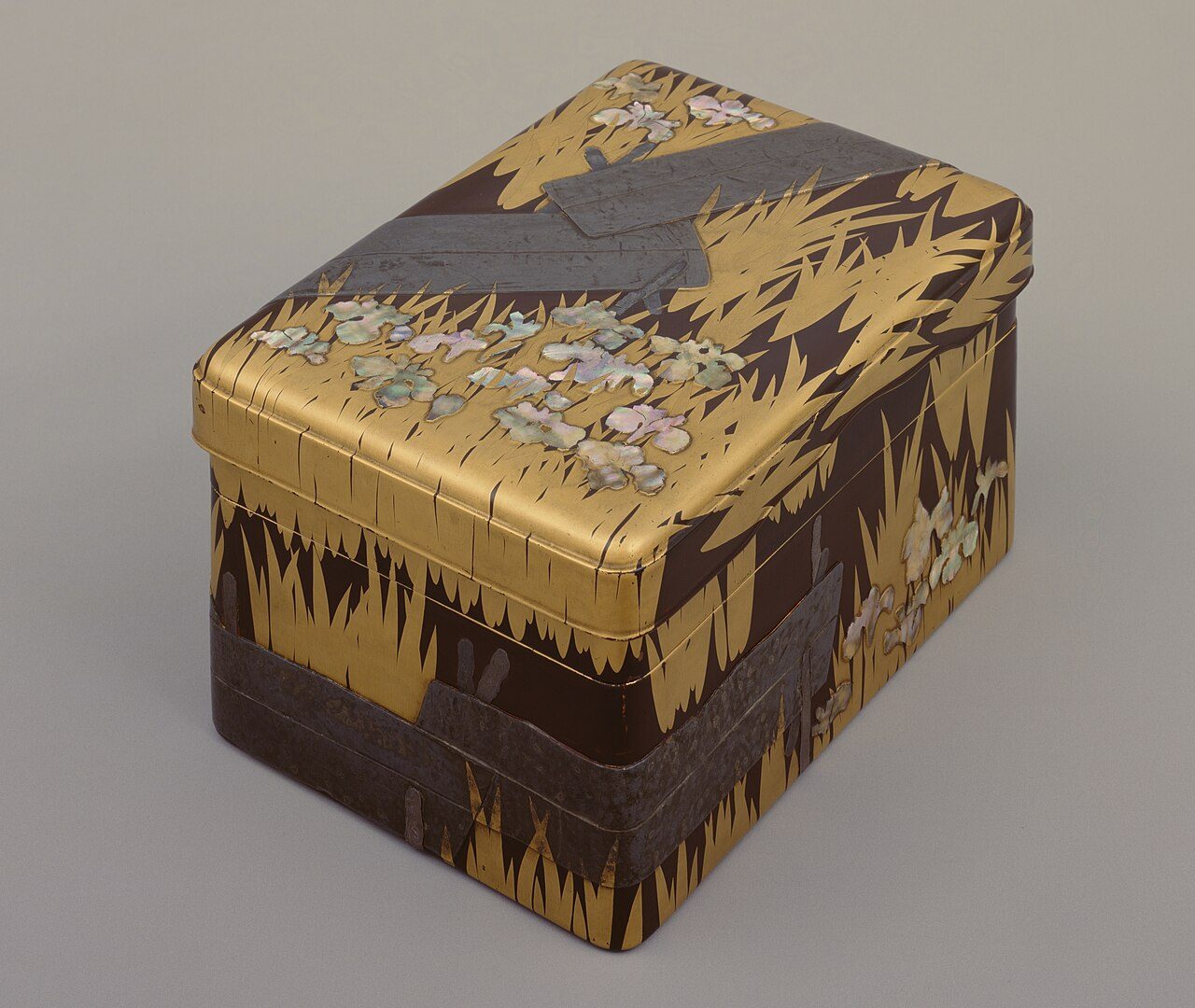
6 min read · 2 sourcesJapanese Lacquerware (日本漆器, shikki) is a Japanese craft with a wide range of fine and decorative arts, as lacquer has been used in urushi-e, prints, and on a wide variety of objects from Buddha statues to bento boxes for food. The characteristic of Japanese lacquerware is the diversity of lacquerware using a decoration technique called maki-e (蒔絵) in which metal powder is sprinkled to attach to lacquer. The invention of various maki-e techniques in Japanese history expanded artistic expression, and various tools and works of art such as inro are highly decorative. A number of terms are used in Japanese to refer to lacquerware. Shikki (漆器) means "lacquer ware" in the most literal sense, while nurimono (塗物) means "coated things", and urushi-nuri (漆塗) means "lacquer coating." The terms related to lacquer or lacquerware such as "Japanning", "Urushiol" and "maque" which means lacquer in Mexican Spanish, are derived from Japanese lacquerware. 1
Jōmon-Edo period
It has been confirmed that the lacquer tree existed in Japan from 12,600 years ago in the incipient Jōmon period. This was confirmed by radioactive carbon dating of the lacquer tree found at the Torihama shell mound, and is the oldest lacquer tree in the world found as of 2011. Lacquer was used in Japan as early as 7000 BCE, during the Jōmon period. Evidence for the earliest lacquerware was discovered at the Kakinoshima "B" Excavation Site in Hokkaido. The ornaments woven with lacquered red thread were discovered in a pit grave dating from the first half of the Initial Jōmon period. Also, at Kakinoshima "A" Excavation Site, earthenware with a spout painted with vermilion lacquer, which was made 3200 years ago, was found almost completely intact. Lacquering technology may have been invented by the Jōmon. They learned to refine urushi (poison oak sap) – the process taking several months. Iron oxide (colcothar) and cinnabar (mercury sulfide) were used for producing red lacquer. Lacquer was used both on pottery, and on different types of wooden items. In some cases, burial clothes for the dead were also lacquered. Many lacquered objects have turned up during the Early Jōmon period; this indicates that this was an established part of Jōmon culture. Experts are divided on whether Jōmon lacquer was derived from Chinese techniques, or invented independently. For example, Mark Hudson believes that "Jomon lacquer technology was developed independently in Japan rather than being introduced from China as once believed". One of the masterpieces of ancient Japanese lacquer objects is the Tamamushi Shrine from middle of the seventh century AD. The shrine is made of lacquered hinoki or Japanese cypress and camphor wood, both native species. 1
The Meiji era
Early nineteenth-century economic hardship decreased the demand for gold- or silver-decorated lacquerwares. The Meiji era saw a renewed interest in lacquer as artists developed new designs and experimented with new textures and finishes. Foremost among these was Shibata Zeshin, who has been called "Japan's greatest lacquerer". The appeal of his highly original style was in the choice of motifs and subject matter rather than embedded gold and silver. He placed lacquer panels in frames, imitating Western oil paintings. Other notable lacquer artists of the 19th century include Nakayama Komin and Shirayama Shosai, both of whom, in contrast with Zeshin, maintained a classical style that owed a lot to Japanese and Chinese landscape art. Maki-e was the most common technique for quality lacquerware in this period. Shibayama wares invented in the 1770s during the Edo period, combined lacquer, gold, silver, shellfish, ivory, coral, tortoise shell, ceramics and other novel materials in elaborate decorations. They get their name from Shibayama Senzo, originally Onogi Senzo, who adopted the name of his hometown on moving to Edo, and whose family produced and exhibited lacquerware in the new style. This style became popular in the Meiji period because it could be produced more quickly and cheaply than traditional lacquers. Somada ware, invented in the 1670s during the Edo period, is characterized by a regular pattern of finely cut shellfish, gold leaf and silver leaf, and became popular during this period. Richly-decorated lacquerwares in original designs were popular domestically, and even more so with Western buyers during this period of European and American fascination with Japanese art. 1
Twentieth century onwards
After the Meiji era, a new generation of artists further changed the decorative language, depicting plants in a stylised way without naturalistic settings. In recent decades, there has been effort made by the Japanese government to preserve the art of making lacquerware. Through the process of designating important craftsmen such as Gonroku Matsuda (松田権六) and Kazumi Murose (室瀬和美) as Living National Treasure as well the government's effort to encourage the development of new Urushi workshop, the art is gradually establishing itself once again. The best lacquer technique from the end of the Edo period to the Meiji period, especially the inro technique, was almost lost in the westernization of Japanese lifestyle. However, in 1985 Tatsuo Kitamura (北村辰夫) set up his own studio called "Unryuan" (雲龍庵) and succeeded in recreating it. His lacquer works are collected in the Victoria and Albert Museum in London (V&A), and the 21st Century Museum of Contemporary Art, Kanazawa, and are an object of collection for the world's wealthy. 1
In 2024, the first edition of an initiative called the Craft x Tech Tohoku Project was launched in Tokyo. The project is "aimed at revitalizing Japanese crafts" by pairing "designers, technologists and artisans to create collectible design objects that elevate Japanese craft in the eyes of international audiences." It includes contemporary designs made by lacquerware artisans such as Kawatsura-Shikki (from Akita prefecture) and Tsugaru-Nuri (from Aomori prefecture). The work was later exhibited at Art Basel/Design Miami, and subsequently in the Victoria and Albert Museum during the 2024 London Design Festival. 1
Techniques and processes
As in other countries where lacquerware has traditionally been produced, the process is fundamentally quite basic. An object is formed from wood, sometimes leather, paper, or basketry. Lacquer is applied to seal and protect the object, and then decoration is added. Generally, three coats (undercoat, middle-coat, and final coat) are used, the final coat sometimes being clear rather than black lacquer, in order to allow decorations to show through. Alongside the red and black lacquers, it is common to see the use of inlay, often seashells or similar materials, as well as mica or other materials. The application of gold powder is known as maki-e, and is a very common decorative element. A few examples of traditional techniques follow: 1
ikkanbari (一閑張), also known as harinuki (張貫) is one common technique used to make tea wares. 1
Regional forms
As with most traditional arts, variations emerged over time as individual centers of production developed… 1
The text above is adapted from the Wikipedia article “Japanese lacquerware”, available under the Creative Commons Attribution-ShareAlike 4.0 licence. 1
Japanese lacquerware is Japanese craft using lacquer to coat objects, according to the structured record cited below. This entry was generated automatically from that record and has not yet been reviewed by a person familiar with the tradition. 2
The source record links this tradition to 1 external register, which can be verified through the citation. 2