The tradition & historical record
6 min read · 2 sourcesJapanese mythology is a collection of traditional stories, folktales, and beliefs that emerged in the islands of the Japanese archipelago. Shinto traditions are the cornerstones of Japanese mythology. The history of thousands of years of contact with Chinese and various Indian myths (such as Buddhist and Hindu mythology) are also key influences in Japanese religious belief. Japanese myths are tied to the topography of the archipelago as well as agriculturally-based folk religion, and the Shinto pantheon holds uncountable kami ("god(s)" or "spirits"). Two important sources for Japanese myths, as they are recognized today, are the Kojiki and the Nihon Shoki. The Kojiki, or "Record of Ancient Matters," is the oldest surviving account of Japan's myths, legends, and history. Additionally, the Shintōshū describes the origins of Japanese deities from a Buddhist perspective. One notable feature of Japanese mythology is its explanation of the origin of the Imperial Family, which has been used historically to deify to the imperial line. Japanese is not transliterated consistently across all sources (see spelling of proper nouns). 1
Literary sources
The Kojiki and the Nihon Shoki, completed in A.D. 712 and A.D. 720 respectively, had the two most referenced and oldest sources of Japanese mythology and pre-history. Written in the Eighth century, under the Yamato state, the two collections relate the cosmogony and mythic origins of the Japanese archipelago, its people, and the imperial family. It is based on the records of the Kojiki and Nihon Shoki that the imperial family claims direct descent from the sun goddess Amaterasu and her grandson Ninigi. Emperor Temmu enlisted the help of Hiyeda no Are who committed to memory the history of Japan as it was recorded in two collections that are thought by historians to have existed before the Kojiki and Nihongi. Under Empress Gemmei's rule, Hideya no Are's memory of the history of the Japanese archipelago and its mythological origins were recorded in spite of Emperor Temmu's death before its completion. As a result of Hideya no Are's account, the Kojiki was finally completed, transcribed in kanji characters, during Empress Genshō's time as sovereign. The Yamato state also produced fudoki and Man'yōshū, two more of the oldest surviving texts that relate the historical and mythical origins of Japan's people, culture, and the imperial family. Motoori Norinaga, an Edo-period Japanese scholar, interpreted Kojiki and his commentary, annotations, and use of alternate sources to supplement his interpretations are studied by scholars today because of their influence on the current understanding of Japanese myths. 1
Archaeological sources
Archaeologists studying the history of the Japanese Archipelago separate the prehistoric history into three eras based on attributes of the discoveries associated with each era. The Jōmon period marks the first cases of pottery found on the archipelago, followed by the Yayoi period and the Kofun period. The Yayoi district of the Japanese capital Tokyo, is the namesake of the Yayoi period because archaeologists discovered pottery associated with the time period there. Contact with Korean civilization in the latter part of the Yayoi period influenced the culture of the Japanese Archipelago greatly, as evidenced by the discovery of artifacts that archaeologists associate with various cultural streams from Korea, and northeast Asia. Finally, Kofun period artifacts, ranging from A.D. 250 to A.D. 600, are the archaeological sources of what historians know about the Yamato kingdom — the same Yamato state that was responsible for the two most prominent literary sources of Japanese myth, the Kojiki and Nihon Shoki. 1
Kuniumi and Kamiumi
Japan's archipelago creation narrative can be divided into the birth of the deities (Kamiumi) and the birth of the land (Kuniumi). The birth of the deities begins with the appearance of the first generation of gods who appeared out of primordial oil, a trio of gods who produced the next seven generations of gods. Izanagi and Izanami were eventually born, siblings, and using a naginata decorated with jewels, named Ame-no-nuhoko ("Heavenly Jeweled Spear") that was gifted to them. Izanagi created the first islands of the Japanese Archipelago by dipping the Naginata into the primordial waters. Historians have interpreted the myth of Izanagi's creation of the first Japanese Island Onogoro as an early example of phallocentrism in Japanese mythology.The earliest creation myths of Japanese mythology generally involve topics such as death, decay, loss, infanticide, and contamination. The creation myths place great importance on purification, ceremonial order, and the masculine. For example, the first child born to Izanagi and Izanami after they attempt a union ceremony is born with no limbs or bones, and the parents discard the child by sending him to sea in a boat. When Izanagi and Izanami ask the older gods why their child was born without bones or limbs, they are told it was because they did not conduct the ceremony properly and that the male must always speak before the female. Once they follow the directions of the older gods correctly, they produce many children, many of whom are the islands of the Japanese Archipelago. Among their children are the Ōyashima, or the eight great islands of Japan — Awaji, Iyo, Oki, Tsukushi, Iki, Tsushima, Sado, and Yamato. 1
Yomi
After Izanami's death, the myth of Izanagi's efforts to rescue her from Yomi, an underworld described in Japanese mythology, explains the origins of the cycle of birth and death. After killing their child Kagutsuchi, Izanagi was still grief-stricken, so he undertook the task of finding a way to bring Izanami back from the dead. After finally locating her, he disobeyed her order to not look at her while she went to ask permission to leave Yomi. He used his hair to create a flame, and when he gazed at Izanami's rotting, maggot-filled flesh he fled in fear and disgust. Izanami felt betrayed and tried to capture him, but he escaped by creating obstacles for Izanami's horde of shikome including using peaches to threaten them. The myth of Izanagi's journey into Yomi features many themes of food, he creates grapes to distract the shikome who stop to eat them, granting him time to escape. Izanagi declared these peaches divine, naming them Ōkamuzumi, and peaches appear in many other Japanese myths, especially the tale of Momotarō the peach boy. 1
The Sun, Moon, and Storm
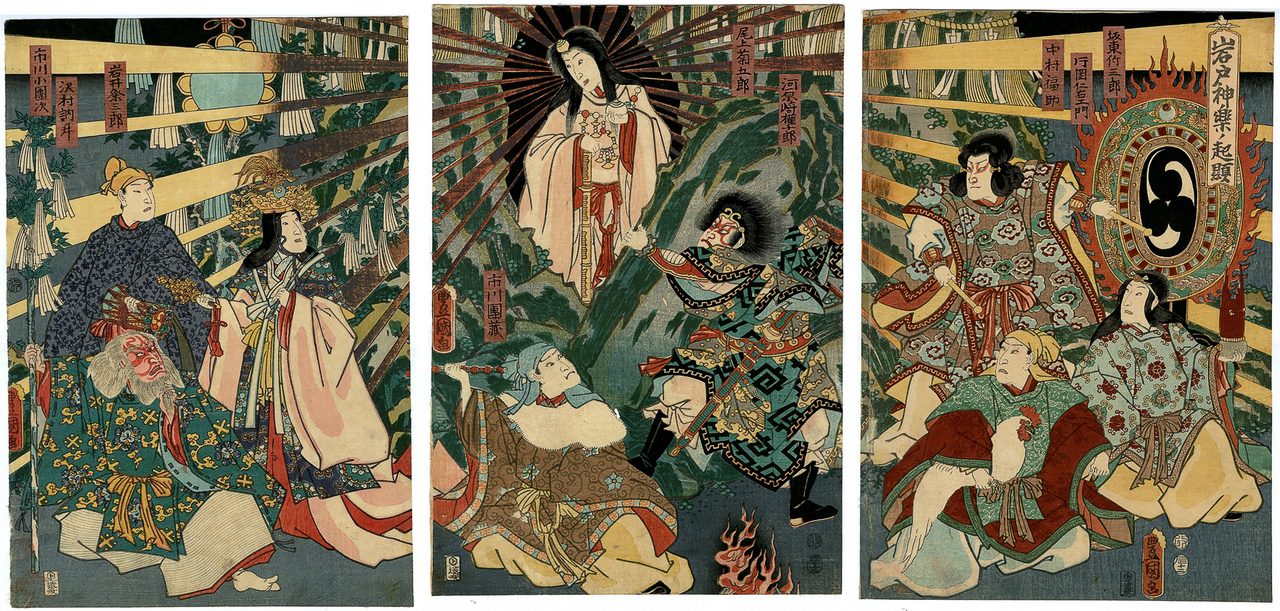
The origins of the Sun and the Moon are accounted for in Japanese mythology through the myth of Izanagi's return from Yomi. After spending so much time in Yomi, Izanagi cleansed himself with a purification ceremony. As Izanagi cleansed himself, the water and robes that fell from his body created many more gods. Purification rituals still function as important traditions in Japan today, from shoe etiquette in households to sumo wrestling purification ceremonies. Amaterasu, the Sun goddess and divine ancestor of the first Emperor Jimmu, was born from Izanagi's eye. 1
The text above is adapted from the Wikipedia article “Japanese mythology”, available under the Creative Commons Attribution-ShareAlike 4.0 licence. 1
Japanese mythology is mythology, according to the structured record cited below. This entry was generated automatically from that record and has not yet been reviewed by a person familiar with the tradition. 2
The source record links this tradition to 16 external registers, which can be verified through the citation. 2