The tradition & historical record
7 min read · 2 sourcesJean de l'Ours (French pronunciation: [ʒɑ̃ də luʁs]) or John the Bear, John of the Bear, John-of-the-Bear, John Bear, is the leading character in the French folktale Jean de l'Ours classed as Type 301B in the Aarne–Thompson system; it can also denote any tale of this type. Some typical elements are that the hero is born half-bear, half-human; he obtains a weapon, usually a heavy iron cane, and on his journey; he bands up with two or three companions. At a castle the hero defeats an adversary, pursues him to a hole, discovers an underworld, and rescues three princesses. The companions abandon him in the hole, taking the princesses for themselves. The hero escapes, finds the companions and gets rid of them. He marries the most beautiful princess of the three, but not before going through certain ordeal(s) by the king. The character is said to be one of "the most popular tale-types in Hispanic and Francophone tradition". Numerous variants exist in France, often retaining the name Jean de l'Ours or something similar for the hero. Some of the analogues in Europe that retain the names corresponding to "John" are: Jan de l'Ors (Occitan: [ˈdʒan de ˈluɾs]); Joan de l'Ós (Catalan: [ʒuˈan də ˈlɔs] or [dʒoˈan də ˈlɔs]); Juan del Oso, Juan el Oso, Juanito el Oso, Juanillo el Oso (Spanish: [ˈxwan (d)el ˈoso], [xwaˈnito el ˈoso; -niʎo]); Giovanni dell'Orso (Italian: [dʒoˈvanni delˈlorso]), Iann he vaz houarn (Breton); Ivashko Medvedko (Russian). 1
Physical appearance
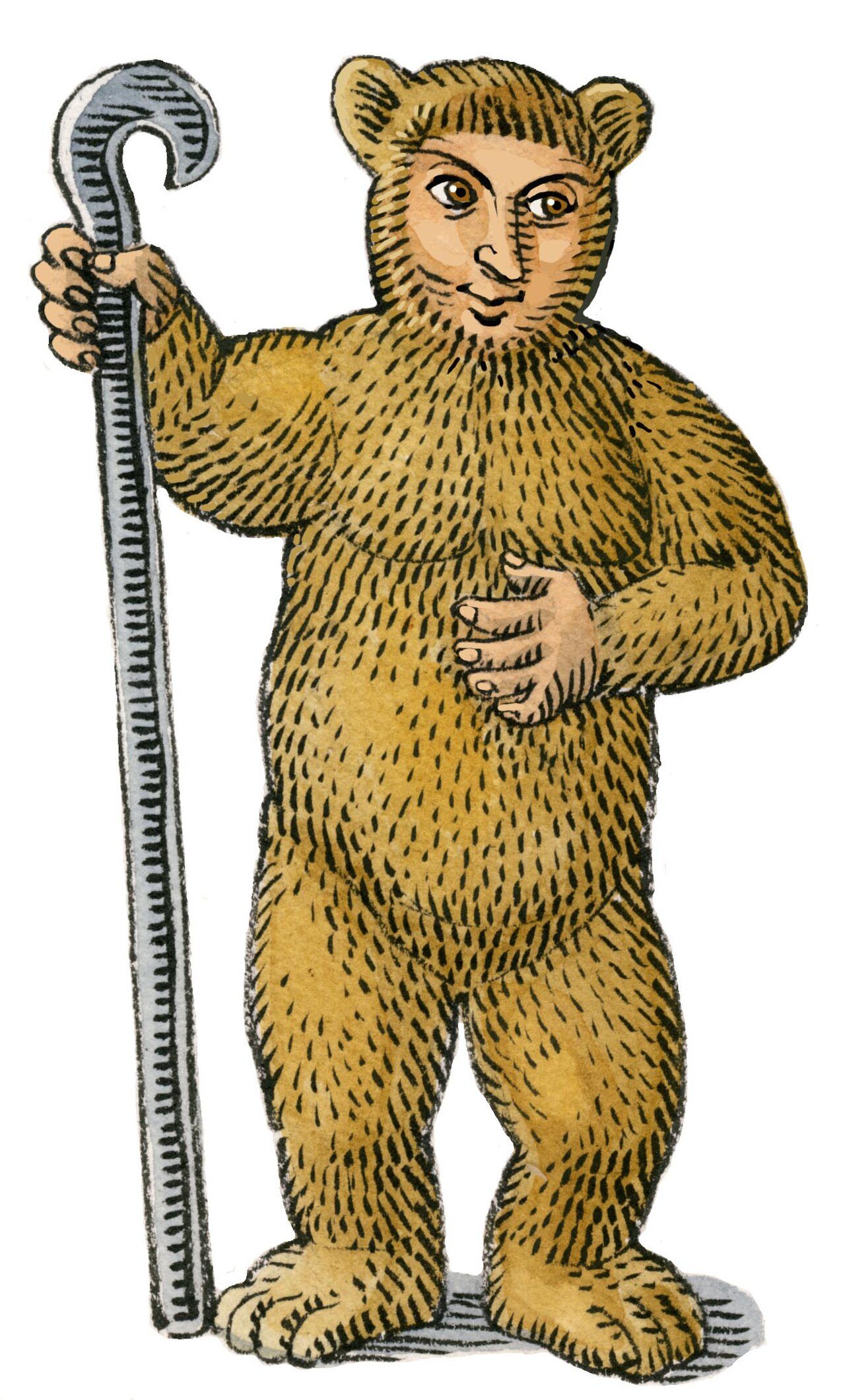
Several French versions explicitly comment on Jean de l'ours being covered with body hair on his entire body. One Gascon version, Jan l'Oursét adds that he had "a large head just like a bear's, except for its shape". The hero is human from the waist up and bear from the waist down in one Mexican version (Juan el Oso) as well as the Russian tale "Ivanko Medv(i)edko" (or "Ivanko the Bear's son"). For comparison, in the Avar tale "Bear's Ear", the protagonist has ears like a bear. Jean de l'Ours is a beautiful abandoned child raised by a mother bear in Henri Carnoy's version (1885). Along the same vein, Jean de l'Ours was a beautiful foundling adopted by a widow according to Carnoy in another version (1885, illustrated by Édouard Zier), but this, except for an altered telling of the boy's origin, is by and large identical to the tale given earlier by Hippolyte Babou (1862): In both texts he is depicted as an angel-faced, blue-eyed boy who wears a bearskin around his loins, has a lush mane like Samson's falling from head to chest, and carries a poplar sapling as a staff. The artist's depiction by Jean-Claude Pertuzé in his Le conte de Jean de l'ours (1988) depicts Jean with rounded bear's ears attached high on his head. 1
Tale type
"John the Bear" is categorized as Type 301 or "Three Stolen Princesses" type. Type 301 is also sometimes termed the "Bear' son" type, although "Bear's Son Tale" in general practice is a looser term that encompasses both 301 and 650A types. The tale is classed more narrowly as type 301 B, and the whole group dubbed the "Jean de l'ours" type, especially in the French folkloristics community, whereas 301B is often called the "Strong man and his Companions" type in English-language circles. And analogues of "Jean de l'ours" often get admixed with elements of another but very similar tale type, Strong John (AT 650). The Juan Oso tales as analyzed by the Spanish-language folklorists are described in similar vein, with certain differences. Juan Oso tales have disseminated widely to the New World, and fall widely into types 301A, 301B, 301C, or 301D. And they exhibit mixing not only with the AT 650 mentioned above, but also with Type 513 A, "Six Go through the Whole World". Type 513 A is marked by the presence of "extraordinary helpers". Cosquin believed these were an outside element introduced from other tales; and Clive Claudel attributed such helpers to Thompson's tale type 513 A. Bertram Colgrave on the other hand believed certain companions ("treeman", "mountain man", "stone man", etc.) should be regarded as native to Juan Oso tales, whereas generic companions (such as "the runner") are "strictly speaking" foreign to the tale group. It has been suggested that tale types ATU 301 and Jean de l'Ours, ATU 650 ("Strong Hans"), ATU 302 ("Devil's Heart in the Egg") and ATU 554 ("The Grateful Animals") may have once comprised a single narrative, but, with time, the original story fragmented into different tale types. 1
Soldiers' version
A key example of type 301 B noted by French scholars such as Paul Delarue or Daniel Fabre is the version told by soldiers, and first published by Vidal et Delmart in 1833. No regional localization was given for the version. It was designated version 1 by Delarue, who gave a summary of it. It has also been translated into English as the tale of "The Story of John-of-the-Bear". 1
Birth and childhood A woodcutter's wife looking for wood is abducted by the bear, and gives birth to a child by this bear. The child walks at four months, speaks and runs at one year, and soon even rattles the stone with which the bear plugs the cave. The boy lifts the stone at age 5 or 6, and he and his mother escape. At school, his hairiness earns him the nickname "Jean de l'Ours" from other schoolchildren. He retaliates with violence, the schoolmaster demands his parents punish him, he drops out, and enters apprenticeship under a blacksmith. 1
His cane and companions He leaves the blacksmith, and as compensation, obtains an iron cane weighing 800 pounds in the shaft and 200 pounds more at the pommel. He obtains two companions, Tord-Chêne ("Twistoak") and Tranche-Montagne ("Cutmountain"). 1
Inside the haunted castle Jean's party lodge at a castle, without sign of human presence, but with tables and beds prepared, and meals (and other wished-for items) that would appear as if by magic. They decide to go hunting, leaving one behind to sound the lunch bell. Tranche remains at the castle on the first turn, but a size-changing "little giant (petit géant)" descends from the chimney and beats him terribly with a stick. He blames a fall going down to the cellar for being unable to signal. Next day, another companion meets the same fate, and offers a different excuse. 1
Cosquin's version
A version from Lorraine was printed by Emmanuel Cosquin in 1886 (listed as Delarue's version 9). Its English translation appeared in Stith Thompson's One Hundred Favorite Folktales (1968). The plotline is quite similar to the soldier's version summarized above, with numerous differences in detail, which will be noted: The hero's mother was already pregnant before being captured by bear, but still born half-human, half-bear; given the John the Bear name as a child; apprentices under three blacksmiths, cane is 500 pounds. Three companions: Jean de la Meule ('John of the Mill') playing quoits (original: palets) with a millstone, Appuie-Montagne ('Hold-up-Mountain') and Tord-Chêne ('Oak-Twister'). 1
Origins of the hero
Jean de l'Ours in most cases is the child of a mother and a bear. 1
The text above is adapted from the Wikipedia article “Jean de l'Ours”, available under the Creative Commons Attribution-ShareAlike 4.0 licence. 1
Jean de l'Ours is character in Jean de l'Ours, according to the structured record cited below. This entry was generated automatically from that record and has not yet been reviewed by a person familiar with the tradition. 2
The source record links this tradition to 1 external register, which can be verified through the citation. 2