The tradition & historical record
5 min read · 2 sourcesJesper Who Herded the Hares (Danish: Jesper Harehyrde) is a Scandinavian fairy tale, first recorded by Danish folktale collector Evald Tang Kristensen in the first volume of Æventyr fra Jylland. Andrew Lang included it in The Violet Fairy Book. The motif of herding hares is a common fairy tale theme. Another tale featuring it is The Three May Peaches. This tale, and The Griffin, also feature the test of truthfully telling what the character is carrying. The tale and its variants are grouped under the Aarne-Thompson-Uther Index as ATU 570, "The Rabbit-Herd" or "The Sack of Lies". 1
Synopsis
A king of a kingdom so small he could see every border from the towers on his castle, still was proud of it. Having a single daughter, he wished her to marry a man fit to be king. He declared that whoever brought him twelve of the finest pearls (to ensure the wooer was rich) and could perform certain tasks would marry her. Many princes and merchants brought the pearls but failed the tasks, and many tried false pearls and were turned away more quickly. A fisherman had three sons: Peter, Paul, and Jesper. One day he caught three dozen oysters, each of which had a fine pearl. It was decided that each son would have his chance to win the princess. On the way, Peter met the King of the Ants, who was battling the King of the Beetles and had been worsted; he asked for Peter's help, and Peter said he was too busy. Then he met an old woman, who asked what he was carrying; he said cinders, she said that, very well, it was cinders, and when he got to the castle, the pearls turned into cinders. He did not tell what had happened when he came home. Paul tried, and met the same fate. Jesper tried; he helped the king of the ants, who won the field with him, and told the old woman of his pearls. The old woman begged some food from him, since he could eat at the castle. He handed over his entire lunch. The old woman called him back and gave him a whistle that would bring back what he had lost. The king was not pleased with such a son-in-law. He had a sack each of wheat, barley, oats, and rye mixed together and told Jesper he had to sort them in a day. The ants did it for him. 1
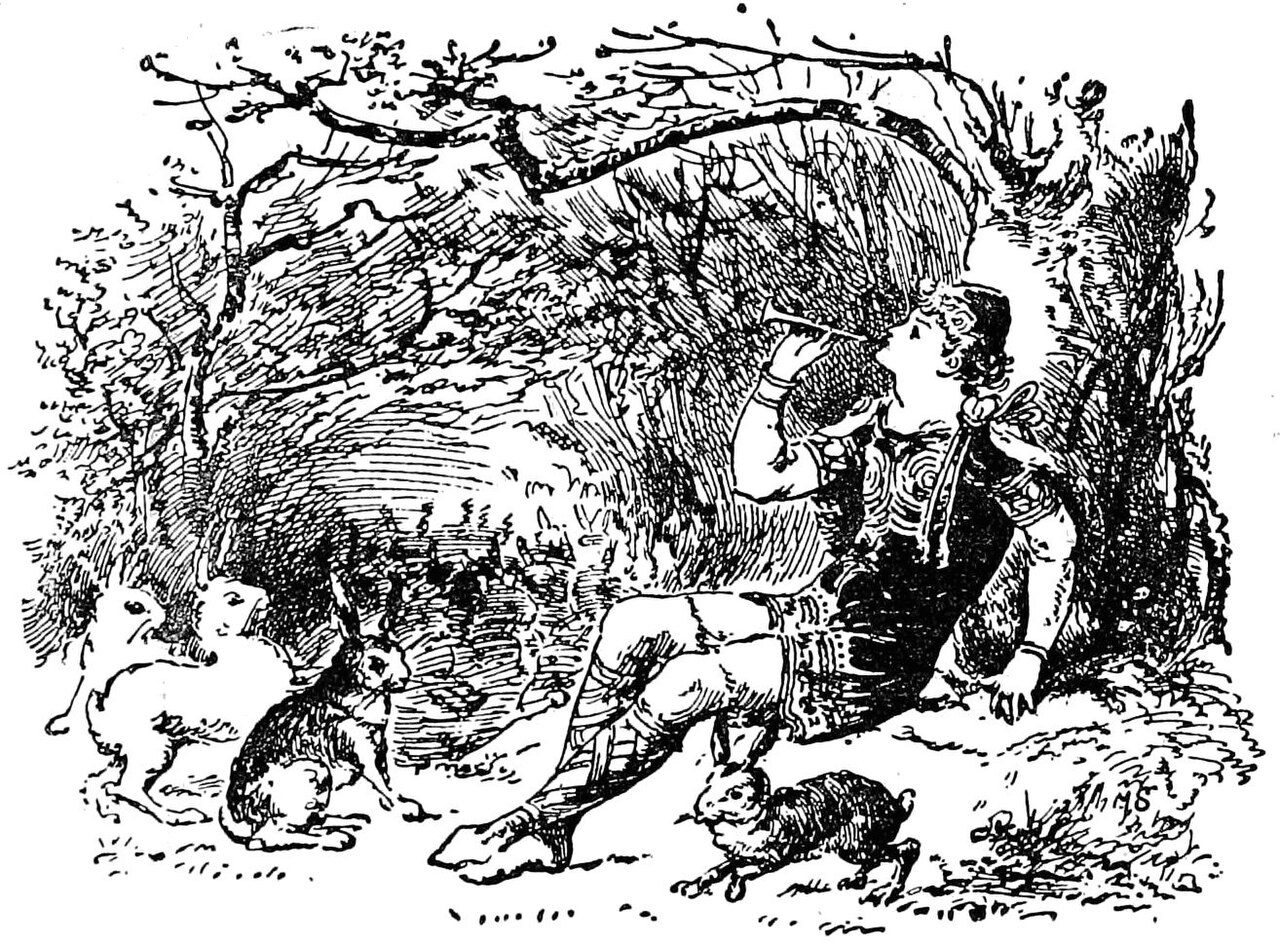
Then he was set to herd a hundred hares. Using the whistle, he kept them together. The king heard of it and resolved to stop him. 1
Tale type
The tale is classified in the international Aarne-Thompson-Uther Index as type ATU 570, "The Rabbit-Herd": the humble protagonist offers to herd the king's hares (or some type of animal), which he does with the use of a magical instrument. 1
Distribution
The tale is said to be found all over Europe, "from Iceland to the Caucasus". It is reported that more than 200 or 400 variants have been recorded, specially from North and Central Europe: 79 versions from Finland; 36 French versions, as noted by Paul Delarue; 53 from all over Germany and 25 in the Schleswig-Holstein region, according to Kurt Ranke. The tale is also claimed by Jack Haney to be "little known outside Russia", but "common in Western Europe". Swedish scholar Waldemar Liungmann located variants across Romance-, Germanic-, Slavic-, Baltic- and Finno-Ugrian speaking areas. This geographic distribution seems to confirm professor Stith Thompson's analysis that the tale "is essentially European", instead of having an Eastern origin. Liungmann also supposed that the tale originated in Europe, probably from a Germanic source. The tale has migrated to the Americas, being found in both North and South America, according to Kurt Ranke. Variants are also found in Turkey, the Levant and in China. Paul Delarue also commented that the tale type exists in Western Asia "as far as India", and in North Africa. 1
Predecessors
The oldest attestation of the tale is considered to be a 1791 publication, unlike other European folktales with a long literary history. Scholarship supposes this happened due to the raciness of the tale. For instance, folklorist Elsie Clews Parsons noted that the informant of a South Carolina variant omitted the details about the sexual encounter between the male protagonist and the women, which were referenced in the Cape Verde tales. William Bernard McCarthy, in the same vein, cited that a storyteller knew of two versions of the tale, one for general audiences and other for a male public. 1
Scandinavia
Benjamin Thorpe translated a Danish version with the title Temptations, where a poor cottager's son employs himself under a master who knows the black arts. The master owns a farm of hares that have to be herded by the boy. This tale was also published in a compilation of Norse folktales. Louis Brueyre indicated that this story was actually the work of Carit Etlar. Illustrator Katherine Pyle published a story titled The Magic Pipe: A Norse Tale, where the hero's name is translated as Boots, who wants to offer his services to king to herd the royal hares. A version from Sweden is reported to have been collected and published with the name The King's Hares. 1
The text above is adapted from the Wikipedia article “Jesper Who Herded the Hares”, available under the Creative Commons Attribution-ShareAlike 4.0 licence. 1
Jesper Who Herded the Hares is Scandinavian fairy tale, according to the structured record cited below. This entry was generated automatically from that record and has not yet been reviewed by a person familiar with the tradition. 2
The source record links this tradition to 1 external register, which can be verified through the citation. 2