The tradition & historical record
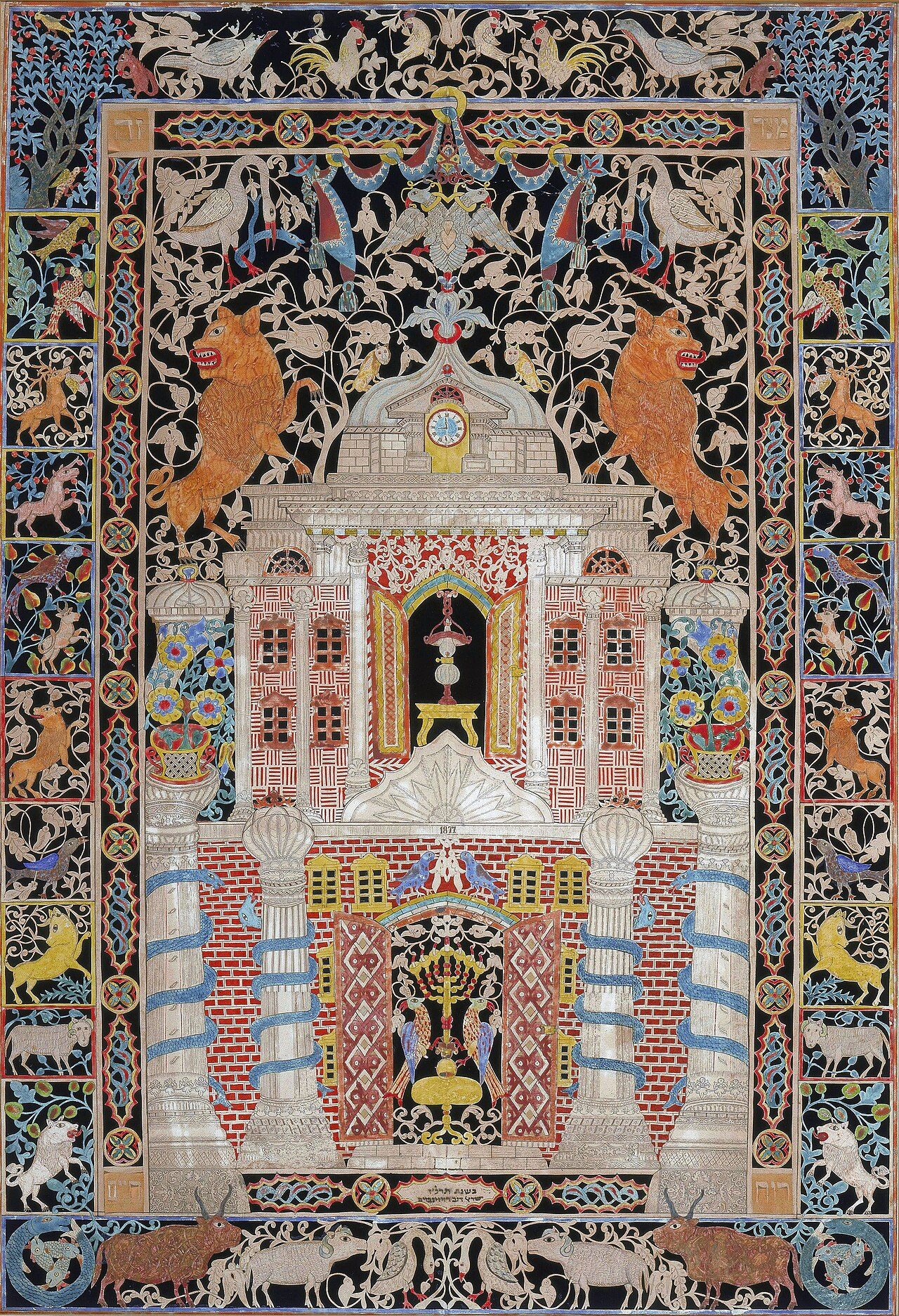
5 min read · 2 sourcesJewish paper cutting is a traditional form of Jewish folk art made by cutting figures and sentences in paper or parchment. It is connected with various customs and ceremonies, and associated with holidays and family life. Paper cuts often decorated ketubbot (marriage contracts), Mizrahs, and ornaments for festive occasions. Paper cutting was practiced by Jewish communities in both Eastern Europe and North Africa and the Middle East for centuries and has seen a revival in modern times in Israel and elsewhere. 1
Origins
The origin of Jewish paper cutting is unclear. Ashkenazi Jews in the seventeenth and eighteenth centuries practiced this type of art. However, Jewish paper cuts can be traced to Jewish communities in Syria, Iraq, and North Africa, and the similarity in the cutting techniques (using a knife) between East European Jews and Chinese paper cutters, may indicate that the origin goes back even further. Some contend that Ashkenazi paper-cutting may date to the 14th century, though its popularity reached a zenith in the 18th and 19th centuries. The first mention of Jewish paper cutting can be found in the treatise "The fight of the pen and the scissors" by a 14th-century rabbi, Shem Tov ben Isaac ben Ardutiel (1290–1369), who describes how he decided to cut letters in paper when his ink became frozen during a harsh winter. To students of Christian Spanish literary history, Rabbi Shem Tov is known as Santob de Carrion de los Condes, the courtly Castilian troubadour who composed the Proverbios morales for Pedro the Cruel. Paper cutting as a folk craft gained popularity in the nineteenth century when paper became a cheap material. Paper cutting was widespread among the Jews of Poland and Russia in the nineteenth century and the early years of the twentieth century. Jewish paper cuts were also produced in Germany and probably in the Netherlands. Some Italian Jewish parchment ketubot (marriage contracts) from the late 17th century until the nineteenth century were decorated paper cuts as well as some elaborate scrolls of the Book of Esther. 1
Disappearance
Jewish paper cutting began disappearing in the first half of the twentieth century, mainly because of the rapid assimilation trends and the waning of many traditional practices, and was practiced only by older people who remembered this art form from their youth. Many paper cuts collections that had been preserved were destroyed during World War II and the Holocaust and relatively few remain in public or private collections. 1
Resurgence
Since the late twentieth century, Jewish paper cuts have again become a popular art form in both Israel and other countries. Paper cutting is again often used to decorate ketubot, wedding invitations, and works of art. To a limited extent, Jewish paper cuts have become more popular in Poland as a result of the Jewish Culture Festival in Kraków, a festival that has been held in Kraków since the 1990s. Beit Hatefutsot – The Museum of the Jewish People in Tel Aviv, Israel presented a 2009 exhibition called "The Revival of Jewish Papercuts: Jewish paper cut art" in October 2009. The exhibit was curated by Prof. Olga Goldberg, Gabriella Rabbi, Rina Biran, the Giza Frenkel Papercut Archive, the Hebrew University of Jerusalem. Additionally, a National Science Foundation-funded study called "Tradition and Continuity in Jewish Papercuts" was conducted by Prof. Olga Goldberg. Artist Oren Loloi writes that the art of Jewish papercutting's resurgence is due in large part to the efforts of Polish-Jewish anthropologist and ethnologist Giza Frankel (see below). Frankel's 1983 book, The Art of the Jewish Papercut (Migzerot neyar: omanut Yehudit amamit), was produced after 50 years of painstaking research. Today, Jewish papercut art has grown in popularity beyond ritual items to art and expressions of Jewish faith, not only in Israel but worldwide. Loloi contends that the resurgence in papercutting's popularity is in part due to its contemporary near-ubiquity as part of the ketubah (marriage contract), which is a contemporary site of hiddur mitzvah, the Jewish principle of honouring the Divine by beautifying ritual objects. Contemporary papercutting art may also be seen in amulets like hamsas, blessings for the home, mizrahim, and other art pieces, usually as a wall plaque. 1
Giza Frankel
In Israel papercutting was reactivated by Giza Frankel, a Polish-born ethnographer. Frankel's most significant publications on paper cutting are Wycinanka żydowska w Polsce and Art of the Jewish Paper Cut. Giza Frankel emigrated to Israel in 1950. 1
Marta Gołąb
Marta Gołąb is both a graphic artist and papercutter. Her papercuts were exhibited in the Jewish Museum (Wien) Skirball Cultural Center, (Los Angeles), in Emanu-El Synagogue (San Francisco), in the Synagogue in Grobzig (Germany) and on the Jewish Culture Festival in Krakow. 1
The text above is adapted from the Wikipedia article “Jewish paper cutting”, available under the Creative Commons Attribution-ShareAlike 4.0 licence. 1
Jewish papercut is Jewish paper cutting, according to the structured record cited below. This entry was generated automatically from that record and has not yet been reviewed by a person familiar with the tradition. 2
The source record links this tradition to 4 external registers, which can be verified through the citation. 2