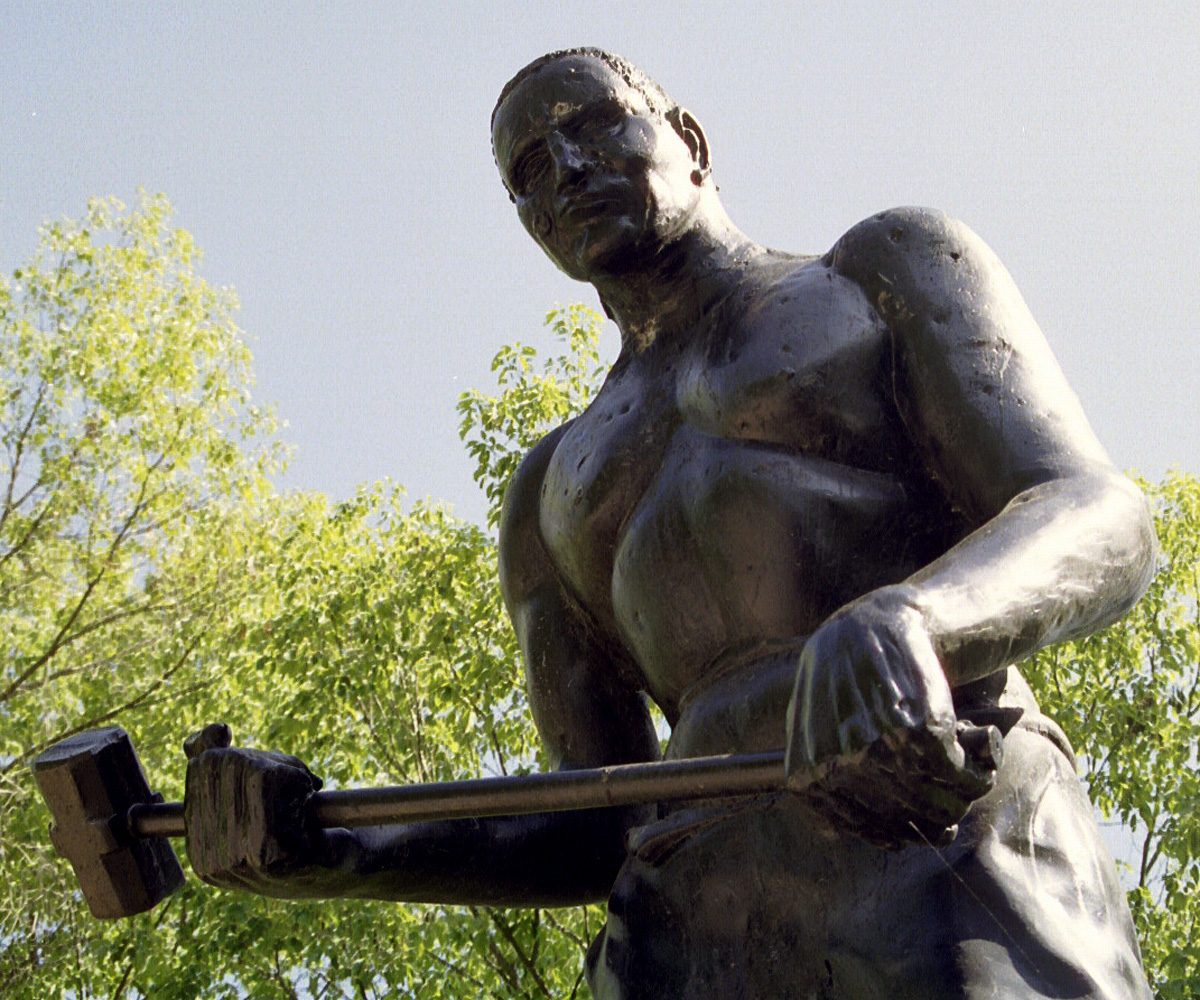
The tradition & historical record
5 min read · 2 sourcesJohn Henry is an American folk hero. A Black American freedman, he is said to have worked as a "steel-driving man"—a man tasked with hammering a steel drill (such as a star drill or similar) into a rock to make holes for explosives to blast the rock in constructing a railroad tunnel. The story of John Henry is told in a classic blues folk song about his duel against a drilling machine, which exists in many versions, and has been the subject of numerous stories, plays, books, and novels. 1
Legend
According to legend, John Henry's prowess as a steel driver was measured in a race against a steam-powered rock drill, a race that he won only to die in victory with a hammer in hand as his heart gave out from stress. Various locations, including Big Bend Tunnel in West Virginia, Lewis Tunnel in Virginia, and Coosa Mountain Tunnel in Alabama, have been suggested as the site of the contest. A real hammerman would have needed to work in tandem with a shaker, who would hold a chisel-like drill against mountain rock, wiggling and rotating the drill to optimize its bite. However, John Henry's shaker is seldom if ever mentioned in the tale. As a result, some retellings recast John Henry as a railroad worker driving spikes into railway tracks, and his mechanical opponent as a primitive rail fastening system. 1
History
The historical accuracy of many of the aspects of the John Henry legend are subject to debate. According to researcher Scott Reynolds Nelson, the actual John Henry was born in 1848 in New Jersey and died of silicosis, a complication of his workplace, rather than from exhaustion. Several locations have been put forth for the tunnel on which John Henry died. 1
Big Bend Tunnel
Sociologist Guy Benton Johnson investigated the legend of John Henry in the late 1920s. He concluded that John Henry might have worked on the Chesapeake and Ohio Railway's (C&O Railway) Big Bend Tunnel but that "one can make out a case either for or against" it. The tunnel was built near Talcott, West Virginia, from 1870 to 1872 (according to Johnson's dating), and named for the big bend in the Greenbrier River nearby. Some versions of the song refer to the location of John Henry's death as "The Big Bend Tunnel on the C. & O." In 1927, Johnson visited the area and found one man who said he had seen it. 1
This man, known as Neal Miller, told me in plain words how he had come to the tunnel with his father at 17, how he carried water and drills for the steel drivers, how he saw John Henry every day, and, finally, all about the contest between John Henry and the steam drill. "When the agent for the steam drill company brought the drill here," said Mr. Miller, "John Henry wanted to drive against it. He took a lot of pride in his work and he hated to see a machine take the work of men like him. "Well, they decided to hold a test to get an idea of how practical the steam drill was. The test went on all day and part of the next day. "John Henry won. He wouldn't rest enough, and he overdid. He took sick and died soon after that." 1
Mr. Miller described the steam drill in detail. I made a sketch of it and later when I looked up pictures of the early steam drills, I found his description correct. I asked people about Mr. Miller's reputation, and they all said, "If Neal Miller said anything happened, it happened." When Johnson contacted Chief Engineer C. W. 1
Lewis Tunnel
In the 2006 book Steel Drivin' Man: John Henry, the Untold Story of an American Legend, historian Scott Reynolds Nelson detailed his discovering documentation of a 19-year-old African-American man alternately referred to as John Henry, John W. Henry, or John William Henry in previously unexplored prison records of the Virginia Penitentiary. At the time, penitentiary inmates were hired out as laborers to various contractors, and this John Henry was noted as having headed the first group of prisoners to be assigned tunnel work. Nelson also discovered the C&O's tunneling records, which the company believed had been destroyed by fire. Henry, like many African Americans, might have come to Virginia to work on the clean-up of the battlefields after the American Civil War. Arrested and tried for burglary, John Henry was in the first group of convicts released by the warden to work as leased labor on the C&O Railway. According to Nelson, objectionable conditions at the Virginia prison led the warden to believe that the prisoners, many of whom had been arrested on trivial charges, would be better clothed and fed if they were released as laborers to private contractors (he subsequently changed his mind about this and became an opponent of the convict labor system). In the C&O's tunneling records, Nelson found no evidence of a steam drill used in Big Bend Tunnel. The records Nelson found indicate that the contest took place 40 miles (64 km) away at the Lewis Tunnel, between Talcott and Millboro, Virginia, where prisoners did indeed work beside steam drills night and day. 1
In popular culture
The tale of John Henry has been used as a symbol in many cultural movements, including labor movements and the Civil Rights Movement. Philosopher Jeanette Bicknell said of the John Henry legend: 1
John Henry is a symbol of physical strength and endurance, of exploited labor, of the dignity of a human being against the degradations of the machine age, and of racial pride and solidarity. During World War II his image was used in U.S. government propaganda as a symbol of social tolerance and diversity. 1
The text above is adapted from the Wikipedia article “John Henry (folklore)”, available under the Creative Commons Attribution-ShareAlike 4.0 licence. 1
John Henry is folklore character, according to the structured record cited below. This entry was generated automatically from that record and has not yet been reviewed by a person familiar with the tradition. 2
The source record links this tradition to 13 external registers, which can be verified through the citation. 2