The tradition & historical record
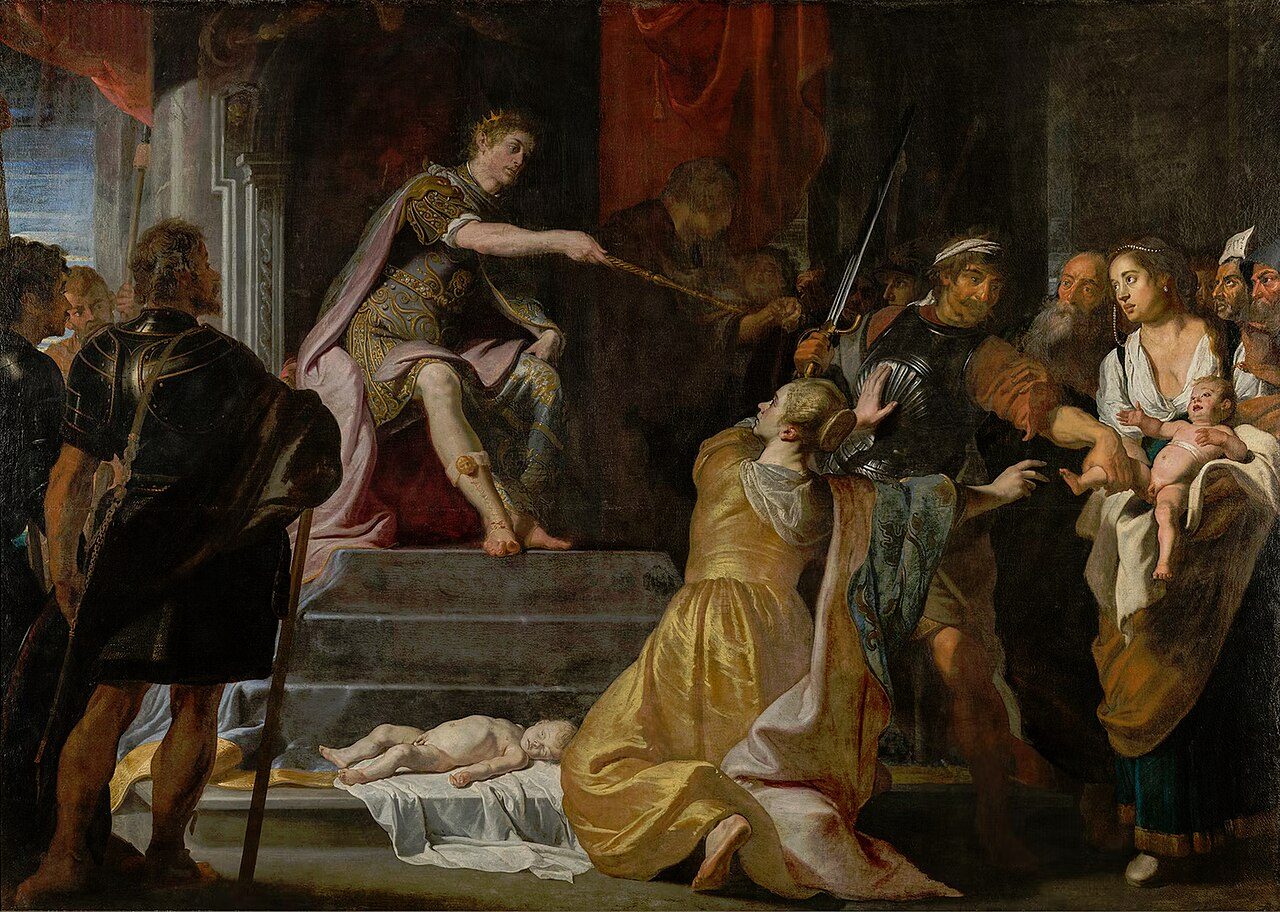
7 min read · 2 sourcesThe Judgement of Solomon is a story from the Book of Kings in which Solomon ruled between two women who both claimed to be the mother of a child. Solomon ordered the baby be cut in half, with each woman to receive one half. The first woman accepted the compromise as fair, but the second begged Solomon to give the baby to her rival, preferring the baby to live, even without her. Solomon ordered the baby given to the second woman, as her love was selfless, as opposed to the first woman's selfish disregard for the baby's actual well-being. Some consider this approach to justice an archetypal example of an impartial judge displaying wisdom in making a ruling. 1
Biblical narrative
1 Kings 3:16–28 recounts that two mothers living in the same house, each the mother of an infant son, came to Solomon. One of the babies had been smothered, and each claimed the remaining boy as her own. Calling for a sword, Solomon declared his judgment: the baby would be cut in two, each woman to receive half. One mother did not contest the ruling, declaring that if she could not have the baby then neither of them could, but the other begged Solomon, "Give the baby to her, just don't kill him!" The king declared the second woman the true mother, as a mother would even give up her baby if that was necessary to save its life, and awarded her custody. This judgment became known throughout all of Israel and was considered an example of profound wisdom. 1
Classification and parallels
The story is commonly viewed in scholarship as an instance or a reworking of a folktale. Its folkloristic nature is apparent, among other things, in the dominance of direct speech which moves the plot on and contributes to the characterization. The story is classified as Aarne-Thompson tale type 926, and many parallel stories have been found in world folklore. In Uther's edition of the Aarne-Thompson index, this tale type is classified as a folk novella, and belongs to a subgroup designated "Clever Acts and Words". Eli Yassif defines the folk novella as "a realistic story whose time and place are determined ... The novella emphasizes such human traits as cleverness, eroticism, loyalty, and wiliness, that drive the plot forward more than any other element". Hugo Gressmann has found several similar stories in world folklore and literature, especially in India and the far east. One Indian version is a Jataka story dealing with Buddha in one of his previous incarnations as the sage Mahosadha, who arbitrates between a mother and a Yakshini who is in the shape of a woman, who kidnapped the mother's baby and claimed he was hers. The sage announced a tug of war, drawing a line on the ground and asking the two to stand on opposite sides of it, one holding the baby's feet, the other his hands – the one who pulled the baby's whole body beyond the line would get to keep him. The mother, seeing how the baby suffered, released him and, weeping, let the Yakshini take him. When the sage saw that, he returned the baby to the hands of the true mother, exposed the identity of the Yakshini and expelled her. In other Indian versions, the two women are widows of one husband. 1
Origin
The story has a number of parallels in folktales from various cultures. All of the known parallels, among them several from India, have been recorded in later periods than the biblical story; nevertheless, it is unclear whether they reflect earlier or later traditions. Hermann Gunkel rules out the possibility that such a sophisticated motif had developed independently in different places. Some scholars are of the opinion that the source of the story is untraceable. In the biblical version, the two women are identified as prostitutes, but in some Indian versions they are widows of one husband. Some scholars have inferred the origin of the story from this difference. Following Gressmann, Gunkel speculates a possible Indian origin, on the basis that "[s]uch stories of wise judgments are the real life stuff of the Indian people", and that, in his view, "a prostitute has no reason to value a child which was not born to her"; he acknowledges, however, that the Indian versions "belong to a later period". On the other hand, Lasine opines that the Hebrew story is better motivated than the Indian one, for it alone attributes the motivation for the behavior of both women to typical motherly feelings: compassion for the true mother and jealousy for the impostor. Other scholars point out that such a travelling folktale might become, in its various forms, more or less coherent. The assertion that one version is more coherent than the other does not compel the conclusion that the first is more original, making the argument about which version's women had more compelling reasons to fight over the child irrelevant. 1
Composition and editorial framing
The story is considered to be literarily unified, without significant editorial intervention. The ending of the story, noting the wisdom of Solomon, is considered to be a Deuteronomistic addition to the text. Some scholars consider the story an originally independent unit, integrated into its present context by an editor. Solomon's name is not mentioned in the story and he is simply called "the king". Considered out of context, the story leaves the king anonymous just like the other characters. Some scholars think that the original tale was not necessarily about Solomon, and perhaps dealt with a typical unnamed king. A different opinion is held by Eli Yassif, who thinks the author of the Book of Kings did not attribute the story to Solomon on his own behalf, but the attribution to Solomon had already developed in preliterary tradition. Scholars point out that the story is linked to the preceding account of Solomon's dream in Gibeon, by the common pattern of prophetic dream and its subsequent fulfillment. Some think this proximity of the stories results from the work of a redactor. Others, such as Saul Zalewski, consider the two accounts to be inseparable and to form a literarily unified unit. In its broader context, the Judgment of Solomon forms part of the account of Solomon's reign, generally conceived as a distinct segment in the Book of Kings, encompassing chapters 3–11 in 1 Kings; some include in it also chapters 1–2, while others think that these chapters originally ended the account of David's reign in 2 Samuel. 1
General description
The story may be divided into two parts, similar in length, matching the trial's sequence. In the first part (verses 16–22) the case is described: The two women introduce their arguments and, at this point, no response from the king is recorded. In the second part (23–28) the decision is described: the king is the major speaker and the one who directs the plot. Apart from this clear twofold division, suggestions have been raised as to the plot structure and the literary structure of the story and its internal relations. As stated before, most of the story is reported by direct speech of the women and Solomon, with a few sentences and utterance verbs by the narrator. The dialogues move the plot forward. 1
The text above is adapted from the Wikipedia article “Judgement of Solomon”, available under the Creative Commons Attribution-ShareAlike 4.0 licence. 1
Judgment of Solomon is bible story and art theme, according to the structured record cited below. This entry was generated automatically from that record and has not yet been reviewed by a person familiar with the tradition. 2
The source record links this tradition to 6 external registers, which can be verified through the citation. 2