The tradition & historical record
7 min read · 2 sourcesJun ware (Chinese: 鈞窯; pinyin: Jūn yáo; Wade–Giles: Chün-yao) is a type of Chinese pottery, one of the Five Great Kilns of Song dynasty ceramics. Despite its fame, much about Jun ware remains unclear, and the subject of arguments among experts. Several different types of pottery are covered by the term, produced over several centuries and in several places, during the Northern Song dynasty (960–1127), Jin dynasty (1115–1234) and Yuan dynasty (1271–1368), and (as has become clearer in recent years) lasting into the early Ming dynasty (1368–1644). Some of the wares were for a popular market, especially the drinking vessels, but others seem to have been made for the imperial court and are known as "official Jun wares"; they are not mentioned in contemporary documents and their dating remains somewhat controversial. These are mostly bowls for growing bulbs or flower-pots with matching stands, such as can be seen in many paintings of scenes in imperial palaces. The consensus that seems to be emerging, driven largely by the interpretation of excavations at kiln sites, divides Jun wares into two groups: a large group of relatively popular wares made in simple shapes from the Northern Song to (at lower quality) the Yuan, and a much rarer group of official Jun wares made at a single site (Juntai) for the imperial palaces in the Yuan and early Ming periods. 1
History
The start date for Jun ware is uncertain; many pieces are dated to the Song dynasty mainly through the similarity of their shapes to those of other Song wares. No Jun ware has yet been recovered from tombs that can be firmly dated to the Song. The two main sites with kilns producing Jun ware are close to Yuzhou, Henan and in Linru County in Henan though, at least by the Yuan, there were many others, explaining the many differences between examples. As with other wares, excavations at kiln sites in recent decades have shown that other types of pottery were also made at the same sites. One Jun ware site was Qingliangsi, where imperial Ru ware was also made. The Chinese character for Jun became incorporated in local place names only as late as 1368. There is no mention of the kilns of Jun ware in written sources from the Song to Yuan dynasties. The first mention of the wares is by the painter Song Xu, writing in 1504, in his 宋氏家規部; Song shi jia guibu; "Song family customs". A black ware with spots was produced at the Xiaobai Valley in the Tang dynasty and can be considered the precursor of Jun ware. It is possible that early pieces in a very light blue are actually the quasi-mythical Chai ware of the 10th century, much praised in early sources, but of which no clear examples matching the early descriptions survive. The purple colour perhaps does not appear until the early 12th century, and then is only controlled by late in that century. By the late 13th century at least one piece has a character formed in splashes. This is a headrest in the Metropolitan Museum of Art with the character for "pillow". The ware experiences a fall in quality into the Jin period, continuing in the Yuan. 1
Characteristics
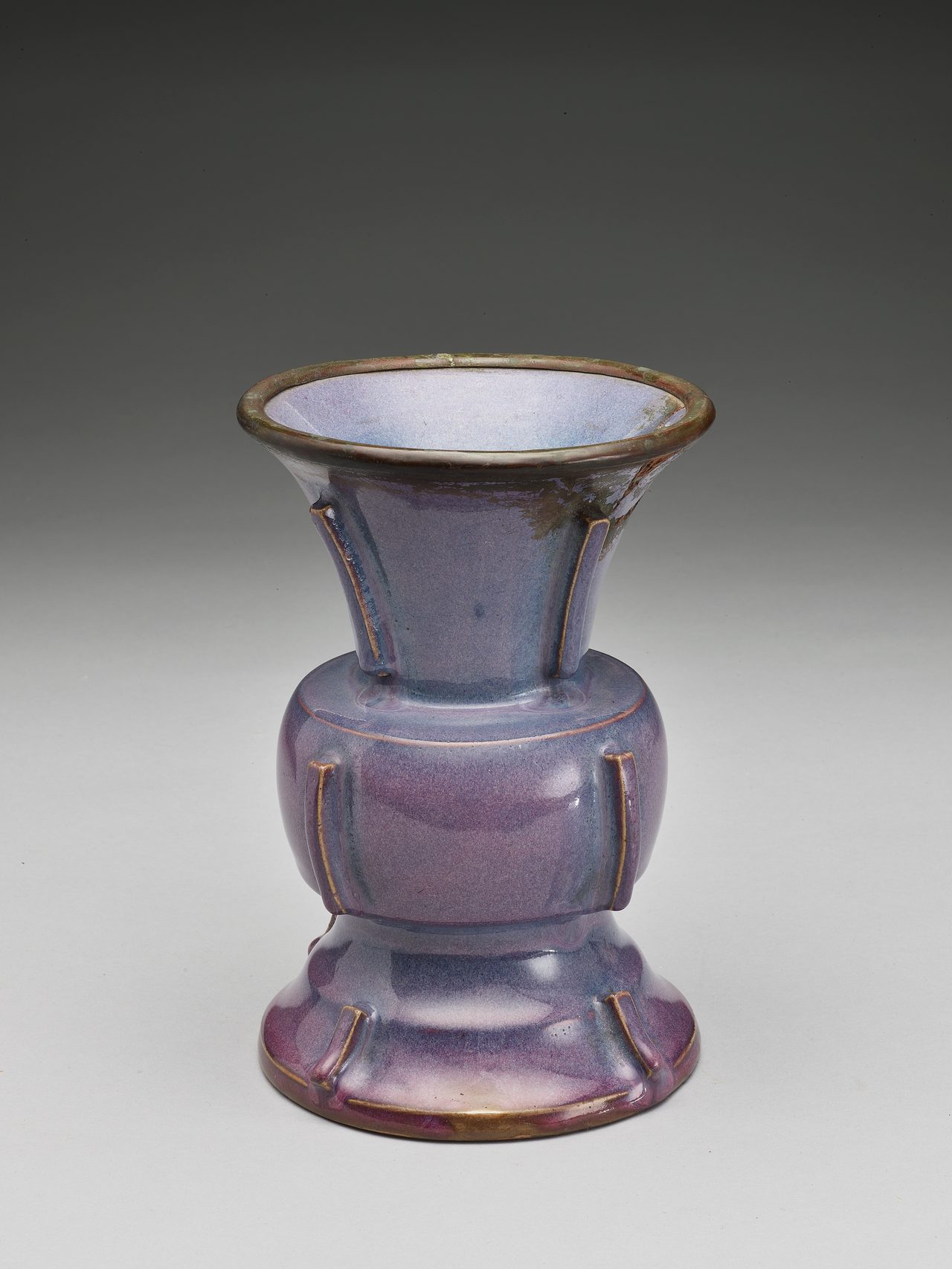
The Jun glaze included blue-grey, sky-blue, moon-white, red and purple, the most prized have crimson or purple splashes. Varying the temperature of the kilns changed colour tints, a technique known as yaobian. 1
General Jun ware
A variety of simple shapes are made, the range mostly similar to that of the very differently decorated Cizhou ware. Like Cizhou wares, the walls are thick and sturdy. Most are natural wheel-formed bowls and dishes, and small vases or wine-carafes, mostly with a narrow neck, but some meipings. There are also boxes, jars, ewers and other shapes. The foot of the later period ware is usually unglazed and brown; the rim of bowls can also be brown or greenish where the glaze is thinner. Song period examples display a careful finishing with glaze inside the foot. Naturally Song shapes are crisp and thinner than later Jin and Yuan examples. All types are thickly glazed, often with the glaze not reaching the foot of the piece. The flower-like ("foliated") rims found in official Jun began in some Song pieces, and echoed contemporary styles in metalwork and lacquer. By the Yuan some shapes, such as vases and circular incense-burners, are given handles. 1
Vases 1
Cups 1
"Official" Jun ware
Although Jun ware is not mentioned by Song writers on ceramics (or in surviving chronicles), at least the last class mentioned above, of "streaked" purple on blue, appears to have been made for the court, and is known as "official" (guan) Jun ware. The streaked pieces are "all of shapes designed for the growing or display of flowers", according to Shelagh Vainker, though other functions are sometimes suggested, giving alternatives such as spitoon/flower-pots, brush-washer/flower pot stand/bulb planters, and so on. As an example, the pot illustrated in the Walters Art Museum, Baltimore is described by them as a "spitoon", but an identical shape in the Percival David Collection is described as a "flower-pot", with an inscribed "6" underneath. Very similar pots are shown with plants growing in them in a Ming imperial portrait. The Walters are cautious on dating, while the British Museum date their piece to 1403–1435, in the early Ming. The sizes and shapes differ from the other groups, being generally larger, heavier, and with more complicated shapes, made in double (two-part) moulds in a process apparently invented by the potters of Jun ware. Many of the rims are irregular, forming flower-like shapes. There are also incisions on the bases of many pieces, of the characters feng hua, the name of a building in the main Song palace at Kaifeng (in at least one case this is a Qing addition). Other pieces have numbers between one and ten impressed on the base. These may indicate standard sizes to help the palace in ordering, the most likely explanation, or members of matching sets. If the numbers indicate sizes, "1" is the largest and "10" the smallest". Such pieces are sometimes called "numbered Jun ware". 1
Technical aspects of the glaze and firing
The glaze of Jun ware is always thick and opaque. It is often very thin or absent around the rim, but thick at the foot, where it typically leaves a small part uncovered. Both the light blue and purple colours are first seen in Chinese pottery in Jun wares. The purple areas are caused by the addition of a solution including copper splashed or painted onto the body between glazing and firing. Some blue or green comes from iron oxide in the glaze, combined with firing in a reducing atmosphere. At high temperature the glaze produced "spontaneous unmixing ... into silica-rich and lime-rich glasses", which through phase separation gives an opalescent final appearance: "The tiny spherules of lime-rich glass scatter blue light, producing a strong bluish cast". The fact that particles or inhomogeneities smaller than a light wavelength preferentially scatter blue light is known as Rayleigh scattering. 1
The text above is adapted from the Wikipedia article “Jun ware”, available under the Creative Commons Attribution-ShareAlike 4.0 licence. 1
Jun ware is a type of Chinese pottery from one of the Five Great Kilns of Song dynasty, according to the structured record cited below. This entry was generated automatically from that record and has not yet been reviewed by a person familiar with the tradition. 2
The source record links this tradition to 4 external registers, which can be verified through the citation. 2