The tradition & historical record
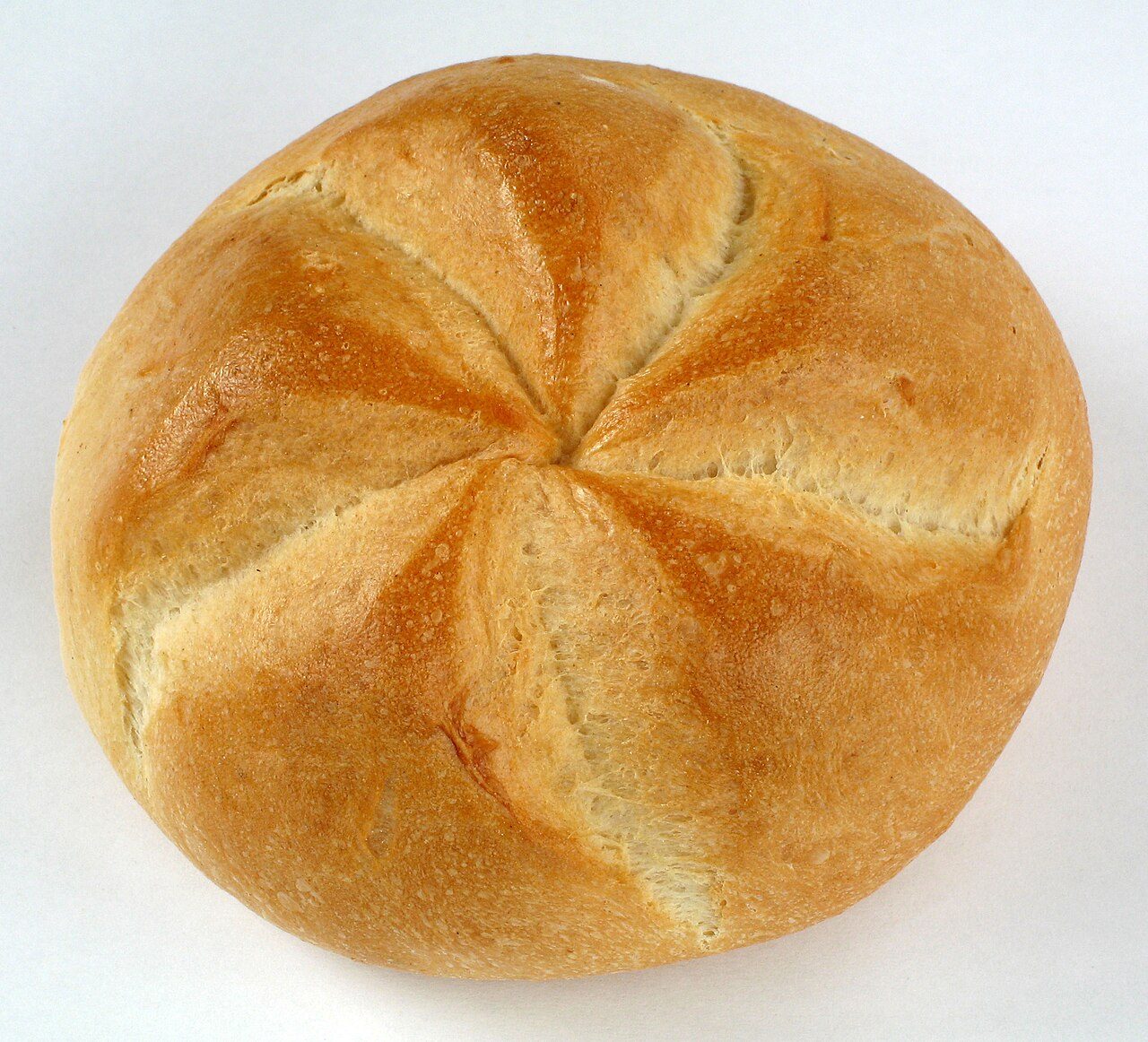
4 min read · 2 sourcesThe Kaiser roll (Austrian German: Kaisersemmel, Bavarian: Kaisersemmel, German: Kaiserbrötchen, "Emperor breadroll"; Slovene: kajzerica; Polish: kajzerka; Hungarian: császárzsemle; Ladin: śemel), also called a Vienna roll (Wiener Kaisersemmel), a hard roll or, if made by hand, also Handsemmel, is a typically round bread roll, originally from Austria. It is made from white flour, yeast, malt, water and salt, with the top side usually divided in a symmetric pattern of five segments, separated by curved superficial cuts radiating from the centre outward or folded in a series of overlapping lobes resembling a crown. The crisp Kaisersemmel is a traditional Austrian food officially approved by the Federal Ministry of Agriculture. According to the Codex Alimentarius Austriacus standards collection, a handmade Kaiser roll is known as a Wiener Kaisersemmel (Handsemmel) . 1
Origin
It is sometimes claimed that kaiser rolls were named to honor Emperor (Kaiser) Franz Joseph I of Austria (born 1830, reigned 1848–1916); but the term appears in writing at least as early as 1825. There is also the theory that the name stems at least in part from a baker family called Kayzer in Opatów in Galicia which had been occupied by the Austrian monarchy in the First Partition of Poland. Others attribute the invention to a Viennese baker named Kayser and date it to around 1730. The additional cuts on the top resulted in a somewhat higher proportion of flavor-enhancing crust, which customers liked. 1
Yet another theory connects the name to an 18th-century law that fixed retail prices of Semmeln (bread rolls) in the Habsburg monarchy. As this claim goes, the name Kaisersemmel came into general use after the bakers' guild sent a delegation in 1789 to Emperor Joseph II (b. 1741, r. 1765–1790) and persuaded him to deregulate the price of bread rolls. The apocryphal sources for the name thus cluster in the mid-late 18th century, around times of Joseph II and Francis I; by the early 19th century the name had been established. Meanwhile, the type of bun nowadays known as Kaisersemmel seems to go back at least to roughly the same time: bread rolls which look quite like the modern version are served, one to the left of each plate, in a Martin van Meytens painting depicting a court dinner in the Great Antechamber of the Hofburg palace, held sometime in the 1760s. With its monarchical connotation, Kaiser rolls stood out against common rolls known as Mundsemmeln ("mouth rolls") or Schustersemmeln ("cobbler's rolls"). 1
Variations
There are multiple variants of the common roll, differing in size, type of flour used, and toppings. While traditionally plain, Kaiser-style rolls are today found topped with poppy seeds, sesame seeds, pumpkin seeds, flax, or sunflower seeds. The Kaiser roll is a main part of a typical Austrian breakfast, usually served with butter and jam. It is often used as a bun for such popular sandwiches as hamburgers in America, and with a slice of Leberkäse in Germany and in Austria, though sliced Extrawurst and pickled gherkins (Wurstsemmel), or a type of Wiener schnitzel (Schnitzelsemmel) are also used. Other similar hard rolls are known as Brötchen in Germany and Austria. A variation called a kümmelweck (alternatively spelled "kimmelweck" or "kummelweck") is topped with kosher salt and caraway, and in the United States is an essential component of a Buffalo-area specialty, the beef on weck sandwich. "Weck" is short for "Weckerl", the diminutative of "Wecken", a loaf of bread, "Kümmel" is caraway. In much of eastern New York State—New York City, Long Island, the Hudson and Mohawk Valleys, and the Adirondacks—and throughout New Jersey, Pennsylvania, Maryland, Delaware, and Connecticut, Kaiser rolls are known as "hard rolls", or "rolls", and are staples of delicatessen and convenience stores. 1
The text above is adapted from the Wikipedia article “Kaiser roll”, available under the Creative Commons Attribution-ShareAlike 4.0 licence. 1
Kaiser roll is hard roll, orginally from Austria, according to the structured record cited below. This entry was generated automatically from that record and has not yet been reviewed by a person familiar with the tradition. 2
The source record links this tradition to 6 external registers, which can be verified through the citation. 2