The tradition & historical record
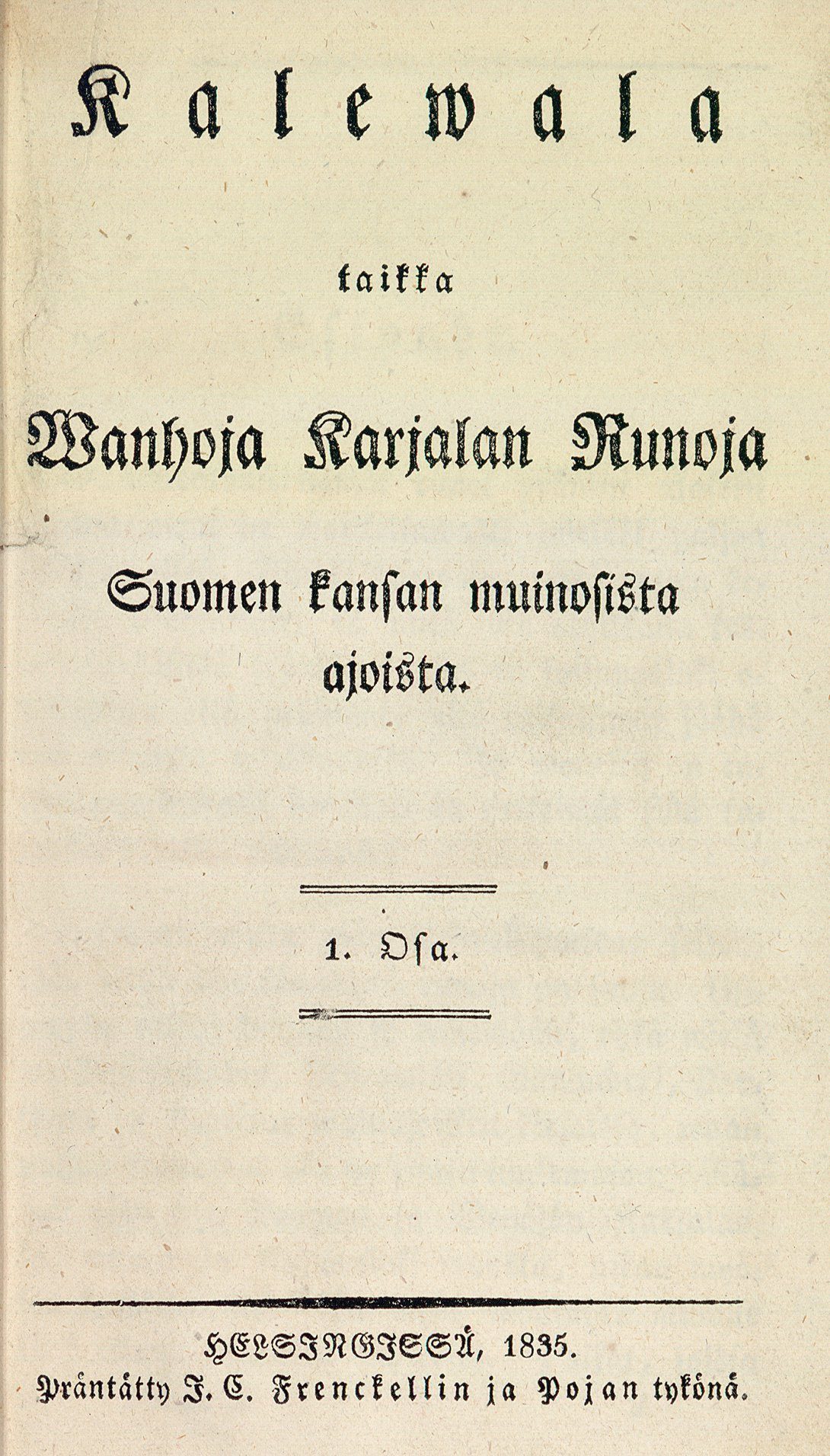
6 min read · 2 sourcesThe Kalevala (IPA: [ˈkɑleʋɑlɑ]) is a 19th-century compilation of epic poetry, compiled by Elias Lönnrot from Finnish, Karelian and Ingrian folklore and mythology, telling a story about the Creation of the Earth, describing the controversies and retaliatory voyages between the peoples of the land of Kalevala called Väinölä and the land of Pohjola and their various protagonists and antagonists, as well as the construction and robbery of the mythical wealth-making machine Sampo. The Kalevala is regarded as the national epic of Finland and Karelia, and is one of the most significant works of Finnish literature along with J. L. Runeberg's The Tales of Ensign Stål and Aleksis Kivi's The Seven Brothers. The Kalevala was instrumental in the development of the Finnish national identity and the intensification of Finland's language strife that ultimately led to Finland's independence from Russia in 1917. The work is known internationally and has partly influenced, for example, J. R. R. Tolkien's legendarium (i.e. Middle-earth mythology, especially The Children of Húrin). The first version of the Kalevala, called the Old Kalevala, was published in 1835, consisting of 12,078 verses. The version most commonly known today was first published in 1849 and consists of 22,795 verses, divided into fifty folk stories (Finnish: runot). An abridged version, containing all fifty poems but just 9,732 verses, was published in 1862. 1
Elias Lönnrot
Elias Lönnrot (9 April 1802 – 19 March 1884) was a physician, botanist, linguist, and poet. At the time he was compiling the Kalevala he was the district health officer based in Kajaani responsible for the whole Kainuu region in the eastern part of what was then the Grand Duchy of Finland. He was the son of Fredrik Johan Lönnrot, a tailor, and Ulrika Lönnrot; he was born in the village of Sammatti, Uusimaa. At the age of 21, he entered the Imperial Academy of Turku and obtained a master's degree in 1826. His thesis was entitled De Vainamoine priscorum fennorum numine (Väinämöinen, a Divinity of the Ancient Finns). The monograph's second volume was destroyed in the Great Fire of Turku the same year. In the spring of 1828, he set out with the aim of collecting folk songs and poetry. Rather than continue this work, though, he decided to complete his studies and entered Imperial Alexander University in Helsinki to study medicine. He earned a master's degree in 1832. In January 1833, he started as the district health officer of Kainuu and began his work on collecting poetry and compiling the Kalevala. During his career, Lönnrot made a total of eleven field trips within a period of fifteen years. Prior to the publication of the Kalevala, Elias Lönnrot compiled several related works, including the three-part Kantele (1829–1831), the Old Kalevala (1835) and the Kanteletar (1840). Lönnrot's field trips and endeavours helped him to compile the Kalevala, and brought considerable enjoyment to the people he visited; he would spend much time retelling what he had collected as well as learning new poems. 1
History
Before the 18th century, Kalevala poetry, also known as runic song, was common throughout Finland and Karelia, but in the 18th century it began to disappear in Finland, first in western Finland, because European rhymed poetry became more common in Finland. Finnish folk poetry was first written down in the 17th century and collected by hobbyists and scholars through the following centuries. Despite this, the majority of Finnish poetry remained only in the oral tradition. Finnish-born nationalist and linguist Carl Axel Gottlund (1796–1875) expressed his desire for a Finnish epic in a similar vein to the Iliad, Ossian and the Nibelungenlied compiled from the various poems and songs spread over most of Finland. He hoped that such an endeavour would incite a sense of nationality and independence in the native Finnish people. In 1820, Reinhold von Becker founded the journal Turun Wiikko-Sanomat (Turku Weekly News) and published three articles entitled Väinämöisestä (Concerning Väinämöinen). These works were an inspiration for Elias Lönnrot in creating his master's thesis at Turku University. In the 19th century, collecting became a more extensive, systematic and organised endeavour. Altogether, almost half a million pages of verse have been collected and archived by the Finnish Literature Society and other collectors in what are now Estonia and Russia's Republic of Karelia. The publication Suomen Kansan Vanhat Runot (Ancient Poems of the Finns) published 33 volumes containing 85,000 items of poetry over a period of 40 years. They have archived 65,000 items of poetry that remain unpublished. 1
Lönnrot's field trips
In total, Lönnrot made eleven field trips in search of poetry. His first trip was made in 1828 after his graduation from Turku University, but it was not until 1831 and his second field trip that the real work began. By that time he had already published three articles entitled Kantele and had significant notes to build upon. This second trip was not very successful and he was called back to Helsinki to attend to victims of the Second cholera pandemic. The third field trip was much more successful and led Elias Lönnrot to Viena in east Karelia where he visited the town of Akonlahti, which proved most successful. This trip yielded over 3,000 verses and copious notes. In 1833, Lönnrot moved to Kajaani where he was to spend the next 20 years as the district health officer for the region, living in the Hövelö croft located near Lake Oulujärvi in the Paltaniemi village, spending his spare time searching for poems. His fourth field trip was undertaken in conjunction with his work as a doctor; a 10-day jaunt into Viena. This trip resulted in 49 poems and almost 3,000 new lines of verse. It was during this trip that Lönnrot formulated the idea that the poems might represent a wider continuity, when the poem entities were performed to him along with comments in normal speech connecting them. On the fifth field trip, Lönnrot met Arhippa Perttunen who, over two days of continuous recitation, provided him with some 4,000 verses for the Kalevala. He also met a singer called Matiska in the hamlet of Lonkka on the Russian side of the border. Although this singer had a somewhat poor memory, he did help to fill in many gaps in the work Lönnrot had already catalogued. 1
Methodology
Lönnrot and his contemporaries, e.g. Matthias Castrén, Anders Johan Sjögren, and David Emmanuel Daniel Europaeus collected most of the poem variants; one poem could easily have countless variants, scattered across rural areas of Karelia and Ingria. Lönnrot was not really interested in, and rarely wrote down the name of the singer except for some of the more prolific cases. His primary purpose in the region was that of a physician and of an editor, not of a biographer or counsellor. 1
Form and structure
The poetry was often sung to music built on a pentachord, sometimes assisted by a kantele player. 1
The text above is adapted from the Wikipedia article “Kalevala”, available under the Creative Commons Attribution-ShareAlike 4.0 licence. 1
Kalevala is 19th-century work of epic poetry compiled by Elias Lönnrot from Karelian and Finnish oral folklore and mythology, according to the structured record cited below. This entry was generated automatically from that record and has not yet been reviewed by a person familiar with the tradition. 2
The source record links this tradition to 39 external registers, which can be verified through the citation. 2